
Best Travel Insurance Companies in India 2026: Which One Should You Choose?

The content of this material is informational and educational in nature and cannot be regarded as financial advice. It is extremely important to conduct an independent analysis before any financial transactions. If you are not sure about financial matters, it is strongly recommended to seek the advice of an independent expert.
Travel insurance acts as financial backup when trips go sideways—whether hopping between Indian cities or heading overseas. Medical emergencies abroad drain savings fast. Trip cancellations, vanishing baggage, endless flight delays add stress and expenses. Get the right policy and you’re covered instead of paying everything yourself.
Picking an insurer gets complicated though. Planning USA or Europe? Medical coverage needs to be way higher than domestic India travel. Students going abroad deal with totally different risks than retirees exploring new places. Families benefit from group policies. Business folks flying international three or four times yearly? Annual plans make more sense.
This guide examines India’s top 10 travel insurance companies—their actual offerings, coverage amounts, premium costs, whether claims get paid.
Best Travel Insurance Companies 2026:
| Product | Features | Rating | Link | |
|---|---|---|---|---|

AURAS Travel Insurance |
Budget coverage from $1.50 daily with instant digital policies for ages 1-100, no medical exams needed | 4.9/5 | Get It Here | |
ICICI Lombard Travel Insurance |
India's biggest private general insurer using AI for claims, 9,500+ cashless hospitals across 216 countries | 4.9/5 | Get It Here | |

EKTA Travel Insurance |
Just three simple plans covering ages 2 months to 100 years, includes chronic disease flare-ups | 4.8/5 | Get It Here | |

Tata AIG Travel Insurance |
Goes up to $1 million coverage max, Super Senior plans work for people over 80 | 4.8/5 | Get It Here | |

Bajaj Allianz Travel Insurance |
Cheapest IRDAI-regulated at ₹13 daily, approves cashless treatment in 60 minutes | 4.6/5 | Get It Here | |

HDFC ERGO Travel Insurance |
Settles 97.45% of claims, handles everything in-house, includes OPD coverage | 4.6/5 | Get It Here | |
Niva Bupa Travel Insurance |
Best for students, offers 100% pre-existing disease coverage on year-long education visas | 4.5/5 | Get It Here | |
Reliance General Travel Insurance |
Only major company insuring up to age 90, throws in free international SIM and home burglary protection | 4.5/5 | Get It Here | |

IFFCO Tokio Travel Insurance |
Japanese expertise meets India's widest rural network, runs government emigrant worker schemes | 4.4/5 | Get It Here | |

SBI Travel Insurance |
State Bank backing, 30-day free review period, works seamlessly with SBI cards | 4.4/5 | Get It Here |
Top 10 Travel Insurance Companies in India 2026
AURAS Travel Insurance — Fast Online Policy Issuance
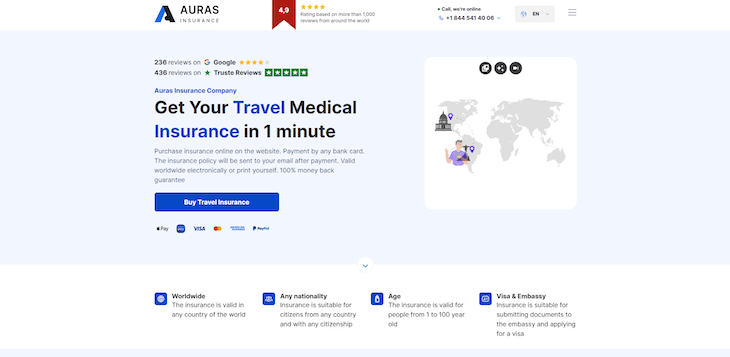
AURAS launched from UAE in 2023, already written 597,000+ policies worldwide. Everything’s digital—policy hits your email 3-5 minutes after buying. Perfect when booking flights at midnight and suddenly remembering you forgot insurance.
Three tiers keep pricing simple. Basic plan runs $1.50 daily for $100,000 medical coverage. Standard jumps to $250,000. Premium hits $1,000,000 for comprehensive international protection. Every plan covers COVID-19 hospitalization, emergency evacuation, trip cancellation within limits, plus 24/7 assistance across languages.
What stands out? They’ll insure anyone 1 to 100 years old. Helps when travelling with infants or elderly grandparents Indian insurers keep rejecting. No medical exams required either.
Key Features:
- Policy ready under 5 minutes
- Ages 1-100 accepted, no exams
- COVID-19 hospitalization included
- Emergency evacuation covered
- Pregnancy coverage available (up to 27 weeks)
| Feature | Details |
|---|---|
| Sum Insured | $100,000 to $1,000,000 |
| Premium Range | From $1.50/day |
| Claim Process | Online submission, email support |
| Network | Global assistance partners |
ICICI Lombard Travel Insurance — Trusted Brand with Broad Travel Coverage
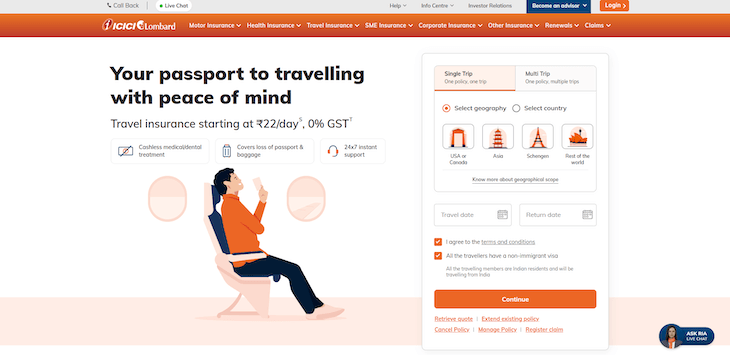
ICICI Lombard holds 9% of India’s general insurance market. Biggest private insurer here, issued 32.7 million policies since 2001. IRDAI registration #115 keeps them regulated. Claim settlement ratio bounces 85-97% depending on the year—solid reliability with actual regulatory oversight backing it.
Their TripSecure+ uses AI tech for instant approvals and fraud detection. Most advanced travel insurance in India right now. Four plans cover different budgets: Silver ($50,000), Gold ($100,000), Platinum ($250,000), Titanium ($500,000). Under 70 gets full coverage limits. Senior plans for 71-85 cap at $50,000.
The “Cashless Everywhere” feature stands out. Get treatment at non-network hospitals globally, they reimburse within 4 hours instead of making you fight months. Actually useful during medical emergencies somewhere without network hospitals.
Access spans 9,500+ hospitals worldwide. IL TakeCare app handles everything—buying policies, filing claims, locating hospitals, tracking status.
Key Features:
- AI-powered instant claim approvals
- Cashless treatment at 9,500+ hospitals, 216 countries
- “Cashless Everywhere” for non-network hospitals
- Emergency medical expenses covered
- Trip cancellation for illness, injury, emergencies
| Plan Tier | Sum Insured | Deductible | Daily Premium |
|---|---|---|---|
| Silver | $50,000 | $100 | ₹22/day |
| Gold | $100,000 | $100 | ₹35/day |
| Platinum | $250,000 | $50 | ₹58/day |
| Titanium | $500,000 | $50 | ₹95/day |
EKTA Travel Insurance — Flexible Plans for International Trips
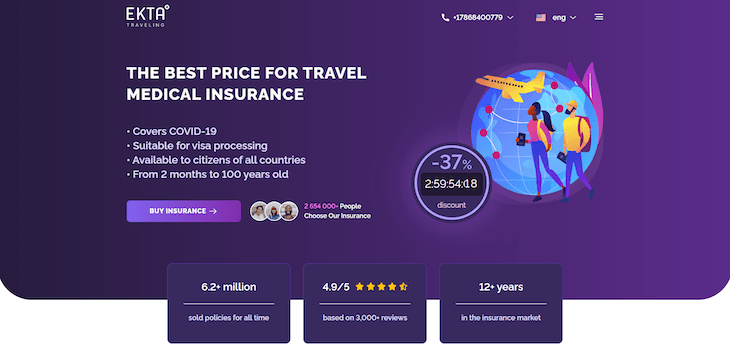
EKTA launched 2018 through UAE registration. They’ve stripped away confusing plan variations you see elsewhere. Coverage works for anyone 2 months to 100 years old—helpful when travelling with newborns or elderly parents other insurers reject.
Just three tiers. START gives $50,000 coverage with 25% deductible at $0.99/day—cheapest entry point anywhere. GOLD offers $150,000 with zero deductible at $1.75/day. MAX+ reaches $500,000 at $5.90/day. Every plan covers medical emergencies, hospitalization, ambulance rides, emergency dental work, repatriation.
Something interesting—they cover chronic disease exacerbation. Sudden worsening of pre-existing conditions during trips. Most insurers won’t touch that.
Purchase takes minutes online. Policy documents hit email immediately. Coverage starts departure date, runs entire trip up to 365 days.
Key Features:
- Three simple options
- Chronic disease exacerbation covered
- Ages 2 months to 100 years
- Zero deductible on GOLD/MAX+
- Instant email policy
| Plan | Sum Insured | Deductible | Premium |
|---|---|---|---|
| START | $50,000 | 25% | $0.99/day |
| GOLD | $150,000 | 0% | $1.75/day |
| MAX+ | $500,000 | 0% | $5.90/day |
Tata AIG Travel Insurance — Balanced Coverage for Frequent Travelers
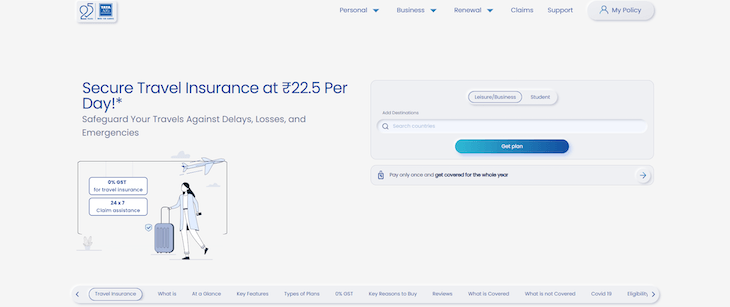
Tata Group owns 76% of this company, American International Group holds 24%. That combination brings Tata’s brand trust together with AIG’s presence across 130+ countries. Since 2001, they’ve served over 5 crore customers. Claim settlement ratio sits at 95.43%—among India’s best for travel insurance. Customer ratings average 4.6 out of 5 from over 8,534 reviews.
Five comprehensive tiers run from Silver ($50,000) through Titanium ($1,000,000)—that’s the highest ceiling you’ll find among Indian insurers. Titanium plan uniquely covers pre-existing disease up to $20,000 for life-threatening situations. Hospital daily cash pays $75 per day. Business class upgrade benefits worth $1,000.
They offer specialized products for specific needs. Student insurance protects tuition fees for ages 16-35. Senior Plus extends to age 80. Super Senior plans accommodate travellers over 80—genuinely rare in India’s market.
Emergency assistance runs through Europe Assist. Toll-free lines work from India and USA/Canada. COVID-19 coverage handles hospitalization, trip cancellation if you test positive, quarantine accommodation, automatic policy extension when pandemic issues delay your travel.
Key Features:
- Medical coverage hitting $1,000,000 on Titanium
- Pre-existing disease coverage for life-threatening emergencies
- Super Senior plans for people over 80
- Tuition fee reimbursement for students
- Annual multi-trip supporting business travellers
| Plan | Medical Cover | Personal Accident | Trip Cancellation |
|---|---|---|---|
| Silver | $50,000 | $25,000 | Up to $1,000 |
| Gold | $250,000 | $50,000 | Up to $2,500 |
| Platinum | $500,000 | $75,000 | Up to $5,000 |
| Titanium | $1,000,000 | $100,000 | Up to $10,000 |
Bajaj Allianz Travel Insurance — Budget-Friendly Option for Short Trips
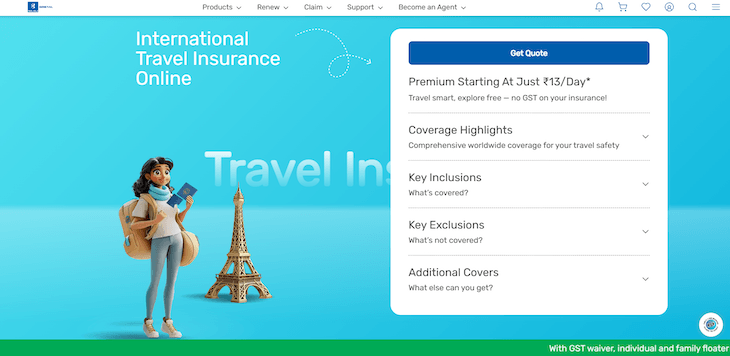
Bajaj Allianz (rebranded Bajaj General Insurance Limited) delivers India’s cheapest IRDAI-regulated travel insurance at ₹13 daily—about ₹201 for 15 days. Despite budget pricing, claim settlement hits 93.54%. ICRA gave them iAAA rating for 11 straight years—highest claims-paying ability among general insurance companies here.
Coverage works across 216+ countries with 1 lakh+ cashless hospitals worldwide. Travel Ace product lets you customize $10,000 to $1,000,000, picking specific benefits instead of preset packages. That flexibility separates Bajaj from competitors stuck with fixed plans.
Their in-house Health Administration Team approves cashless treatment within 60 minutes—way faster than 4-6 hour industry norm. Matters when sitting in foreign hospital emergency rooms.
Student benefits stand out. Tuition reimbursement up to $10,000. Sponsor protection if financial backer dies. Bail bond insurance. Laptop protection. Track-a-Baggage GPS. Pet Stay coverage. Maternity/newborn coverage from day one.
Key Features:
- 60-minute cashless approvals in-house
- Modular $10,000 to $1,000,000 coverage
- Student tuition reimbursement $10,000
- Track-a-Baggage GPS tracking
- Pet Stay during delays
| Feature | Coverage | Limit |
|---|---|---|
| Medical | Emergency treatment | Up to sum insured |
| Baggage Loss | Lost/damaged | Up to $2,500 |
| Trip Cancellation | Pre-departure | Up to $5,000 |
| Tuition Fee | Student withdrawal | Up to $10,000 |
HDFC ERGO Travel Insurance — Strong Global Assistance Network
HDFC ERGO hits 97.45% claim settlement ratio for FY 2024-25. Three-year average sits at 96.71%. This Munich Re and HDFC joint venture processes one claim every minute through their in-house team—they’re the only major insurer handling decisions without third-party administrators. Direct control means faster processing and higher approval rates compared to competitors using external TPAs.
Student Suraksha portfolio extends coverage up to 365 days single-trip, fitting year-long study abroad programs. Explorer plan uniquely includes OPD (outpatient) treatment coverage—non-hospitalization medical needs most competitors ignore. Senior citizen coverage extends to age 80 with no medical check-up needed, simplifying purchase for elderly travellers.
Network spans 1 lakh+ cashless hospitals worldwide through partner Allianz Global Assistance. Works in USA, UK, Thailand, Singapore, Spain, Japan, Germany, Canada. Premiums start at ₹31 per day. Policy extension goes up to 360 days from initial start date—useful when you’re uncertain about return dates or decide to extend your trip.
Key Features:
- In-house claim processing delivers industry-best settlement
- OPD coverage for outpatient treatment without hospitalization
- Student plans extending up to 365 days single-trip
- Policy extension up to 360 days total
- Senior coverage without medical examination
| Plan | Sum Insured | Best For | Starting Premium |
|---|---|---|---|
| Explorer | $50,000-$100,000 | Leisure travellers | ₹31/day |
| Preferred | $250,000 | Business travel | ₹55/day |
| Student Suraksha | $100,000-$500,000 | Students | ₹40/day |
| Premier | $500,000-$1,000,000 | High coverage | ₹90/day |
Niva Bupa Travel Insurance — Strong Choice for Students and Long Stays
Niva Bupa (formerly Max Bupa), a Bupa UK and True North joint venture, got named one of India’s Most Innovative Organisations in 2025 by ET Edge and Times Group. Covered 20 million+ lives with 92.39% claim settlement ratio, focusing on specialized segments like students and adventure enthusiasts.
TravelAssure Student offers what competitors don’t: 100% pre-existing disease coverage as add-on for students on education visas with 12+ month policies. Standard single-trip plans give PED coverage at 5% sum insured or $2,500 max for emergencies—more generous than competitors’ life-threatening-only approach. Student focus includes maternity/newborn cover for 12+ month policies plus cancer screening.
Specialty plans target specific needs. Cruise & Adventures covers water sports, high-altitude activities. Honeymooners bundles romantic protections like wedding dress coverage. Sports & Adventure includes physiotherapy, equipment rental reimbursement. Pre-authorization processes within 30 minutes. 10% discount for two+ travellers.
Key Features:
- 100% pre-existing disease for student policies
- Maternity/newborn for 12+ months
- Specialty plans for cruises, adventures
- 30-minute pre-authorization
- 10% group discount
| Plan Type | Sum Insured | Special Coverage | Premium |
|---|---|---|---|
| Student Standard | $100,000 | Education-specific | ₹25/day |
| TravelAssure | $250,000 | PED add-on | ₹35/day |
| Cruise & Adventures | $500,000 | Water sports | ₹50/day |
| Honeymooners | $100,000 | Wedding | ₹30/day |
Reliance General Travel Insurance — Flexible Plans with Practical Add-Ons
Reliance General (rebranded IndusInd General Insurance Company Limited) is the only major insurer covering up to age 90. Addresses super-senior market everyone else ignores. Operating 128+ branches, serving 5 crore+ policyholders, maintaining 87.34% claim settlement with IRDAI oversight.
Senior plans span three bands. Standard serves 61-70. Senior Plus fits 71-80. Super Senior uniquely extends 81-90 years. Coverage reaches $50,000 even for oldest travellers. Pre-existing disease available for life-threatening situations up to age 70. Student plans extend 730 days (2 years), longer than most competitors’ single-year maximums.
Unique features separate Reliance from competitors. Every policy includes free international SIM for immediate connectivity abroad. Home Burglary Insurance protects India possessions during travel—no other company offers this. Policies auto-extend up to 30 days for medical emergencies, 7 days for carrier delays without extra premium.
Key Features:
- Coverage up to age 90
- Free international SIM included
- Home burglary insurance
- Automatic 30-day emergency extension
- Student plans up to 730 days
| Age Group | Plan Type | Medical Cover | Deductible |
|---|---|---|---|
| Under 60 | Standard | Up to $500,000 | $50 |
| 61-70 | Senior | Up to $100,000 | $50 |
| 71-80 | Senior Plus | Up to $50,000 | $100 |
| 81-90 | Super Senior | Up to $50,000 | $100 |
IFFCO Tokio Travel Insurance — Value-Focused Travel Insurance Option
IFFCO Tokio combines Indian Farmers Fertiliser Co-operative (51%) with Tokio Marine Group—Japan’s largest insurance company (49%)—bringing international expertise to India’s market since 2000. Operating through 78 Strategic Business Units, 171 Lateral Spread Centers, 400+ Bima Kendras gives unmatched rural penetration across India.
Ranked #4 among general insurers in IRDAI’s 2025 customer satisfaction survey with 87%+ recommendation rate. Travel Protector offers five tiers: Bronze ($50,000), Silver ($100,000), Gold 100/250/500 (up to $500,000). Network spans 7,500+ cashless hospitals globally. Emergency assistance runs through PHM Global/Paramount Healthcare Management and Mercur Assistance Deutschland for international support.
IFFCO Tokio administers Pravasi Bharatiya Bima Yojana—mandatory insurance for Indian emigrant workers (ECR category) travelling to UAE, Saudi Arabia, Kuwait, Qatar, 13 other designated countries. This government product covers personal accident, maternity up to ₹1 lakh, hospitalization, litigation, repatriation, one-way airfare if employment terminates.
Key Features:
- Japanese Tokio Marine expertise
- Pravasi Bharatiya Bima Yojana for workers
- 7,500+ cashless hospitals globally
- Widest rural distribution
- Five tiers Bronze to Gold 500
| Plan | Sum Insured | Network | Premium |
|---|---|---|---|
| Bronze | $50,000 | 7,500+ hospitals | ₹30/day |
| Silver | $100,000 | Global cashless | ₹45/day |
| Gold 250 | $250,000 | Premium | ₹70/day |
| Gold 500 | $500,000 | Full | ₹105/day |
SBI Travel Insurance — Reliable Basic Coverage from a Known Insurer
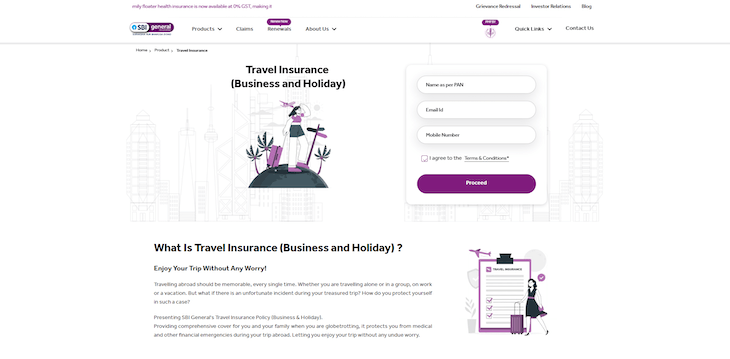
SBI General gets 70% ownership from State Bank of India, leveraging India’s largest banking network since 2010. IRDAI registration #144. Maintains 82% claim settlement while simplifying travel insurance through straightforward offerings instead of overwhelming variations.
Travel Insurance (Business and Holiday) offers clean options spanning $50,000 to $500,000 medical expenses. Personal accident caps $25,000 (10% cover limit). Personal liability reaches $200,000 or 50% medical limit. The 30-day free-look period—longest among insurers—allows thorough review before commitment, letting travellers cancel with full refund.
Single-trip extends 180 days, expandable to 270 days through extensions. Multi-trip annual policies support frequent business travellers taking multiple international trips yearly. 6,000+ hospital network provides cashless treatment globally. Geographic options include “Worldwide” or “Worldwide excluding USA/Canada”—latter offers lower premiums avoiding expensive North American destinations.
Key Features:
- State Bank backing and branch access
- 30-day free-look for review
- Extension up to 270 days
- SBI Credit Card integration
- Golfer’s Hole-In-One included
| Coverage Type | Limit | Benefit |
|---|---|---|
| Medical | Up to $500,000 | Emergency treatment |
| Accident | 10% sum insured | Death/disability |
| Liability | Up to $200,000 | Legal coverage |
| Baggage | Up to $2,000 | Loss/damage |
Understanding Travel Insurance: Coverage and Protection
Travel insurance works as your financial backup when trips go sideways—whether hopping between Indian cities or flying overseas. Buying a policy basically means you’re handing off travel emergency risks to an insurance company. They’ll either pay you back or cover costs directly when medical stuff hits, trips get messed up, belongings disappear, or other expensive problems pop up that could otherwise wipe out lakhs from your savings or thousands of dollars.
Healthcare abroad? Costs an absolute fortune. American emergency rooms charge over $2,000 just for showing up with something minor. Actually need hospitalization for a few days? Bills easily hit $100,000. Europe’s cheaper but still runs thousands of euros. Your regular Indian health insurance won’t cover foreign treatment—leaves you totally exposed without specific travel coverage.
What Travel Insurance Usually Covers
Most decent policies sold in India handle standard problems:
| Coverage Type | What You Get |
|---|---|
| Medical Emergencies | Hospital stays, doctor visits, medications, tests, emergency dental |
| Emergency Evacuation | Air ambulance getting you to better facilities or back to India |
| Trip Cancellation | Money back for what you can’t recover if forced canceling before leaving |
| Trip Interruption | Unused portions plus extra costs when emergencies force early return |
| Baggage Problems | Cash for lost, stolen, damaged luggage plus money for essentials during delays |
| Document Loss | Passport replacement costs and related embassy expenses |
| Flight Delays | Hotel, food, necessities when flights delay past limits (usually 6-12 hours) |
| Personal Liability | Legal costs if accidentally hurting someone or wrecking their property |
| 24/7 Help | Support across languages, medical connections, legal help, crisis coordination |
What Travel Insurance Won’t Cover
Standard policies refuse certain situations:
- Pre-existing medical issues (unless declared them specifically and bought coverage)
- Adventure sport injuries without add-ons—denied flat out
- Claims involving alcohol or drugs—rejected immediately
- Pregnancy complications past specified weeks
- Mental health situations, self-inflicted injuries
- Visiting war zones or places with travel warnings
- Theft from unlocked luggage—your fault basically
- Claims missing proper paperwork like medical records, police reports, original receipts—they’ll reject these too
Types of Travel Insurance
Travel insurance in India comes in different forms addressing various traveller situations. Knowing which type matches your trip saves money and gets actual protection instead of paying for coverage you’ll never use.
Coverage by Travel Scope
| Insurance Type | Who Needs It | What You Get |
|---|---|---|
| Domestic Travel | India trips only | Medical emergencies, cancelled trips, lost luggage between Indian cities. Way cheaper than international plans. |
| International Travel | Overseas journeys | Higher medical limits ($50,000-$1,000,000), emergency evacuation across borders, meets visa requirements for Schengen. |
Coverage by Traveller Type
Student Travel Insurance: Handles unique risks students face abroad. Reimburses tuition if health problems force withdrawing from university. Protects if whoever’s funding your education dies unexpectedly. Study interruption coverage kicks in when medical issues disrupt academic programs. Policy periods stretch matching school terms—typically 180-365 days instead of standard vacation lengths.
Senior Citizen Travel Insurance: Works for travellers over 60. Age-appropriate limits, skips demanding medical exams (or simplifies them significantly), covers health issues common among older folks. Most plans accept people through ages 70-80, though some companies now insure travelers hitting 90.
Family Travel Insurance: Covers your whole group under one purchase. Costs less compared to buying individual coverage for each family member separately. Kids often get included free below certain ages. Combined coverage limits account for multiple people travelling together.
Corporate or Business Travel Insurance: For employees travelling on work, usually purchased as annual multi-trip policies by companies. Beyond standard medical coverage, includes business equipment protection, important work documents, even kidnap/ransom insurance when employees visit dangerous locations.
Coverage by Trip Frequency
| Plan Type | Best For | How It Works |
|---|---|---|
| Single-Trip | Occasional travellers | Handles one specific journey from departure through return. Good for one or two international trips yearly. |
| Multi-Trip Annual | Frequent flyers | Covers unlimited trips within year, individual journeys typically max 30-180 days each. Makes financial sense for three+ international trips annually. |
Essential Factors for Selecting the Right Travel Insurance Policy
Picking the right travel insurance means looking at several critical things that determine whether coverage actually protects you or leaves gaps when emergencies hit.
1. Medical Coverage Limits
Where are you actually going? This determines everything. Planning Europe? Schengen embassies want €30,000 minimum (around ₹27-28 lakhs)—they won’t budge on this. Heading to America or Canada? Think $100,000 bare minimum, though honestly $500,000 makes way more sense given how stupidly expensive their hospitals charge. Asia destinations like Thailand or Malaysia? Usually need somewhere between $50,000-$100,000. Watch out for policies hiding sub-limits that cap specific expenses—really annoying when you discover them later.
2. Trip Cancellation Coverage
What actually gets you money back when plans collapse? Typical stuff includes getting sick, injuries happening, family emergencies, natural disasters hitting where you’re going, even losing your job. Check whether the policy refunds what you can’t recover—plane tickets, hotel deposits, tour packages, visa fees. Curtailment’s different though—that’s when you bail partway through. Good coverage pays back unused expenses plus extra costs getting you home early.
3. Baggage and Passport Protection
Most baggage coverage caps around $1,500-$3,000 total, with limits per item that become problematic when you’re hauling expensive camera gear. Delayed bag money usually kicks in after waiting 6-12 hours. Passport loss needs covering replacement fees plus whatever costs pile up while you’re stuck waiting for embassy paperwork to clear.
4. Geographical Coverage
Does your policy actually work everywhere you’re planning to visit? Some straight-up exclude entire countries. Buying Schengen coverage? Better have clear language covering all 29 countries without exceptions. Check protection applies during layovers too, not just your final stop.
5. Emergency Evacuation
Can you actually reach someone 24/7 who speaks your language? Medical evacuation better cover air ambulance costs—these frequently hit $50,000+—plus getting you back to India when local hospitals can’t handle what you’ve got.
6. Pre-Existing Disease Rules
Companies call something pre-existing if it’s been stable 60-180 days before you leave. You’ve got to disclose upfront, even when not claiming for it. Coverage ranges from emergency-only through full add-ons costing 15-30% extra. Skip disclosure? They’ll reject every single claim you file.
7. Adventure Sports
Basic policies won’t cover diving, skiing, high treks, water sports. Planning these? Buy add-ons specifically for them. Otherwise injuries get rejected immediately.
8. Claim Settlement
Ratios above 90% mean they actually pay. Check the filing process—easy online or endless paperwork? IRDAI-regulated companies give better options when disputes happen.
Step-by-Step Guide to Selecting the Best Travel Insurance
Picking the right plan needs systematic approach finding coverage that actually protects your trip.
Step 1: Define Trip Type and Destination
Where are you going and for how long? Domestic versus international makes huge difference. Heading Europe? Schengen demands €30,000 minimum—non-negotiable. America needs $100,000 given crazy medical costs. Asia falls between $50,000-$100,000. Trip length determines whether single-trip or annual saves money.
Step 2: Identify Traveller Category
What’s your situation? College student abroad? Need tuition protection and full academic calendar coverage. Retired senior? Age-friendly coverage accepting 70+ matters. Whole family? Group policies work cheaper. Business person flying international regularly? Three trips yearly means annual plans save versus buying separately.
Step 3: List Essential Coverage Needs
What keeps you up nights about this trip? Medical emergencies abroad top everyone’s list. Dropped thousands on non-refundable bookings? Trip cancellation becomes essential. Hauling expensive camera gear, laptops? Baggage coverage matters. Diving, skiing, trekking planned? Need adventure sports riders. Managing chronic conditions? Pre-existing disease coverage isn’t optional.
Step 4: Shortlist 2-3 Insurers Based on Reputation
Which companies actually pay claims? Look for settlement ratios hitting 90%+—means approving nine of ten claims. Read actual customer reviews, not marketing fluff. Want regulatory protection? Stick with IRDAI-regulated like ICICI Lombard, HDFC ERGO, Tata AIG, Bajaj Allianz. Trade regulatory backing for cheaper premiums? AURAS and EKTA offer lower prices—just know trade-offs.
Step 5: Compare Policy Terms and Exclusions
Read actual policy documents. What gets excluded? Where are sub-limits hiding? What deductible hits before coverage starts? Don’t just look at flashy numbers. That “$200,000 coverage” might cap rooms at $300 nightly—makes generous coverage suddenly stingy.
Step 6: Purchase Online and Save Documents
Buy direct through company websites or use PolicyBazaar comparing options. Buy within 15 days of booking flights—gets pre-departure cancellation protection. Save docs multiple places—phone, email yourself, print backups.
Must-Have Travel Insurance Covers for Better Protection
Comprehensive travel insurance goes way past basic medical stuff. Understanding each protection helps figure out whether a policy actually protects your journey or leaves you exposed when things go wrong.
Essential Coverage Quick Reference
| Coverage Type | What Gets Covered | Typical Limits | How Important |
|---|---|---|---|
| Medical Emergencies | Hospitals, doctors, meds, tests | $50K-$500K | Absolutely critical |
| Emergency Evacuation | Air ambulance, body repatriation | Up to $100K+ | Can’t skip this |
| Trip Cancellation | Non-refundable bookings | Varies by trip | High priority |
| Baggage Loss | Lost/damaged bags | $1,500-$3,000 | Moderate |
| Flight Delays | Hotels, meals during waits | Per policy | Moderate |
| Personal Liability | Legal claims, property damage | $50K-$200K | Moderate |
| Adventure Sports | Risky activity injuries | Optional extra | Only if doing these |
Medical Emergencies and Hospitalization
Covers unexpected sickness or injury treatment during trips—emergency rooms, hospital stays, surgeries, doctor appointments, prescription meds, diagnostic work. Coverage should match where you’re headed. Going somewhere in Asia? Fifty thousand usually handles it. America or Europe though? Start hundred thousand minimum, push toward half million for States since their medical bills are straight-up criminal.
Who needs this: Everyone heading overseas, no exceptions. Especially critical going anywhere with stupidly expensive healthcare where one ER visit can bankrupt you.
Emergency Medical Evacuation and Repatriation
When local hospitals can’t handle what you’ve got, evacuation coverage flies you via air ambulance somewhere that can actually help. Air ambulances easily run fifty to hundred thousand dollars. Repatriation covers the worst-case scenario—if you die abroad, this brings your body home covering casket, preservation, all the paperwork involved.
Who needs this: People heading somewhere remote, doing risky activities, or visiting places where medical care’s questionable at best. Older travelers and anyone with existing health problems absolutely can’t skip this.
Trip Cancellation, Interruption, and Curtailment
Cancel before leaving? Trip cancellation refunds what you can’t recover—kicks in when sudden illness, injuries, family disasters, natural catastrophes force you bailing. Trip interruption covers unused prepaid costs plus extra expenses getting home early. Protects flight money, hotel deposits, tour payments, visa fees—all stuff you’d otherwise lose entirely.
Who needs this: Anyone who dropped serious non-refundable cash—expensive holidays, group trips, cruises, destination weddings. Seniors worried about health issues definitely need this.
Flight Delays and Missed Connections
Flights delayed past certain hours (usually six to twelve) trigger coverage for hotels, food, essentials you need. Missing connections because first flight ran stupid late? This covers replacement tickets, somewhere to crash till you actually reach destination.
Who needs this: Travelers with barely-there connection times, attending events with hard deadlines, flying during crazy holiday periods when delays happen constantly.
Baggage Loss, Delay, and Personal Belongings
Airlines permanently lose your checked bags? Coverage typically pays fifteen hundred to three thousand, though individual items have caps that bite. Bags showing up late? Get cash for necessities after six to twelve hours waiting. Also covers theft or damage to what you’re hauling around. Watch those per-item limits and what expensive stuff they exclude.
Who needs this: People carrying pricey gear, checking anything valuable, travelers with tight connections raising serious delay risk.
Passport and Document Loss Support
Losing passports abroad creates instant chaos and panic. Coverage gets emergency travel papers from Indian embassies sorted, covers associated fees, advances accommodation cash while bureaucracy grinds slowly forward, reimburses lost tickets. Company reps actually coordinate with embassy staff helping you navigate red tape nightmare.
Who needs this: Every single international traveler without exception. Extra critical for first overseas trips and visiting anywhere theft happens regularly.
Personal Liability Abroad
Accidentally hurt someone or wreck their property during travels? This protects against legal claims coming your way. Coverage typically runs fifty to two hundred thousand, paying legal defense costs, settlements, court judgments if needed.
Who needs this: Anyone renting cars overseas, families traveling with kids, visiting lawsuit-happy countries like America where people sue constantly.
Pre-Existing Disease Cover
Pre-existing means health conditions you got treatment or medications for within past four years. Standard policies either won’t touch these at all or only cover immediately life-threatening emergencies. Full coverage add-ons exist but demand completely honest upfront disclosure. Hide anything? They’ll reject everything you claim later, even totally unrelated medical issues.
Who needs this: Anyone managing diabetes, high blood pressure, heart conditions, asthma, chronic stuff requiring regular medications. Students on year-long programs and elderly travelers especially need this protection.
Adventure Sports Cover
Regular policies flat-out exclude higher-risk activities—scuba diving, skiing, bungee jumping, paragliding, high-altitude trekking, white water rafting. Adventure sports add-ons expand medical coverage, evacuation protection, equipment coverage for these activities. Always verify your exact planned activities actually appear on their covered activities list.
Who needs this: Planning ski vacations, diving trips, mountain treks, adventure tourism in places like New Zealand, Swiss Alps, Thailand beaches.
Travel Insurance Consultants vs Buying Online
Insurance buying has changed massively. You’ve basically got two options—traditional consultant or buy online yourself.
Quick Comparison
| Factor | Agents | Online |
|---|---|---|
| Speed | Slow (meetings) | Fast (10 min) |
| Cost | Higher (commissions) | Lower |
| Choice | Limited | Wide |
| Guidance | Personal | Self-research |
| Best For | Seniors, complex | Simple trips |
Travel Insurance Consultants
Agents give personal touch. Sit down, figure what you need, suggest plans that fit. Break down confusing jargon into normal language. Handle boring paperwork. Help navigate claims later. For older folks uncomfortable with computers or complicated health situations, having someone walk through makes sense.
Downside? Agents work for specific companies, so “recommendations” might be about what they sell versus what you need.
Buying Online
Online’s fast, straightforward. Sites like PolicyBazaar let you compare insurers at once—features, prices, how often they pay claims, one screen. Finish buying ten minutes from couch—policy hits inbox immediately. Everything upfront, no weird surprises. Cheaper too, cutting agent commissions.
Catch? You’re figuring everything out alone. Got pre-existing conditions or want adventure coverage? Might get confused about what you need.
Quick Comparison: Top 10 Travel Insurance Companies in India
Comparing insurers side-by-side makes figuring out which companies match your needs and budget way easier. This table breaks down key features from India’s major travel insurance providers so you can scan through quickly.
Keep in mind—what you actually get depends on which specific plan you pick, where you’re headed, all those policy details buried in fine print. Coverage amounts and what you’ll pay change dramatically based on trip length, your age, how much coverage you’re buying. Final benefits vary significantly between plans, destinations, and individual circumstances.
| Insurance Company | Popular Plan Name | Medical Coverage | Trip Cancellation/Curtailment | Baggage + Passport/Document | Best For |
|---|---|---|---|---|---|
| AURAS | Basic/Standard/Premium | Yes | Yes | Yes | Budget travellers, 100-year age coverage |
| ICICI Lombard | TripSecure+ Silver/Gold/Platinum/Titanium | Yes | Yes | Yes | Tech-savvy travellers, AI claims processing |
| EKTA | START/GOLD/MAX+ | Yes | Yes | Yes | Budget-conscious, simple plan selection |
| Tata AIG | Silver/Gold/Platinum/Titanium | Yes | Yes | Yes | Super seniors 80+, highest coverage ceiling |
| Bajaj Allianz | Travel Ace (Modular) | Yes | Yes | Yes | Students, fastest cashless approval |
| HDFC ERGO | Explorer/Student Suraksha/Premier | Yes | Yes | Yes | Claim reliability, OPD coverage |
| Niva Bupa | TravelAssure/Student/Cruise & Adventures | Yes | Yes | Yes | Students with PED, adventure sports |
| Reliance General | Standard/Senior Plus/Super Senior | Yes | Yes | Yes | Travellers up to 90 years, free SIM |
| IFFCO Tokio | Bronze/Silver/Gold | Yes | Yes | Yes | Emigrant workers, rural distribution |
| SBI | Business and Holiday | Yes | Yes | Yes | SBI customers, banking integration |
How to Avoid Hidden Costs While Choosing Travel Insurance
Policies hide costs that seriously cut coverage or jack up what you pay during claims. Understanding these traps helps pick solid protection.
Policy Exclusions
Exclusions are the insurer’s “get out of paying” list. Pre-existing conditions not mentioned? Denied. Hurt doing adventure sports without add-on? Denied. Alcohol involved? Denied. Hiding even one condition voids everything—entire policy becomes worthless.
Sub-Limits and Coverage Caps
Buy $100,000 policy feeling secure, then discover they’ll only pay $300 nightly for rooms, cap surgery at $10,000, limit doctor fees to $5,000. Generous coverage suddenly isn’t covering much. Pick policies where sub-limits don’t gut protection.
Deductibles and Co-Payment
Deductibles mean paying first chunk yourself—usually $50-$100 before insurance kicks in. Co-payment (common for seniors) means splitting costs 10-20% even after deductible. Sometimes cheaper premium isn’t worth shouldering more risk.
Pre-Existing Condition Disclosure
Not mentioning conditions treated within four years is biggest mistake. Think “it’s controlled” so skip disclosure. File unrelated claim, insurer investigates (always do), finds undisclosed condition, rejects everything. Declaring costs 15-30% more but non-disclosure guarantees zero payout.
Adventure Sports Restrictions
Standard policies won’t cover common activities—snorkeling, jet skiing, skiing, trekking above certain altitudes. Adventure add-on costs extra but without it any injury means paying everything yourself.
Cancellation Coverage Triggers
Trip cancellation sounds great until reading what qualifies. Sudden illness? Covered. Family death? Covered. Lost job? Nope. Changed mind? Definitely not.
Documentation Requirements
Miss deadline (7-30 days) or forget documents, claims get rejected. Medical needs original bills. Lost baggage requires airline report plus police FIR. Moment something goes wrong, notify insurer.
Making the Right Travel Insurance Choice
Picking the best travel insurance in India comes down to understanding what you actually need. For solid consumer protection, go with IRDAI-regulated companies—HDFC ERGO, ICICI Lombard, Tata AIG all have settlement ratios above 90%, meaning they actually pay claims. AURAS and EKTA offer cheaper international rates but less regulatory backing.
Students should check Niva Bupa for pre-existing condition coverage or Bajaj Allianz for tuition reimbursement. Seniors over 80? Try Reliance General covering up to age 90. Flying internationally multiple times yearly? Multi-trip annual plans pay for themselves after three trips.
Before buying, narrow to 2-3 companies fitting your situation. Compare real details—not just headline numbers. Does medical coverage match destination costs? What triggers cancellation? What’s excluded? Check deductibles and sub-limits.
Buy within 15 days of booking flights to get pre-departure cancellation coverage. Wait longer, you’re only covered during travel.
The right policy won’t make your trip better, but it’ll keep bad situations from becoming catastrophic.
Frequently Asked Questions About Travel Insurance
1.
Do travel plans cover pandemics like COVID-19?
Most Indian insurers now include COVID coverage in standard policies—IRDAI basically pushed them to do it. What you’ll usually get: hospital bills if catching COVID while travelling, emergency care, quarantine accommodation if authorities force it, trip refund if testing positive before leaving. But every company handles it differently. Don’t assume you’re covered just because COVID’s mentioned. Actually read what situations they’ll cover.
2.
Is travel insurance compulsory for Indians travelling abroad (including Schengen trips)?
Depends where you’re headed. Going Europe on Schengen visa? Absolutely mandatory. Embassy won’t process application without insurance proof showing €30,000 coverage (roughly ₹27-28 lakhs) valid all 29 Schengen countries. Cuba’s same—can’t enter without proof. USA, Canada, UK, Asia? Legally nobody’s forcing you. But ER visit in America runs $2,000+. Hospitalization hits $100,000. Technically optional. Practically? Going without insurance to expensive healthcare countries is financial suicide.
3.
Can travel insurance be purchased after booking tickets?
Sure, buy anytime—even flight morning if really disorganized. Here’s timing thing though. Buy within two weeks of paying for trip, you’re covered if something comes up before leaving. Wait longer, coverage only starts once travelling. Several insurers have waiting periods. Could be two-three days. Means coverage doesn’t activate immediately after purchase.
4.
Does travel insurance cover pre-existing conditions, and what needs disclosure?
Have to tell them about any condition treated for in past four years. What happens if don’t disclose? Say you had high blood pressure two years ago but didn’t mention. Then travelling, break leg in unrelated accident. File claim, they investigate (always do), discover undisclosed blood pressure, reject entire claim. Not just blood pressure issues. Everything. Most basic policies won’t cover pre-existing at all, or only life-threatening emergencies. Want actual coverage? Pay 15-30% more.
5.
What should be verified before buying online?
Does coverage make sense for destination? Europe needs €30,000 minimum, USA want way more. Check claim settlement ratio—over 90% decent. Make sure hospitals in destination accept them. Read exclusions properly—detailed list, not overview. Planning diving, skiing, altitude hiking? Policies often exclude these unless paying extra. Check sub-limits. $200,000 coverage might cap rooms $300 nightly.
6.
Can policies be cancelled for refunds?
Most give “free-look period”—15-30 days after buying. Cancel anytime during window, get full refund if trip hasn’t started. After period or trip begins, getting money back becomes difficult. Some give partial refund if canceling trip with proof, haven’t filed claims. Amount varies, they’ll take administrative fees. Don’t count on much back after grace period.