
Best SOP Software for 2026: 10 Tools Compared for Process Documentation

The content of this material is informational and educational in nature and cannot be regarded as financial advice. It is extremely important to conduct an independent analysis before any financial transactions. If you are not sure about financial matters, it is strongly recommended to seek the advice of an independent expert.
Most companies face the same documentation problem. Standard operating procedures live in Google Drive folders nobody opens. Processes get documented in Word files that become outdated within weeks. Critical knowledge disappears when employees leave.
SOP software fixes this. But picking the right platform isn’t straightforward. The market’s flooded with options, each taking a different approach.
This guide evaluates 10 platforms. The comparison examines pricing models, feature sets, and actual usability. Small teams need simple documentation. Mid-sized companies require approval workflows and version control. Enterprises demand compliance tracking and advanced permissions. This analysis addresses all three scenarios.
10 SOP Software Platforms Evaluated:
| Product | Features | Rating | Link | |
|---|---|---|---|---|

Trainual |
AI-powered business playbook with 500+ templates and automated role-based training paths | 4.9/5 | Start Now! | |

Process Street |
No-code compliance operations platform with live workflow execution and AI compliance agent | 4.9/5 | Start Now! | |

Whale |
Fast documentation with AI assistant Alice and built-in screen recorder for visual guides | 4.8/5 | Start Now! | |

Handover |
Video-first knowledge capture with AI transcription and enterprise-grade security certifications | 4.7/5 | Start Now! | |

Scribe |
Automated visual guide creation used by 94% of Fortune 500 companies | 4.6/5 | Start Now! | |

Document360 |
AI-powered knowledge base with interactive decision trees and custom workflows | 4.4/5 | Start Now! | |

SweetProcess |
Active-member billing model with built-in approval workflows and flowchart capabilities | 4.6/5 | Start Now! | |

Confluence |
Atlassian's collaborative workspace with 3,000+ marketplace app integrations | 4.7/5 | Start Now! | |

MagicHow |
Budget-friendly automated guide creation with generous free tier for 25 users | 4.3/5 | Start Now! | |

Waybook |
Unified SOP and training platform with visual capture and built-in assessment tools | 4.3/5 | Start Now! |
Top 10 SOP Software Tools for 2026
Trainual: Automated Training That Grows With Your Team
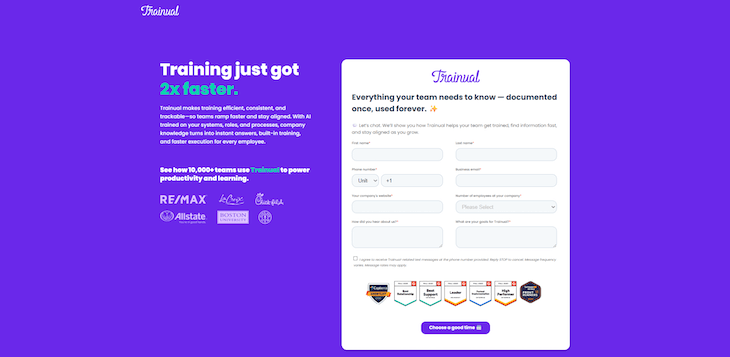
Trainual creates a centralized system where procedures double as training materials. No more maintaining separate files for SOPs and onboarding content. Everything lives in one place, accessible from day one for new hires.
The editor handles rich media without issues. Videos, images, audio explanations, GIFs—all embed cleanly. AI features draft content from brief prompts or rough notes, cutting documentation time significantly. The template library covers 500+ scenarios.
Role-based assignments update automatically when someone’s position changes. That’s the differentiator here. The system tracks completion, quiz performance, and timing. E-signature collection handles policy acknowledgment.
Key Features:
- AI Smart Outline and Compose tools for rapid SOP creation
- Built-in Loom-powered screen recording
- Automated role-based training path assignments
- Quiz builder with progress tracking
- Version history (30 days on Core, unlimited on Premium)
- Chrome extension for contextual help
- 500+ customizable templates
Price: Starts at $249/month for 10 seats (Core plan). Additional seats cost $3-5/month depending on tier. Pro runs $319/month, Premium $399/month. Enterprise requires custom quotes. A $1,000 one-time implementation fee applies.
Free plan / trial: No free plan. Free trials available.
| What we like | What should improve |
|---|---|
| Role automation cuts onboarding time by 50-80% | Higher cost than alternatives ($24.90 per user monthly) |
| AI drafting turns rough notes into complete procedures | API access locked to Enterprise tier only |
| 500+ templates cover most business scenarios | $1,000 implementation fee adds upfront cost |
| Quiz builder verifies employee understanding | No forever-free option for small teams |
| Strong integrations (Slack, BambooHR, Gusto, Okta) | Version history limited to 30 days on Core plan |
Process Street: Turn SOPs Into Live, Auditable Workflows
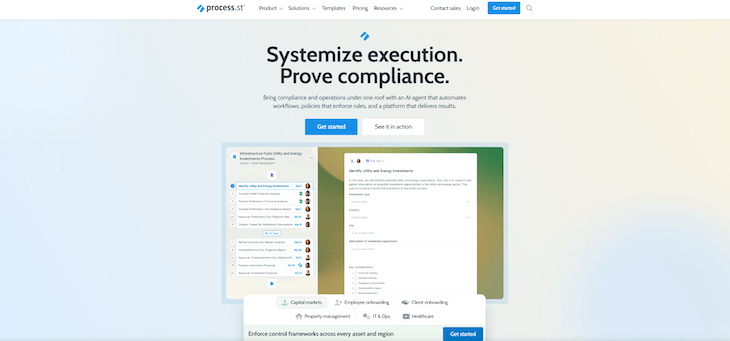
Process Street doesn’t do static documentation. It creates executable checklists that people actually run. SOPs become trackable workflows with conditional logic, form fields, and approval gates. Every execution creates a permanent audit trail.
The AI compliance agent (Cora) monitors workflows in real time. Skipped steps? Flagged. Compliance risks? Identified. It checks adherence across ISO 9001, SOC 2, HIPAA, and GDPR. For regulated industries, this automatic oversight eliminates manual review burden.
The drag-and-drop builder handles dynamic branching based on form responses. Schedule recurring workflows, assign tasks with due dates, set up automated notifications. A separate Pages feature provides static documentation alongside interactive workflows. Integration coverage spans 5,000+ tools via Zapier plus direct connections to major platforms.
Key Features:
- Live workflow execution with task ownership and deadlines
- Cora AI compliance agent for real-time monitoring
- Conditional logic branching based on responses
- Permanent audit trails for every workflow run
- Pages feature for static knowledge base content
- Scheduled and recurring workflow automation
- 5,000+ app integrations via Zapier
Price: Startup plan costs approximately $100/month for businesses under 15 employees. Pro jumps to roughly $1,500/month with dedicated support and workflow setup services. Enterprise pricing is custom.
Free plan / trial: No free plan (was removed). 14-day free trial available.
| What we like | What should improve |
|---|---|
| Executable workflows create permanent audit trails | Steep price jump from Startup ($100) to Pro ($1,500) |
| Cora AI monitors compliance across multiple frameworks | No offline access capability |
| Conditional logic reduces need for manual oversight | Free plan was discontinued |
| Strong for heavily regulated organizations | Pricing not transparent—requires sales contact for Pro |
| Pages feature adds static documentation alongside workflows | Complex for teams needing simple documentation only |
Whale: Speed Up Documentation With AI Assistant Alice
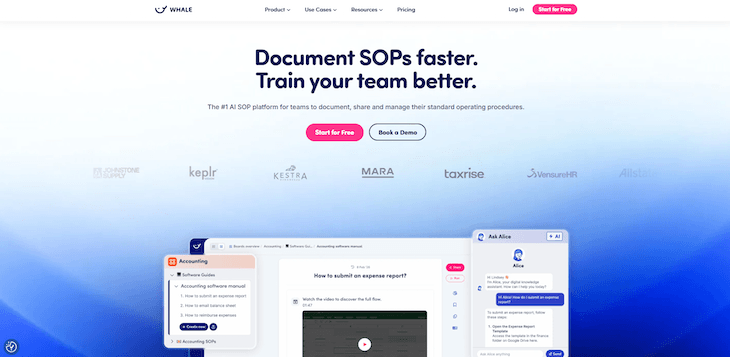
Whale focuses on speed. The platform combines AI-assisted SOP creation with employee training and an AI knowledge assistant named Alice. The built-in screen recorder auto-converts recordings into guides using AI. Teams report cutting documentation time by 70%.
The card-based editor handles standard content types: text, images, video, GIFs, embeds. Templates cover major business functions. Training paths include AI-generated quizzes with completion tracking.
Alice provides conversational search across documented SOPs. Employees ask questions in natural language—via Slack, browser extension, or mobile app—and get instant answers. The platform works particularly well for companies running the Entrepreneurial Operating System (EOS).
Key Features:
- Built-in screen recorder with AI conversion to guides
- Alice AI assistant for natural language search
- Card-based visual editor
- AI-generated quizzes for training verification
- Assignment tracking and completion analytics
- QR code access for physical workspace procedures
- Templates across all business departments
Price: Whale offers a free plan for 5 users. Paid plans currently start at $99/month billed yearly for Team (10 users), while Scale starts at $299/month billed yearly for 25 users. Enterprise pricing is custom.
Free plan / trial: Genuine forever-free plan for up to 5 users. No credit card required.
| What we like | What should improve |
|---|---|
| Forever-free plan supports up to 5 users | No flowchart or visual process mapping tools |
| Screen recording cuts documentation time by 70% | Document import from Word/PDF loses formatting |
| Alice AI delivers instant answers to questions | Training features locked behind paid Scale plan |
| Exceptional G2 ratings (9.6/10 ease, 9.8/10 support) | Limited integrations compared to competitors |
| QR codes connect physical workspaces to procedures | Card-based editor may feel limiting for complex docs |
Handover: Capture Knowledge Through Video, Not Text

Handover operates differently. Instead of typing procedures, users respond to AI-guided prompts via video, voice, or screen share. The platform automatically transcribes, summarizes, and structures recordings into searchable documentation.
Use cases extend beyond SOPs. Job handovers, reference checks, policy simulations, exit interviews, async team updates. All captured knowledge gets indexed in a searchable library with AI-generated summaries and key point extraction.
The platform holds SOC 2 and ISO 27001 certifications with GDPR compliance. Video-first capture reportedly works 10x faster than typing and captures nuance that text misses.
Key Features:
- AI-guided video prompts for knowledge capture
- Automatic transcription and summarization
- Structured indexing with AI-generated summaries
- SOC 2 and ISO 27001 security certifications
- GDPR compliance for data protection
- Searchable library with key point extraction
- Multi-use cases beyond traditional SOPs
Price: Not publicly listed—evaluation requires booking a demo.
Free plan / trial: No free plan or self-serve sign-up visible.
| What we like | What should improve |
|---|---|
| Video capture 10x faster than typing procedures | Pricing not publicly available—requires sales contact |
| Captures context and nuance lost in text | Very limited independent reviews and validation |
| AI-powered gap analysis identifies missing info | Non-traditional approach may not suit text-based needs |
| Enterprise-grade security (SOC 2, ISO 27001, GDPR) | No self-serve sign-up or trial available |
| Flexible for various knowledge transfer scenarios | Uncertain market traction for video-first approach |
Scribe: Automated Visual Documentation Used by Fortune 500
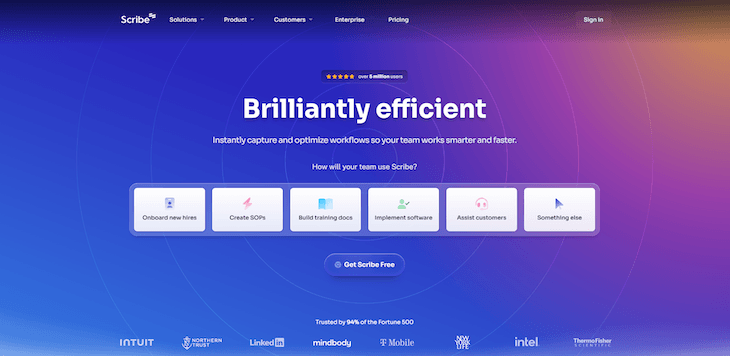
Scribe automatically creates visual guides by recording what you do. Turn on the Chrome extension or desktop app. Perform a process. Scribe generates a polished guide. Annotated screenshots, text descriptions, clickable links. The whole thing takes seconds.
Adoption numbers tell the story here. 94% of Fortune 500 companies use it. Over 5 million users. It’s become the go-to standard for auto-capture documentation.
The Pages feature combines multiple Scribes with text, videos, and links into comprehensive documents. Pro plans add screenshot editing, sensitive data redaction, branding customization, multiple export formats. Enterprise brings admin approval workflows, SSO/SCIM, multi-team management.
User ratings sit at 4.8-4.9/5 on G2. People consistently praise how fast it works.
Key Features:
- Automatic screenshot and instruction generation
- Chrome extension and desktop app capture
- Pages feature for combining guides with documentation
- Screenshot editing and annotation tools
- Sensitive data redaction capabilities
- Multiple export formats (PDF, HTML, Markdown)
- SSO/SCIM for Enterprise tier
Price: Pro Personal costs $23/user/month (annual), Pro Team runs $59/month including 5 users ($12 per additional user, annual). Enterprise is custom-priced.
Free plan / trial: Free Basic plan for unlimited browser-based guides (with limitations). Education and nonprofit discounts available.
| What we like | What should improve |
|---|---|
| Creates guides 12x faster than manual documentation | Can’t edit captured UI—requires re-recording for changes |
| 94% Fortune 500 adoption proves enterprise trust | Desktop capture and exports locked behind paid plans |
| Almost no learning curve—just start recording | Seat-based pricing adds up fast for larger teams |
| Generous free tier for browser-based guides | Limited customization on free plan |
| Excellent ratings (4.8-4.9/5 on G2) | No workflow or approval features in core product |
Document360: Enterprise Knowledge Base With AI-Powered Features
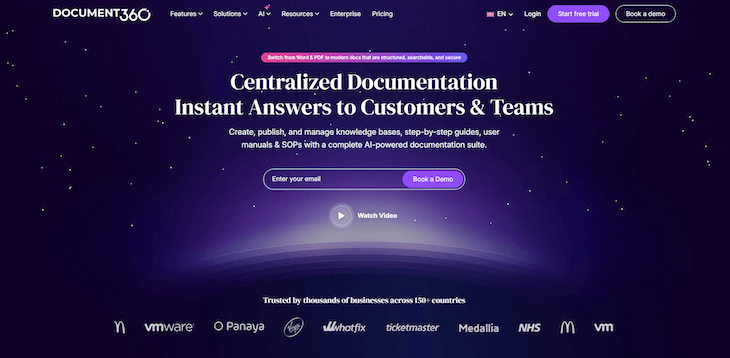
Document360 works as a comprehensive knowledge base for internal and external documentation. Document360 offers three editor options: Markdown, WYSIWYG (HTML), and an Advanced WYSIWYG editor. The AI Writing Agent generates documentation from uploaded video, audio, text files. Eddy AI provides ChatGPT-style search delivering contextual answers.
The Interactive Decision Tree builder creates guided troubleshooting and SOP flows with branching logic. Custom Workflow Builder automates task assignments, review cycles, publishing schedules. Version control includes full article versioning, change comparison, rollback capabilities.
The Ticket Deflector measures support tickets deflected by the knowledge base. Quantifies actual impact on support load with real numbers.
Key Features:
- Dual editor (WYSIWYG and Markdown)
- AI Writing Agent for content generation
- Eddy AI for natural language search
- Interactive Decision Tree builder
- Custom Workflow Builder for automation
- Comprehensive version control system
- Auto-translation to 50+ languages
Price: Quote-based pricing. Third-party sources reference legacy pricing starting around $99/month per project.
Free plan / trial: No free plan (discontinued). 14-day free trial available (no credit card required).
| What we like | What should improve |
|---|---|
| Industry-leading organization for large doc sets | No built-in screen capture—content manually authored |
| Powerful AI throughout (writing, search, translation) | Quote-based pricing requires sales engagement |
| Interactive Decision Tree for guided troubleshooting | Steeper learning curve noted by reviewers |
| Ticket Deflector quantifies support impact | Free plan was discontinued in late 2024 |
| Auto-translation to 50+ languages | Pricing not transparent on website |
SweetProcess: Active-Member Billing With Built-In Approval Workflows
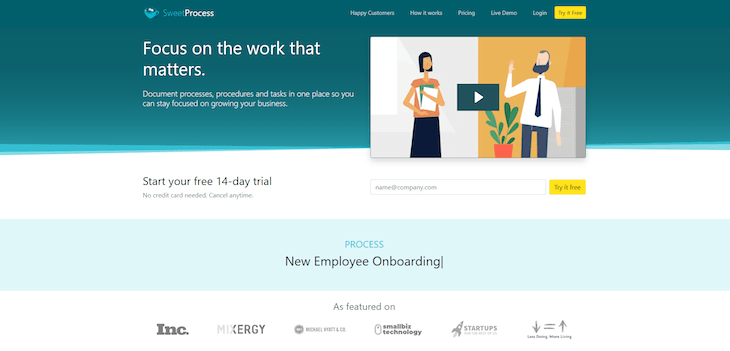
SweetProcess combines procedures, policies, processes, knowledge base, task management, and flowcharts in one platform. SweetAI generates SOP drafts automatically. The platform includes built-in approval workflows ensuring procedures undergo review before publishing, with full version history including comparison and rollback.
Role-based access controls determine who can view, edit, and approve different procedures. The distinguishing pricing feature: active-member-only billing. Organizations pay only for users actively using the platform, with prorated credits when users become inactive.
Key Features:
- SweetAI for automated SOP generation
- Built-in approval workflows with review chains
- Full version history with comparison and rollback
- Role-based access controls
- Integrated flowchart creation
- Task delegation and assignment
- Active-member-only billing model
Price: Starts at $99/month for up to 20 active team members, with additional users at $5/month each. Annual billing reduces this to $82.50/month.
Free plan / trial: No free plan. 14-day free trial (no credit card required). 30-day money-back guarantee.
| What we like | What should improve |
|---|---|
| Fair billing—pay only for active users | No automatic screen capture for visual guides |
| All features at every price point (no tiering) | Interface lacks modern polish vs newer competitors |
| Built-in approval workflows with audit trails | Relies on Zapier for most integrations |
| 30-day money-back guarantee reduces risk | Flowcharts less advanced than dedicated tools |
| Low learning curve praised in reviews | No free plan to test before committing |
Confluence: Atlassian’s Collaborative Workspace With Massive Scalability
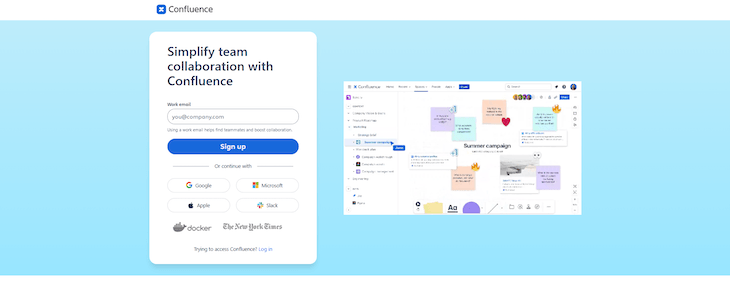
Confluence serves as Atlassian’s collaborative workspace. It’s a general-purpose wiki and knowledge management platform. Not purpose-built for SOPs. But people use it for procedure documentation anyway.
The reason? Powerful editor. Extensive templates. Deep integration with Jira, Trello, Bitbucket, Loom.
AI features powered by Rovo/Atlassian Intelligence assist with content generation, summarization, search. The rich WYSIWYG editor supports macros, live documents, whiteboards, databases. Template coverage spans every department you can think of.
Confluence scales from small free teams to deployments of 150,000+ users per site. Supports 20+ languages.
Key Features:
- Rich WYSIWYG editor with macros and live documents
- AI-powered content generation and summarization
- Deep Atlassian ecosystem integration
- 3,000+ Marketplace apps available
- Whiteboard and database capabilities
- Supports 150,000+ users per site
- 20+ language support
Price: Standard costs approximately $5.42/user/month (annual), Premium $10.44/user/month, Enterprise is custom-quoted. Data Center (self-managed) starts at $28,000/year for 500 users.
Free plan / trial: Free plan supports up to 10 users with unlimited pages. Seven-day free trial available for Standard and Premium.
| What we like | What should improve |
|---|---|
| Generous free tier (10 users, unlimited pages) | No native approval workflows—requires add-ons |
| Massive scalability (150,000+ users per site) | Complexity creates learning curve for non-technical users |
| Competitive per-user pricing structure | Lacks dedicated SOP features (training, read receipts) |
| Powerful Atlassian ecosystem integration | General-purpose means more setup for SOP use |
| 3,000+ Marketplace apps for customization | Can become cluttered without proper governance |
MagicHow: Budget-Friendly Automated Guide Creation
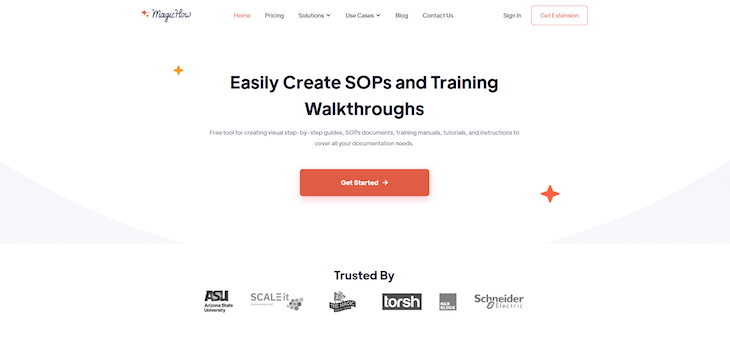
MagicHow automates guide creation via browser extension or desktop app. Captures user actions. Converts them into visual step-by-step SOPs. Think Scribe but more affordable. A separate free AI SOP Generator creates text-based procedures.
Supports capture across Chrome, Firefox, Edge, Safari browsers plus a desktop app. Editing features? Annotations, logo insertion, sensitive data blur, color customization. Export options cover PDF, HTML, Markdown. Embedding support for Confluence, Notion, Zendesk, WordPress.
Key Features:
- Automated visual guide creation via screen capture
- Multi-browser support (Chrome, Firefox, Edge, Safari)
- Desktop app for non-browser processes
- Screenshot editing and annotation tools
- Sensitive data blur functionality
- Multiple export formats (PDF, HTML, Markdown)
- Free AI SOP Generator for text procedures
Price: Personal plans cost $10/user/month (annual), Team plans $8/user/month (annual, minimum 5 seats), Enterprise is custom.
Free plan / trial: Exceptionally generous free Starter plan for up to 25 users (limited to 3 projects and 10 guides, browser capture only). The Team plan includes 10 free view-only workspace members, while paid seats are used for active editors and collaborators.
| What we like | What should improve |
|---|---|
| Most generous free tier (25 users) | Early-stage startup with limited market validation |
| Very affordable ($8-10/user/month) | No reviews on G2 or Capterra yet |
| Multi-platform capture (Chrome, Firefox, Edge, Safari) | Lacks workflow management or approval features |
| View-only users are free—only editors charged | Long-term viability uncertain (founded 2023) |
| Multiple export formats and embedding options | Documentation creation only—not full SOP platform |
Waybook: Unified Training Platform With Visual Capture
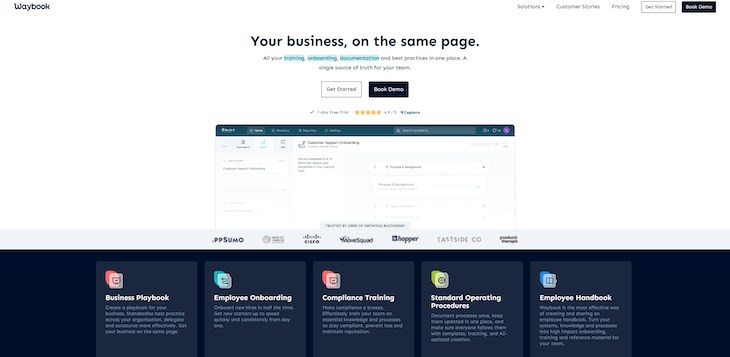
Waybook combines SOP documentation with employee training in a unified “business playbook.” The platform includes built-in testing, quizzes, progress tracking, and read receipts—ensuring SOPs are understood, not just stored. Waybook Shots provides visual process capture for instant documentation, while an AI Content Writer generates SOPs quickly.
The platform uses structured hierarchy: Categories → Subjects → Documents → Steps, with role-based permissions and step revision tracking. Update notifications automatically alert users when content changes. The Pro plan adds SSO, directory sync, audit logs, and advanced permissions.
Key Features:
- Waybook Shots for visual process capture
- AI Content Writer for rapid SOP generation
- Built-in tests and quizzes with progress tracking
- Structured playbook hierarchy
- Automatic update notifications
- Read receipts and verification tracking
- Custom branding on all plans
Price: Starts at $99/month (annual) for 20 team members on the Core plan, with additional users at $5/month. Pro costs $198/month (annual) for 20 users with additional users at $10/month. Enterprise is custom.
Free plan / trial: No free plan. 7-day free trial available.
| What we like | What should improve |
|---|---|
| Combined SOP and training with built-in assessment | Text editor limitations (styling, formatting issues) |
| Waybook Shots for visual process capture | No API available for custom integrations |
| Custom branding available at all tiers | Lower G2 rating (3.5/5) vs competitors |
| Read receipts verify employee understanding | Waybook’s core navigation remains in English, but teams can create content in their own language. |
| Update notifications keep users informed | No free plan to test before purchasing |
SOP Software Comparison Table
Quick breakdown of costs and who each platform suits best:
| Platform | Starting Price | Free Plan | Key Strength | Best For |
|---|---|---|---|---|
| Trainual | $249/mo (10 seats) | No | Automated role-based training | Growing SMBs scaling onboarding |
| Process Street | ~$100/mo (Startup) | No | Live workflow execution with audit trails | Compliance-heavy organizations |
| Whale | $99/mo (10 seats) | Yes (5 users) | Alice AI assistant + screen recorder | Fast-growing teams needing speed |
| Handover | Custom quote | No | Video-first knowledge capture | Teams preferring video over text |
| Scribe | $59/mo (5 seats) | Yes (browser only) | Automatic visual guide generation | Fortune 500 standard for documentation |
| Document360 | Custom quote | No | Enterprise knowledge base with AI | Large documentation libraries |
| SweetProcess | $99/mo (20 users) | No | Active-member billing + approval workflows | Cost-conscious compliance teams |
| Confluence | $5.42/user/mo | Yes (10 users) | Atlassian ecosystem integration | Engineering teams using Jira |
| MagicHow | $42/mo (5 seats) | Yes (25 users) | Most generous free tier | Budget-conscious small teams |
| Waybook | $99/mo (20 seats) | No | Combined SOP + training with quizzes | Teams needing verification tracking |
Notable patterns:
Free options exist. Whale offers 5 seats. Scribe works for browser captures without payment. Confluence includes 10 users. MagicHow? 25 users—far more generous than competitors.
Two pricing models dominate. Per-user charges (Scribe, Confluence, MagicHow) versus flat monthly rates with included seats (Trainual, Whale, SweetProcess, Waybook). Three vendors won’t list prices publicly: Process Street, Handover, Document360 all require sales conversations.
What is SOP Software?
SOP software creates, stores, and manages standard operating procedures digitally. It replaces scattered Word documents, outdated PDFs, and tribal knowledge that walks out the door when employees quit.
What these platforms actually do:
- Build procedures – Text, images, videos, screenshots combined into step-by-step guides
- Store everything centrally – One place everyone accesses
- Track versions – See what changed, when, and by who. Roll back mistakes.
- Manage access – Decide who views, edits, or approves
- Search fast – Find what you need in seconds
- Connect to training – Assign procedures, track completion, test understanding
Traditional documentation lives everywhere and nowhere at once. Email. Personal folders. Someone’s brain. That person leaves? Knowledge vanishes with them.
Modern platforms do more than file storage.
They don’t just hold documents. They build systems that work. AI turns rough notes into complete standard operating procedures. Screen recorders capture processes automatically. Approval chains ensure review before anything goes live. Read receipts prove someone opened the document. Quizzes confirm they actually understood it.
Drive stores files. Confluence builds wikis. Procedure documentation software runs operations.
Here’s why it matters. Research shows companies lose 42% of role knowledge when employees leave. New hires burn weeks learning what should take hours. Teams field identical questions daily. Mistakes multiply because everyone’s following different versions of the same procedure.
Dedicated SOP software stops this. Standard operating procedures stay accessible, current, and actually get used—not written once then ignored forever.
SOP Software vs Knowledge Base vs Workflow Management: What’s the Difference?
These three categories overlap. But they’re solving different problems.
| Category | Primary Purpose | Key Features | Example Use Case |
|---|---|---|---|
| SOP Software | Document repeatable processes with training/verification | Procedures, quizzes, read tracking, approval workflows | Onboarding checklist with verification tests |
| Knowledge Base | Answer questions and provide reference material | Articles, search, FAQs, public/private content | Customer help center or internal wiki |
| Workflow Management | Execute and automate tasks with accountability | Task assignment, due dates, conditional logic, integrations | Monthly compliance audit with automated reminders |
SOP Software documents how your team does things. Repeatable procedures with steps, screenshots, videos. The platforms verify employees actually read procedures—not just that you sent them. Think employee handbooks. Training materials. Operational playbooks.
Knowledge Base Software answers questions. Reference material people search when they’re stuck. Less about following steps in order. More about finding answers fast. Zendesk Guide works this way. So does Notion.
Workflow Management executes processes instead of just describing them. Assigns tasks. Tracks who finished what. Sends reminders. Automates handoffs between team members. Asana does this. Monday.com too.
Here’s where it gets messy. Modern platforms don’t stay in their lanes anymore. Process Street mixes SOPs with live workflow execution. Document360 functions as both knowledge base and SOP system. Confluence? Wiki, knowledge base, SOP storage—all rolled together.
Start with your biggest pain point. Need to train employees on procedures? SOP software. Fielding repetitive support questions? Knowledge base. Tracking recurring tasks across teams? Workflow management.
Most companies eventually use all three. But beginning with what hurts most today makes more sense than trying to solve everything at once.
How We Evaluated These SOP Platforms
This comparison pulls from multiple sources to provide objective analysis.
Evaluation criteria:
1. User Reviews & Ratings
The analysis examined ratings from G2, Capterra, and Software Advice. Focus remained on verified users running similar businesses—same size, same industry. Consistent complaints reveal real problems. One negative review means nothing. Twenty saying the same thing? That matters.
2. Pricing Transparency
Public pricing earned credit. Making prospects book a demo just to see costs? Lost points fast. The evaluation tracked free tiers, trial periods, and sneaky fees buried in terms.
3. Feature Depth
Started with core SOP capabilities: documentation creation, version control, approval workflows, search, access management. Then modern additions. AI drafting. Visual capture. Training integration. Compliance tracking.
4. Ease of Use
Interface design either kills adoption or saves it. The evaluation tested onboarding flows, tried editors, checked mobile apps. Steep learning curves hurt teams—no matter how powerful the features are.
5. Integration Ecosystem
Does it play nice with tools teams already use? Slack, Teams, Google Workspace, HR systems, project management platforms. Native connections beat Zapier workarounds every time.
6. Scalability
Will it grow with teams or force a painful migration later? User limits, pricing jumps at scale, performance with big teams, enterprise features.
7. Support Quality
Response times. Chat, email, phone availability. Documentation quality. Community resources.
What got excluded:
Platforms discontinued or acquired during 2025. Tools with under 50 verified reviews unless they offered something truly unique. Workflow platforms like Asana that barely touch documentation.
Disclosure: No affiliate relationships. No sponsored content. Independent research only.
How to Choose the Right SOP Software for Your Team
The primary use case determines everything. Start there.
1. Define Your Core Need
What job needs doing? Training new hires? Building a reference library? Running compliance workflows? Different needs point to different platforms.
- Training new hires → Trainual, Waybook, Whale
- Visual documentation fast → Scribe, MagicHow
- Compliance workflows → Process Street, SweetProcess
- Knowledge base → Document360, Confluence
2. Assess Your Team Size
Under 25 people? Free plans work. Whale, MagicHow, Confluence all offer them.
Between 25-250? Flat-rate pricing makes budgeting easier. Trainual, SweetProcess, Waybook bundle seats.
Over 250? Per-user pricing scales better long-term. Scribe, Confluence, MagicHow charge by actual users.
3. Documentation Speed Matters
Need it yesterday? Visual capture cuts creation time 70%. Scribe, MagicHow, Whale’s recorder, Waybook Shots—they automate screenshots and annotations.
Got time? Traditional editors with AI work fine. Trainual, SweetProcess, Document360 provide solid text editors plus AI drafting.
4. Integration Requirements
Map your tech stack first. Does it connect to what you’re already using? Native integrations beat Zapier connections—faster, more reliable, break less.
Must-haves: Slack or Teams for communication. Google Workspace or Microsoft 365 for documents. BambooHR or Gusto for HR. Jira or Asana for projects.
5. Compliance Needs
Regulated industries need audit trails, approval workflows, version control. Process Street’s Cora AI monitors compliance automatically. SweetProcess and Document360 provide approval chains. Confluence? You’ll need add-ons.
6. Test the Editor
Request demos. Actually try creating a procedure. Clunky editors kill adoption faster than missing features ever will. The best platform? Whichever one your team actually uses.
7. Search Capabilities
SOPs don’t help if nobody finds them. Test search with real queries. AI-powered search (Whale’s Alice, Document360’s Eddy) understands natural language. Keyword matching works worse.
8. Pricing Models
Flat-rate gives budget predictability. Per-user scales gradually. Custom enterprise pricing? Stays hidden until sales calls. Factor in implementation fees, training costs, annual versus monthly differences.
9. Run a Pilot
Start small. One department. Document 5-10 critical procedures. Track adoption. Gather feedback.
Successful pilots need three things: executive sponsorship, clear success metrics, defined timelines. Thirty to sixty days works well.
Don’t try documenting everything at once. That’s how projects fail. Document the most painful procedures first. The ones causing errors. The ones new hires struggle with. The ones explained twenty times per month.
Get those working. Then expand.
10 Essential Features Every SOP Platform Should Have
Not all features matter equally. Some are simply nice to have, while others directly affect how fast teams document processes, keep procedures accurate, and make sure people actually follow them. Here are the features that matter most in practice:
| Feature | Why it matters |
|---|---|
| AI-powered drafting | Turns rough notes into structured procedures faster and reduces the amount of manual writing needed. Without it, teams often delay documentation because starting from scratch takes too long. |
| Visual capture tools | Screen recording and screenshot-based guides make procedures easier to create and easier to follow. This is especially useful for software walkthroughs and repetitive tasks. |
| Version control | Tracks who changed what, when, and why. It also helps teams roll back mistakes and avoid confusion caused by multiple outdated versions. |
| Approval workflows | Routes procedures through review before publishing. This is especially important for compliance-sensitive teams that need verified, officially approved documentation. |
| Role-based permissions | Controls who can view, edit, or manage different procedures. It helps protect sensitive information and keeps teams focused only on what is relevant to them. |
| Smart search | Helps users find the right procedure quickly, even when they do not search using the exact document title or wording. |
| Read receipts and tracking | Shows whether employees actually opened and reviewed procedures. This turns documentation into something measurable instead of something that just exists in a folder. |
| Training integration | Lets teams use procedures as part of onboarding and training, often with quizzes, acknowledgments, or completion tracking built in. |
| Mobile access | Makes procedures available on phones and tablets, which is critical for field teams, retail staff, healthcare workers, and other deskless employees. |
| Notifications and update alerts | Tells users when procedures change, reducing the risk of people following outdated instructions. |
The pattern: Features that automate work matter most. Manual documentation, manual updates, manual tracking—all fail at scale. The best platforms reduce friction at every step.
Why Growing Teams Need Dedicated SOP Software
Scaling breaks informal knowledge transfer. What works at 10 employees fails at 50. Here’s why dedicated platforms matter:
1. Onboarding Speed New hires get up to speed 60% faster with documented procedures versus shadowing. Instead of interrupting senior employees for answers, they find procedures themselves. Self-service learning scales infinitely.
2. Knowledge Retention Research shows companies lose 42% of role-specific knowledge when employees leave. SOP platforms capture that knowledge before it walks out the door. Documentation preserves institutional memory.
3. Quality Consistency Ten employees doing the same task ten different ways creates ten different outcomes. Documented procedures standardize execution. Consistency improves when everyone follows the same steps.
4. Reduced Management Overhead Managers stop answering the same questions repeatedly. “How do I…?” gets answered by the platform, not interrupting workflow. Time savings compound quickly across teams.
5. Faster Training Across Locations Remote teams can’t shadow experienced employees. Video tutorials and step-by-step procedures deliver consistent training regardless of geography. Critical for distributed organizations.
6. Audit Trail for Compliance Regulated industries need proof that employees received training. Read receipts and completion tracking provide documentation auditors actually want. Manual tracking doesn’t scale past 20 employees.
7. Reduced Error Rates Mistakes cost money. Following documented procedures reduces errors by 30-40% according to operational studies. Fewer errors mean fewer customer complaints and less rework.
8. Easier Delegation Entrepreneurs struggle to delegate because “only they know how.” Documentation removes that bottleneck. Clear procedures let you delegate confidently without becoming the permanent answer machine.
The investment pays for itself through reduced training time alone. Everything else is bonus.
Common Challenges When Implementing SOP Software (And How to Fix Them)
Most SOP projects fail for predictable reasons. Here’s what goes wrong and how to prevent it:
1. Low Adoption Rates
Problem: You build a comprehensive library. Nobody uses it. Employees keep asking the same questions anyway.
Solution: Involve employees in creation from day one. People use systems they helped build. Start with procedures that solve their daily pain points—not what management thinks matters. Quick wins drive adoption better than perfect documentation nobody reads.
2. Outdated Documentation
Problem: Procedures get written once, never updated. Within months, they’re wrong. Trust collapses fast.
Solution: Assign ownership. Every procedure needs one person responsible for keeping it current. Set automatic review reminders quarterly. Version control tracks changes. Make updates easy or they won’t happen.
3. Time-Consuming Creation
Problem: Documentation takes forever. Teams give up before finishing the first procedure.
Solution: Use visual capture tools. Record your screen instead of typing everything. AI drafting turns rough notes into structured procedures in minutes. Start with 5-10 critical procedures, not everything. Perfection kills progress.
4. Information Silos
Problem: Marketing can’t find sales procedures. Support doesn’t know where engineering docs live. Knowledge stays trapped in departments.
Solution: Implement clear folder structure and tagging from the start. Use permissions to control access without hiding content. Cross-functional procedures need cross-functional visibility. Search solves discoverability—when it works.
5. Resistance from Experienced Employees
Problem: Veterans say “I don’t need procedures, I already know this.” They refuse to document their knowledge.
Solution: Frame it as knowledge transfer, not micromanagement. Position documentation as their legacy—what they’ll leave behind when promoted. Emphasize it frees them from answering repetitive questions. Make documentation part of promotion criteria if needed.
6. Platform Overwhelm
Problem: Too many features confuse teams. Complex interfaces sit unused because nobody understands them.
Solution: Choose platforms matching your actual needs. Simple beats comprehensive if simple gets used. Hide advanced features initially. Roll out functionality in phases. Train on basics first. Complexity comes later once adoption is solid.
The pattern: Implementation problems are people problems, not software problems. Technology enables behavior—it doesn’t force it. Successful rollouts focus on change management as much as platform features. The best platform you’ll never use is worse than the adequate platform everyone actually opens.
How SOP Software Needs Change as You Scale
Company size determines what matters. Small team needs are completely different from enterprise requirements.
| Business Size | Employee Count | Top Priority | Recommended Platforms |
|---|---|---|---|
| Small | 1-50 | Low cost, easy setup | Whale, MagicHow, Confluence, Scribe |
| Mid-Sized | 50-500 | Permissions, workflows, integrations | Trainual, Process Street, SweetProcess, Waybook |
| Enterprise | 500+ | Security, compliance, SSO | Process Street Enterprise, Confluence Enterprise, Document360 |
Small Businesses (1-50 Employees)
What you actually need:
- Fast documentation creation (not spending weeks on setup)
- Interface simple enough for anyone to figure out in 10 minutes
- Mobile access because everyone works remotely now
- Search that doesn’t make you want to scream
Skip these entirely: Complex approval workflows. Advanced permissions. Enterprise integrations. You won’t use them for years. Why pay for features gathering dust?
Mid-Sized Companies (50-500 Employees)
Structure starts mattering:
- Role-based access across departments
- Approval workflows stopping random changes
- Integration with HR systems, Slack, project tools
- Training verification proving people actually read procedures
- Version control with audit trails
Around 100 employees? Free plans break. You need dedicated support, better security, real workflow management. No way around it.
Large Enterprises (500+ Employees)
Enterprise requirements stop being optional. Start being mandatory:
- SSO/SCIM for authentication
- SOC 2 certification and compliance tracking
- Advanced analytics and reporting
- API access for custom integrations
- Multi-language support
- Dedicated account managers who actually respond
- Enterprise SLAs and multi-region hosting
Cost reality: Enterprise features run 3-5x more than standard plans. For regulated industries? Not negotiable. It’s either pay up or face auditor nightmares.
Smart approach: Start simple. Upgrade when pain hits hard enough. Don’t buy enterprise features before you need them. Premature scaling burns money fast.
8-Step Implementation Plan for SOP Software
Rolling out SOP software? Here’s what works:
Phase 1: Pre-Implementation (Weeks 1-2)
Step 1: Audit Existing Documentation Find what you have. Word docs scattered everywhere. Old PDFs nobody opens. Email threads. Spreadsheets from 2019. List it all before moving anything.
Step 2: Identify Critical Procedures Don’t document everything. That kills projects. Pick 5-10 procedures causing real pain:
- High-impact tasks done constantly
- Procedures where inconsistency creates problems
- Knowledge trapped in one person’s head
- Tasks new hires struggle with most
Step 3: Select Platform & Run Trial Use our comparison above. Run 14-day trials with real work—not demo data.
Phase 2: Pilot Program (Weeks 3-6)
Step 4: Start With One Department Pick a department excited about new tools. Early adopters spread enthusiasm better than mandates.
Step 5: Document Core Procedures Create those 5-10 critical procedures. Use visual capture if available. Get feedback from people who’ll use them daily.
Step 6: Train Power Users Find 2-3 people per department who’ll champion the system. Train them deeply. They’ll train everyone else.
Phase 3: Full Rollout (Weeks 7-12)
Step 7: Expand Gradually Add one department every two weeks. Watch adoption rates. Fix problems before moving forward. Rushing kills momentum.
Step 8: Assign Ownership & Review Cycles Every procedure needs an owner keeping it current. Set quarterly review reminders automatically. Without ownership, documentation dies within months.
Common Rollout Mistakes:
| Mistake | Why It Fails | Better Approach |
|---|---|---|
| Document everything immediately | Overwhelms team, nothing gets finished | Start with 5-10 critical procedures |
| Top-down mandate without training | Creates resistance and confusion | Pilot with enthusiastic early adopters |
| No designated procedure owners | Documentation becomes outdated fast | Assign clear ownership from day one |
| Skipping the pilot phase | Problems discovered after full rollout | Test with small group first |
Success needs executive sponsorship, clear metrics, patience. Most implementations take 3-6 months reaching full adoption. Rush it? You guarantee failure.
Frequently Asked Questions About SOP Software
1.
What’s the difference between SOP software and document management systems?
Document management stores files. That’s it. SOP software does more—structures procedures, tracks who read what, verifies understanding through quizzes, manages approval workflows. Dropbox stores your files. SOP software makes sure people actually use them correctly.
2.
How long does it take to see ROI from SOP software?
Most companies break even within 3-6 months through reduced training time alone. The math’s straightforward. Calculate your average onboarding duration. Multiply by hourly cost. Factor in the 50-60% reduction documented SOPs provide.
Real example: team of 20 making $50,000 annually. Cut onboarding from 8 weeks to 4 weeks? You save roughly $38,000 yearly. Everything else—reduced errors, fewer interruptions, better delegation—that’s all bonus on top.
3.
Can we migrate existing SOPs from Word/PDF/Google Docs?
Yes, but quality varies wildly. Some platforms import cleanly. Others? They lose formatting and need manual cleanup. Document360 offers professional migration services. SweetProcess handles Word and Google Docs reasonably well. Whale provides migration assistance at $1,999. Plan for some manual reformatting regardless of what vendors promise during demos.
4.
Do we need technical skills to manage SOP software?
Not for most platforms here. Trainual, Whale, SweetProcess, Waybook? Built for regular people. Process Street and Confluence have steeper curves but still don’t require coding. Can you use Google Docs? Then you can manage these. API integrations might need IT help though.
5.
How often should SOPs be updated?
Set quarterly reviews as baseline. But update immediately when processes change—not next quarter. Stale documentation is worse than none at all. People stop trusting the system once they catch it being wrong. Use platforms with automatic reminders and version control. Assign clear ownership so updates don’t fall through cracks.
6.
What if employees don’t use the platform after rollout?
Low adoption usually means you documented the wrong things or made it too complex. Fix it by asking employees what procedures they actually need. Simplify navigation. Add visual elements instead of endless text walls. Make search better. Involve employees in creation from the start—people use systems they helped build. Force never works.
7.
Should we build custom SOP software or buy?
Buy. Always buy. Custom development costs $50,000-$200,000 minimum and takes 6-12 months. Off-the-shelf platforms cost $1,000-$10,000 yearly and work immediately. You’ll spend years maintaining custom software while competitors use proven platforms. Build custom only if you’re a software company or have requirements so unique even enterprise plans can’t handle them.