
What 120 Superyachts in Monaco Reveal About the State of Luxury Yachting in 2026

The content of this material is informational and educational in nature and cannot be regarded as financial advice. It is extremely important to conduct an independent analysis before any financial transactions. If you are not sure about financial matters, it is strongly recommended to seek the advice of an independent expert.
One Harbour, One Snapshot
A harbour holding roughly 120 superyachts is not, on its own, a finding. The 35th Monaco Yacht Show, held in Port Hercule from 23 to 26 September 2026, is useful for what that fleet was made of: the mix of sizes, ages, builders and business models that a single quay can hold at one time.
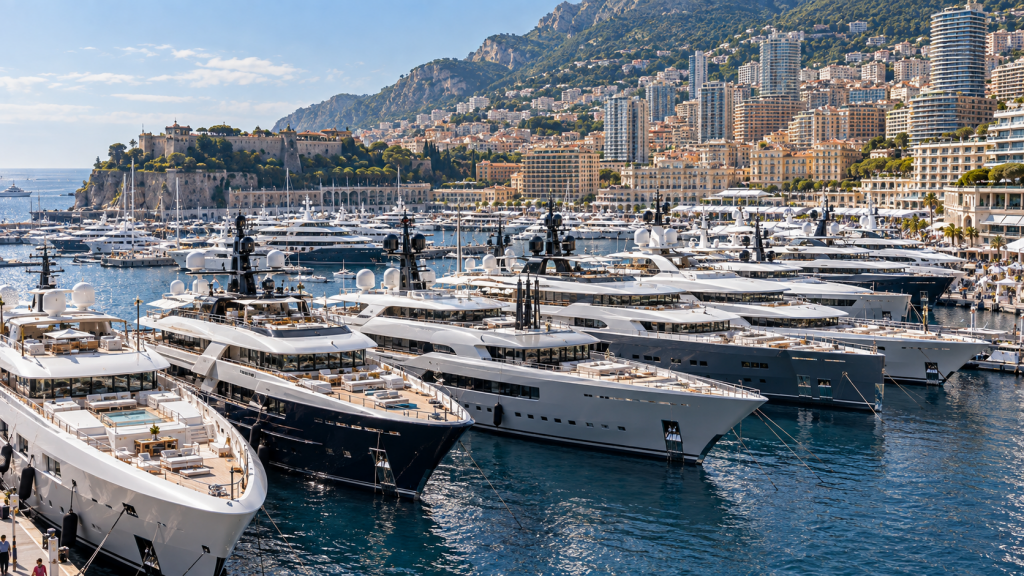
The fleet is not a sample in the statistical sense. The vessels in Port Hercule are curated. Organisers and participating companies decide what is shown, and a berth in Monaco is a commercial choice as much as a reflection of what exists. Not every yacht on display is for sale. Not every one is new. Not every significant owner, buyer or shipyard attends, and plenty of the world’s largest and most private projects never come near a trade show. Any conclusion drawn from the fleet has to carry that qualification with it.
Within that limit, start with age. Of the yachts named in the organisers’ fleet announcement, 43 were identified as 2026 deliveries. That is a claim about completion dates, not about publicity. Some of those boats may have been handed to owners months before the show, and some may have been seen elsewhere first. What the figure does indicate is how much of the display consists of vessels that left a shipyard within the past year, which gives an unusually current picture of what yards are finishing rather than what they are announcing.
Those deliveries also span a wide range. The smallest, the Arcadia A80, measures about 24 metres. The largest, the Lürssen Nixie, is around 102. Between them sits most of the working structure of the industry: semi-custom production yachts, fully bespoke projects, and the larger vessels that move through the market on very different timelines. The show also gathered more than 560 exhibitors, and their range points the same way. Design studios, builders, brokers, charter operators, refit yards, equipment makers, yacht managers and marine service firms all take space at the same event, because in practice their work overlaps constantly on any given boat.
A curated snapshot has real value if it is read for what it is. Leading builders choose what to bring, and brokers choose what to present. That gives a reasonably direct view of what the supply side considers worth putting in front of the industry at a moment when it is most attentive. The size classes that crowd the quays, the shipyards that appear repeatedly and the presence of older yachts returning after refit all say something about where commercial energy currently sits, even if they cannot settle questions about the market as a whole.
The show is also one of the few places where the separate parts of the business can be seen operating side by side. A new build, a recently refitted older yacht and a vessel that spends its summers under charter can share a pontoon, and the people who deal in each of them share the same hospitality tents. Construction, resale, refit and chartering are often discussed as distinct sectors. Here they are effectively neighbours.
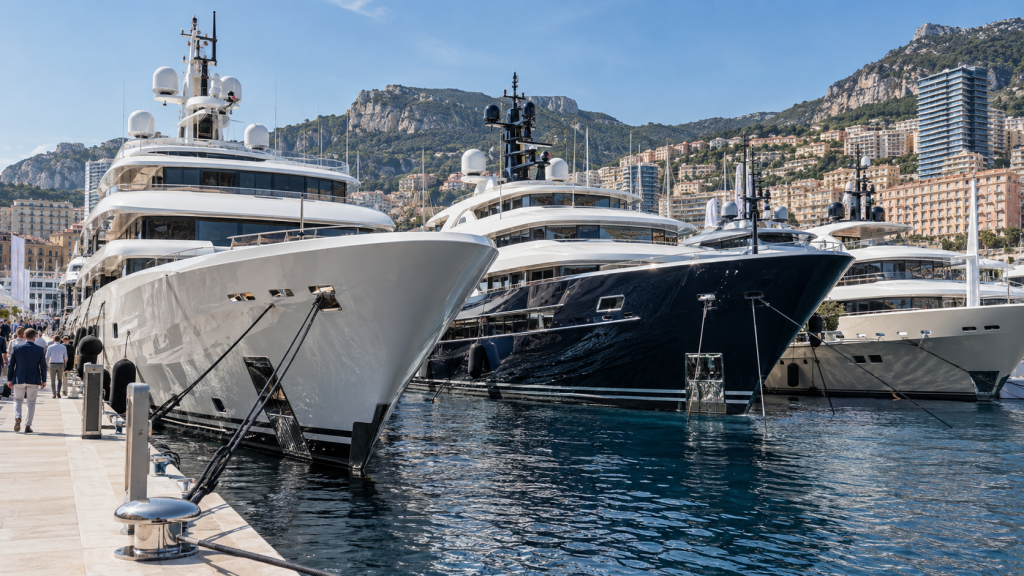
That proximity raises a puzzle that the fleet cannot answer by itself. The wider industry data for 2026 does not describe a sector piling up new projects. It describes one with fewer of them. Yet the yachts appearing on the water, and those still on the slipway, are getting larger. How can an industry have fewer projects in its order book while the yachts being built become bigger?
Counting Boats, Measuring Ships
The answer starts with what the two measures actually capture. The order book cited in the show’s own material, BOAT International’s Global Order Book 2026, records that the number of superyacht projects declined for a second consecutive year. It also records that the average length of yachts under construction reached a record, and that average tonnage did the same. These findings are not in conflict. A count of projects tells you how many contracts exist. Length and tonnage tell you how much boat each contract represents. One can fall while the other climbs.
Consider what a shipyard is, in practical terms. It has a limited number of building halls, berths, skilled workers and supply relationships, and every project draws on them in proportion to its scale. A 100-metre yacht does not simply take up more space than a 35-metre one. It occupies engineering teams, outfitting crews and inspection schedules for far longer, and its systems are usually more numerous and more complicated. When a yard’s capacity is finite, a shift toward larger projects can reduce the number of hulls it starts while raising the total work it carries.
The figures describe a change in the composition of what is being built. They are silent on why owners are commissioning larger yachts, how much they are paying, or whether the pattern will persist. Neither a lower project count nor a record average size settles the question of demand, which the order book, as cited, does not address.
The build queue adds a second layer. According to the same context, slots at leading yards are committed into roughly 2028 and 2029. For a prospective owner who has not yet signed, that timeline is the practical fact that matters. A commission placed today with one of those yards would deliver, on current schedules, years from now. Whether that wait is acceptable depends on the buyer, and buyers’ motives are beyond what these figures can tell us. What can be said is that the arithmetic of the queue changes the value of vessels that already exist.
A recently delivered yacht, or one that has just been refitted, offers something a new contract cannot: it is available on a known date. That does not mean every buyer will choose it, or that a full order book guarantees healthy demand later on. Long queues can reflect strong interest, cautious yard scheduling, the sheer duration of complex builds, or some combination. The evidence does not separate these. It only establishes that time has become a more visible variable in the market.
There is still the matter of who is actually building this tonnage. Yard capacity is not evenly spread across the world’s shipbuilders, and the Monaco fleet leans noticeably toward a small number of national industries. One of them accounts for a striking share of the projects on the global list.
The Italian Weight in the Order Book
The Monaco Yacht Show’s fleet material, citing the same Global Order Book, puts Italian builders at roughly 52% of global superyacht production, measured by projects ordered or under construction. The unit matters. This is a share of projects, not of revenue, not of the yachts already in service, and not the proportion of the Monaco fleet built in Italy. A yard that delivers many mid-sized yachts will count for more in a project tally than in a ranking by value or tonnage.
Even with that caveat, the figure describes a lopsided industry. The reasons are probably structural rather than sentimental, though the data cited does not establish them, so what follows is interpretation. Italian yards are often organised around groups that operate several brands or product lines. Sanlorenzo, Azimut-Benetti and the Ferretti Group brands, all prominent in the Monaco fleet, are examples of companies that can spread engineering, purchasing and production capacity across more than one range instead of treating every hull as a standalone enterprise. Baglietto, Tankoa and The Italian Sea Group belong to the same national industry and work in a different mix of sizes and degrees of customisation. Around all of them sits a dense network of naval architects, interior specialists, outfitters and component suppliers, which shortens the distance between a design decision and a working part.
Depth of that kind has a practical consequence for a show like Monaco. When a national industry produces this many projects, its yards will tend to be well represented wherever builders compete for attention, without any curatorial bias being needed to explain it. Some of the density in Port Hercule is probably just the order book showing up on the water.
It connects to the size range that dominated the harbour. Official show material describes 40 to 60 metres as the densest bracket in the 2026 fleet. That describes the fleet on display; it says nothing about which range is the most profitable or the most popular anywhere in the world, and other evidence would be needed for that.
What the bracket does offer is a useful meeting point. Yachts of this length are large enough to carry substantial crews, complex systems and considerable interior volume, yet they are often built in semi-custom formats, where a proven platform is adapted rather than drawn from nothing. That approach lets a yard deliver something tailored without the multi-year engineering programme of a fully bespoke project. Buyers get a degree of personalisation, and builders get a measure of repeatability.
The same size band is relevant to charter, since vessels of this scale can be operated commercially as well as privately. A single boat can be the product of a semi-custom line, the subject of a brokerage sale and a working asset in a charter fleet, at different points in its life.
The Italian share and the crowded 40 to 60 metre segment suggest an industry whose strength lies in organised, repeatable capacity as much as in one-off showpieces. They do not suggest that every important transaction begins that way. A great deal of the market’s activity never touches a shipyard order book at all, because not every relevant yacht deal starts with a new order.
Beyond the Shipyard Gate
Once the queue for new construction stretches toward 2028 and 2029 at leading yards, the rest of the market becomes easier to see. Buying a yacht is only one of several ways of arriving at one, and each route performs a different function. Treating the alternatives as a single waiting-list workaround would flatten distinctions that professionals in the sector take seriously.
Refit is the part of the picture that the Monaco fleet makes unusually visible. Alongside the 2026 deliveries were older yachts presented after recent refits, a reminder that the show is not purely a showcase of freshly launched vessels. Refit can update systems and interiors, adjust a yacht’s layout or capabilities and extend the period over which a platform stays relevant. It gives an existing hull a route back to the market on terms different from those of a new one. The figures involved, including cost, duration and any effect on resale value, vary too much between projects to be guessed at. What the presence of these yachts does establish is that updating an existing platform is a substantial line of business in its own right.
Brokerage works on a different axis. Brokers handle sales of existing yachts, represent buyers seeking specific vessels and manage the negotiation, inspection and paperwork that surround a transaction. Resale gives a yacht a second life with a new owner and keeps a vessel built years ago in circulation. None of that requires a shipyard to have a free slot. Not every client who declines a long wait turns to the used market, though. Some will stay with a new build, some will look for a nearly new yacht, and some will choose an entirely different way of using boats.
Management sits behind all of this, though it seldom gets the attention that builders do. Running a large yacht means crewing, maintenance planning, regulatory compliance, budgeting and logistics, and those tasks continue whether the vessel is new, refitted or bought second-hand. Management companies and the specialist suppliers around them are a large part of why exhibitors at Monaco extend well beyond builders.
Charter is a separate route again. It allows a client to use a large yacht for a defined period without acquiring it, which is a different proposition from ownership in almost every respect: no commissioning, no long-term operating responsibility, no decision about resale. It is also a commercial activity that shapes how many yachts are specified, managed and refitted. In a market where a new commission can take years to deliver, it is one of the ways the same fleet gets used by a wider range of people than its owners alone. The ecosystem around Port Hercule therefore extends from construction and purchase into yacht charter in Monaco, where vessels, crews and management structures meet clients on a temporary basis and the emphasis shifts from acquisition to operation.
Charter deserves a closer look, because it sits at a different point between access, operation and ownership than any of the other routes.
Access Without Ownership
Charter is the easiest part of the yacht economy to misdescribe, because from the outside it can look like a cheaper version of owning. It is a different arrangement altogether. Commissioning a new yacht means specifying, financing and supervising a build over several years. Buying an existing one transfers a finished vessel and its history to a new owner. Brokers sit between the parties in both cases, negotiating terms and testing claims about condition. Management companies run the yacht once it is in service, handling crew, maintenance schedules and compliance. A charter client does none of this. They use a vessel for a defined period, and the responsibilities of ownership stay with someone else.
That separation explains why charter and sales businesses coexist at an event like Monaco. Brokerage houses often work on both sides, and the exhibitor base includes firms active in charter alongside builders and refit yards. It does not follow that every yacht in Port Hercule can be chartered. Some are on the water to be sold, some are there for a builder to show what a yard can deliver, and some belong to owners who never let anyone else aboard. The show reveals who operates in each part of the market, not which boats are available to whom.
For larger vessels, charter is an operating business with its own requirements. A yacht in the upper size ranges needs a professional crew, a management structure able to keep it compliant and maintained, and a base within reach of the waters where it will work. In the Mediterranean, activity follows a seasonal rhythm, and Monaco’s position on the Riviera makes it a natural point of contact for owners, captains, managers and brokers organising a summer programme. The operational side of superyacht charter in Monaco rests on the same supporting layers that the show gathers in one place: crews, management arrangements and the brokers who connect vessels with clients.
What charter contributes to that ecosystem is worth stating without inflating it. A yacht used for charter is, by definition, used by more than its owner, which changes how it is managed and maintained. It keeps crews employed through a season and gives brokers regular business between sales. It may also influence how some yachts are specified and refitted, since layout, cabin count and equipment matter differently when a vessel is designed to host a rotating set of guests. These are structural observations. How much of the fleet is chartered, what charter earns and how far it drives new orders are questions the available material leaves open.
It also helps to remember that the Mediterranean is not one market. Yacht charter on the French Riviera, in the Balearics, along the Italian coasts and in Greece involves different ports, seasons and regulatory conditions, even though many of the same brokers and managers work across all of them. Monaco’s usefulness lies in being a place where those threads meet before the summer season begins or ends.
Established yacht brands appear across these segments, the civilian charter market included. Riva, a name with a long manufacturing history, is one such brand, and models from that lineage also turn up within Mediterranean yacht charter. The example is illustrative only. It is offered as a picture of the category, not as one of the yachts shown in Port Hercule, and it carries no connection to the 2026 fleet or to the show.
The categories, in other words, overlap more than tidy diagrams imply, and a harbour full of yachts includes vessels at different stages of the same commercial life. That brings the discussion back to the larger question of how much such a concentration can actually tell us.
What the Harbour Can and Cannot Say
The temptation with a number like 120 is to let it carry more weight than it can bear. A curated fleet, assembled by organisers and participating companies for a trade event, is not a neutral sample of every yacht owner, buyer or shipyard in the world. Anything drawn from it has to stay inside that limit.
Within the limit, several observations hold up. The fleet includes a substantial group of 2026 deliveries, which gives the display a recent character. The wider order-book figures show fewer projects alongside record average length and tonnage, which is consistent with yards allocating finite capacity to larger and more complex work, and leading yards have committed build slots years ahead. Italian builders account for about 52% of global production measured by projects, a share that helps explain why so many Italian names appear in the harbour. And the presence of refitted older yachts, brokers, managers and charter businesses shows that a large part of the industry operates well away from the moment a hull is launched.
Other conclusions would go too far. The fleet cannot tell us what buyers globally prefer, because the buyers who matter most may never appear at a show. Whether demand is rising or falling stays open, since neither a lower project count nor a record average size settles it, and prices, returns and segment shares lie outside what the fleet can say. The dense 40 to 60 metre bracket describes the fleet on display, not a ranking of the industry’s most valuable range.
Monaco itself is best understood as an effective meeting point rather than as a cause. The harbour, the Riviera setting and the concentration of yards, brokers, designers, managers and suppliers allow people who work on the same yacht at different stages to meet within a few days and a few hundred metres. That is an organisational advantage, and it is why the show generates so much useful information.
The value of the 120-yacht fleet, then, does not lie in confirming one clean story about the market. It lies in bringing several forces that are usually scattered across shipyards, brokerage offices and management companies into one place, where their overlaps and tensions can be seen together.