
Italy’s Police Just Got a 907-HP Lamborghini — and It’s Not for Show

The content of this material is informational and educational in nature and cannot be regarded as financial advice. It is extremely important to conduct an independent analysis before any financial transactions. If you are not sure about financial matters, it is strongly recommended to seek the advice of an independent expert.
A Lamborghini in Police Colors, With a Job to Do
On September 4, 2026, a new Lamborghini Temerario was presented at the company’s headquarters in Sant’Agata Bolognese and handed over to the Italian State Police. The photographs from the day do what pictures of a police Lamborghini always do. They stop the scroll. A low, wide, mid-engined hybrid supercar in the livery of the Polizia di Stato is a visual contradiction, the kind of image that invites a quick joke about public budgets or a quick suspicion about marketing.
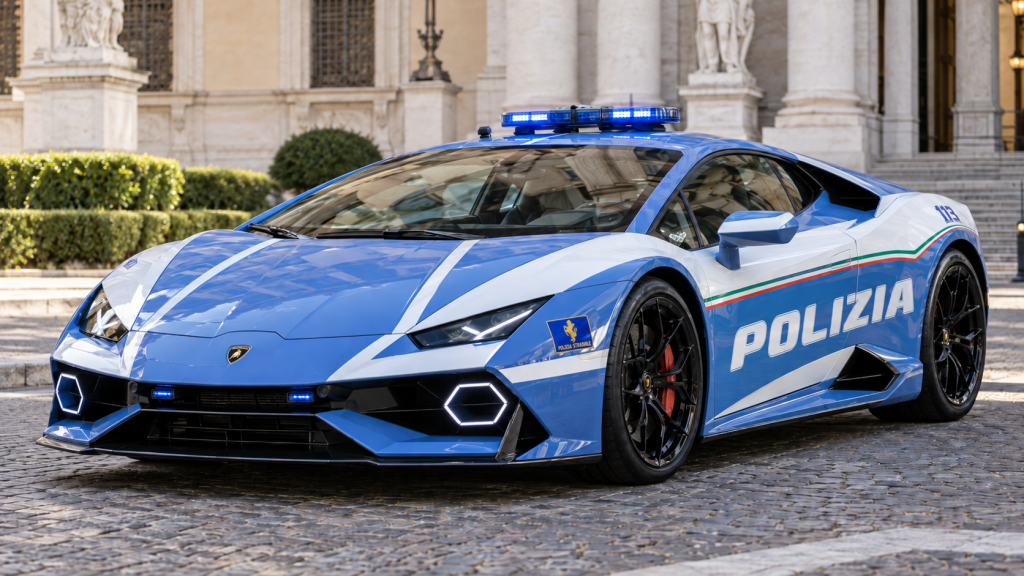
Both reactions are reasonable. Neither holds up for long once you look at what the car has been given to do.
Lamborghini says the Temerario is intended for services the police regard as socially important, and the most concrete of them is the emergency transport of organs and medical supplies. That description comes from the company, and it should be read as such. But it points to a practical purpose that a purely promotional gesture would not need. A publicity car can sit under studio lights. A car assigned to urgent medical logistics has to be dependable and available when it is called on.
The handover also arrives in the middle of an existing story rather than at its start. The Polizia di Stato and Lamborghini have worked together for more than two decades, and the Temerario is the newest car in that line, not an experiment announced out of nowhere. The event at Sant’Agata was less a debut than a renewal: the latest vehicle passing into a program that had already established what such cars are used for.
That continuity changes how the image reads. The instinct is to treat a police Lamborghini as an anomaly, a one-off flourish that briefly embarrasses the ordinary logic of public fleets. The record points to something closer to a habit. Italy’s police have a long-running practice of accepting cars from the country’s most famous performance maker, and the work attached to them has included tasks far removed from what most people imagine when they see a supercar in police livery. For the Temerario in particular, the announced role centers on medical transport rather than pursuit or enforcement. That is the role this article follows, and it makes no claim about every vehicle in a program that spans twenty years.
There is still a reason to single out the Temerario, and it lies in the car itself. Lamborghini’s newest generation is built around a hybrid powertrain, a departure from the engines that once defined the brand’s public image. Each earlier police Lamborghini reflected whatever the company happened to be building at the time. Seen that way, a police Temerario is a small measurement of where Lamborghini stands in 2026, and of how the institution receiving its cars has moved along with it.
None of this makes the sight of the car any less startling, and there is no need to pretend otherwise. The strangeness is real. It is simply the least interesting thing about the story.
The better question is what kind of machine the Polizia di Stato has just been given, and what its engineering says about the work it is meant to do. That begins with what sits behind the seats.
What Hybrid Power Changes for Lamborghini
The mid-mounted engine is unlike the Lamborghini of popular memory. The core is a new 4.0-liter V8 fitted with two turbochargers, and it does not work alone. Three electric motors share the load, and together the system produces 920 CV (about 907 hp), or 677 kW in the metric unit engineers increasingly prefer.
The combination matters more than any single number. A twin-turbo engine draws its strength from forced air, compressing the intake charge so that a compact displacement can behave like a much larger one. Electric motors contribute differently. They are generally valued for how quickly they respond, a useful trait beside an engine that relies on turbochargers. What that means in this car depends on how Lamborghini has calibrated the system, and the details of that calibration belong to its engineers, not to an outside observer.
The performance figures published by the company give a sense of the ceiling. Lamborghini lists 0–100 km/h in 2.7 seconds and a maximum speed of 343 km/h. They are official specifications, useful for placing the car among its peers. They are also figures about capability under controlled conditions, and they say nothing about how the car is used once it is assigned to police duty. A public road is not a test track, and nothing about the Temerario’s paper performance implies that anyone will ever approach its limits behind the wheel of a state vehicle.
The more revealing shift is philosophical. For a long stretch of its history, Lamborghini’s reputation rested on large, naturally aspirated engines, the kind whose noise and drama were half the point of owning one. The hybrid Temerario represents a different bargain. Combustion remains central, and the V8 is still the heart of the car, but it now shares the work with electrification. The company is not abandoning the emotional appeal of the brand. It is rebuilding how that appeal is produced.
That transition carries weight for a police vehicle in a way it would not for a private buyer’s weekend car. An institution that adds a Lamborghini to its fleet is, in effect, choosing a moment in the manufacturer’s development. Earlier cars in the police program came from earlier chapters of the company’s engineering. This one comes from the chapter in which Lamborghini decided that the future of its supercars would be hybrid. The handover therefore records more than a delivery. It shows that the relationship between the Polizia di Stato and the manufacturer has kept pace with the manufacturer’s own direction, instead of settling into a museum piece frozen at a single era.
It would be easy to oversell the connection between engineering sophistication and the specific job the car has been given. Urgent medical transport does not require 343 km/h, and no serious argument for the program should depend on it. What a current-generation car offers is narrower and more plausible: a vehicle from a line the manufacturer is actively developing, not one it stopped thinking about long ago. Whether a given mission ever tests the powertrain’s limits is a separate question, and the record gives no reason to assume it does.
A new generation also brings unfamiliar questions for everyone who handles it. A hybrid supercar is a different object from its predecessors in how it is driven and looked after, and how the police version is prepared is not something this article can speak to. The technology has changed, and institutions rarely take on such changes lightly.
Which returns to the puzzle the handover poses. A police force does not usually accept a new generation of a company’s most extravagant product on impulse. It does so when a relationship already exists, and when earlier cars have given both sides reasons to continue. The interesting question is how long that relationship has existed, and what it has actually produced.
A Relationship Built One Car at a Time
The answer starts in 2004. That year Lamborghini delivered a Gallardo to the Polizia di Stato, the first car in what would become a long series. In September of the same year, that Gallardo carried out an organ-transport mission, and the program had its first documented use of a kind it would keep returning to.
The early history matters because it shows the direction of travel. The partnership’s first recorded activity was a medical task, and the rest grew around it.
From there the record moves by model rather than by date. A later Gallardo, the LP 560-4, joined the story, and the Huracán followed. Each represented a newer generation of the company’s cars, and each passed into the police program in turn. The sequence suggests renewal rather than a single fixed vehicle kept in service for as long as it would run. As Lamborghini’s range changed, the police relationship changed with it.
The next step was less predictable. In 2023 the Urus Performante entered police service, and it is a very different kind of Lamborghini from the mid-engined coupes that came before it. It is a high-performance sport utility vehicle, larger and more practical in its proportions. Its arrival shows the partnership was never tied to one body style or one image of what a police Lamborghini should look like. The Temerario, arriving in 2026, adds another chapter to a list that already includes both shapes. Lamborghini’s material does not suggest that every car was given identical duties, and it would be a mistake to assume so. What the record supports is a shared thread of public-service work, not a single uniform job description.
Three years separate the Urus Performante’s entry into service from the Temerario’s presentation. That is a short interval against the two decades behind it, and it suggests a program refreshed on the manufacturer’s own cycle of new models instead of one revived for occasional anniversaries. Whether the Urus Performante remains in daily use is not something the public material settles, and this article does not guess.
Two totals give the thread its weight. Lamborghini reports that its police vehicles have taken part in more than 200 organ-transport missions across Italy. Over more than two decades, that is a substantial body of work, and it changes the reading of any single delivery. A one-off gift would not accumulate a record of this kind. Repeated use over many years implies working arrangements that both sides were willing to sustain, though the public material does not describe their details.
Both totals come from the company rather than from an independent audit, and they are best read that way. The public material does not explain how a mission or an initiative is defined, so the numbers cannot be pressed too hard. Even so, the scale of the claim is worth registering. “Across Italy” implies work that was not confined to one corner of the country, and a tally that reaches into the hundreds implies a program used often enough to leave a record, not one wheeled out for ceremonies.
The second figure looks in a different direction. The company also cites more than 1,500 road-safety education initiatives in which these cars have taken part. The specifics of those events are not spelled out in the material available, so they should not be embroidered. But the number says something about how the cars are used away from urgent medical work. Their unusual appearance, which makes them look almost out of place in a photograph, may well explain part of their usefulness in that setting, since a car people notice is a car that can help hold an audience’s attention. The material does not say so directly, which keeps it an observation rather than a finding.
Taken together, the two numbers describe a program with two faces. One is quiet and urgent, tied to the movement of organs and medical supplies. The other is public and educational, tied to the everyday task of persuading road users to take care. A headline number can flatten a great deal of variation, and here it should be read carefully. Not every mission is the same, and nothing in the record suggests that any of them was carried out at the limits of a car’s performance. The figures measure participation and continuity. They do not measure speed.
That is what makes the 2026 handover read differently. Seen alone, a police Temerario looks like an extravagant gesture. Seen at the end of a line that began with the Gallardo in 2004, it looks like the next entry in a ledger that has been kept for more than twenty years. The surprise is how ordinary the arrangement turns out to be in the context of its own history.
What remains unexplained is the logic underneath. Public bodies do not usually reach for the most extreme cars in a manufacturer’s range to do careful medical work. Understanding why this one does requires looking at what the job actually asks of a vehicle.
Reliability First, Spectacle Second
Popular imagination has a ready-made script for a Lamborghini in police hands: a siren, an empty road, a driver running out of options. Film and video games have rehearsed it so often that it seems to come attached to the badge. It also sits badly with what has been announced for the Temerario. Its stated role centers on carrying organs and medical supplies, and that is the job this section examines. It says nothing either way about how earlier cars in the program were used day to day, and it should not be stretched to cover them. A chase is about catching something. A transport run is about delivering something, and the measure of success is arrival.
The word that matters in that description is urgent, and it deserves care. Urgency does not convert automatically into speed, and a fast car does not convert automatically into a better outcome for a patient. On public roads the usable margin is set by traffic, weather, road layout and the rules under which officers drive, and none of those is determined by a spec sheet. How a given mission is driven belongs to the officers’ training and the regulations that govern them. The public record details neither, and it would be wrong to fill the gap with guesses.
So what does an exotic car contribute? The defensible answer is modest and mostly about margin. A car engineered for high performance is built to be driven hard and to stay composed while doing it, and that engineering can give a driver more options in ordinary situations: room to accelerate cleanly onto a fast road, braking that matches the car’s pace, a chassis that does not complain when asked for a quick change of line. These are general properties of the category, not documented features of this particular vehicle, and they are worth stating precisely because they are unglamorous. They describe a car that behaves predictably under load, not one that simply goes faster than everything else.
Readiness is the other half. Time-sensitive work is rarely about the drive alone. It depends on a car being checked and available, and on the people who use it knowing it well. Those are ordinary, almost dull requirements, and they are exactly the ones a flashy vehicle is easily assumed to fail. That an arrangement has persisted across several generations of Lamborghini models suggests they have been met often enough for it to continue, though the public record does not describe how.
Reliability belongs beside that. A vehicle assigned to time-sensitive work has to start, run and arrive when called on, and a manufacturer that treats its cars as engineering products has reasons to care about that beyond any police program. Repetition matters too. A relationship that stretches over many missions gives both sides the chance to learn what the job asks for, which is a firmer basis for trust than any single vehicle’s specifications. “Purpose-built” would overstate what the record shows. “Purposefully assigned” does not.
Visibility complicates the picture in an interesting way. A police Lamborghini is impossible to overlook, and that presence plausibly helps on the road-safety side of the program, since a car people want to photograph is a car they may stop to listen beside. On a medical run, conspicuousness is a different matter, and nothing in the record suggests it is the point. The cars do both jobs because they are the same cars. It is an unusual property for a public asset. The thing that draws a crowd at a road-safety event is also what is used, on other days, to carry something that cannot wait.
A supercar in public service also carries a burden that a conventional sedan does not. Every appearance invites the question of whether the money and the attention are justified, and a state body cannot answer with a shrug. The answer on offer is the record itself, which is why it matters that the program began with a medical mission and not a ceremony.
Set that against ordinary ownership. For most owners a Lamborghini’s engineering serves pleasure: weekends, the occasional long drive, an object admired in a garage. There is nothing wrong with that, but its ends are private. The police program redirects the same engineering toward a public purpose and hands a marque built on excess a job defined by restraint. The car’s ceiling stays where it is. What changes is who benefits from having it.
That such an arrangement exists at all says something about the country in which it developed. In Italy, high-performance cars have rarely been treated only as private indulgences. They are industrial achievements, regional pride and export goods at once, and a state institution accepting one from a maker down the road is arguably easier to imagine there than elsewhere. Italian high-performance cars occupy a place in the national imagination that makes the Polizia di Stato’s choice legible instead of eccentric. To see why, it helps to leave the police fleet altogether and look at the culture around it.
Where Italian Supercars Live Beyond the Factory
Sant’Agata Bolognese is not a large place, and that is part of the point. Lamborghini has been based in the village since its founding in the 1960s, in the flat, densely worked country around Bologna and Modena, where several of the world’s best-known performance-car makers sit within a short drive of one another. Engineering knowledge in that region is not concentrated on a single campus. It lives in workshops, supplier firms and families who have spent generations near the same assembly lines. A carmaker there is less a distant corporation than a neighbor and an employer, which colors how the country talks about what it builds.
That local pride feeds a broader national habit of treating certain cars as accomplishments instead of mere products. A performance car built in Emilia is discussed in Italy much as a fine piece of craft might be elsewhere: as the result of skilled hands and inherited technique, with a certain pride attached.
Supercars leave the factory and live several lives. Some go to collections and museums, where they are looked at behind ropes. Some enter institutional fleets, as the police cars have. Most end up in private hands, on roads and in garages, where the relationship is the ordinary one between a driver and a machine. A fourth relationship falls between these: the borrowed car, driven for a weekend or an afternoon by someone who neither owns nor merely admires it.
Nowhere in Italy does that spectrum show more clearly than in Milan. The city is built around business, design and fashion, and it receives a steady flow of international visitors for trade fairs and fashion weeks, where displays of taste are part of the commercial routine. High-end cars are a natural part of that display. Milan is not a motoring city in the way Emilia is. The cars are made elsewhere, and Milan is where they are seen, photographed and, for a few days at a time, driven by people who do not own them.
The city’s relationship with performance cars is older than its current fashion-week image. Milan has long been where northern Italian industry does its business and shows its products to the world. A car built on the Emilian plain becomes part of Milan’s public life not by being made there but by being placed there: parked outside a hotel during a trade fair, photographed beside a design showroom, noticed on a street that was laid out long before anyone imagined it.
For those without a garage of their own, that borrowed relationship has become a recognizable corner of the city’s car culture. The market for exotic car rental in Milan sits at the meeting point of a city that hosts business travelers and design-week visitors and a local appetite for well-made cars.
It is worth separating that world from the one the police Temerario inhabits. The police car is an institutional asset with a defined purpose and, as far as the record shows, a defined operating context. A civilian Lamborghini, owned or borrowed, answers to no mission beyond its driver’s wishes. The engineering underneath can be shared. The reasons for using it are not.
The nature of those civilian encounters is also shifting as the cars themselves change. The Temerario is a model in Lamborghini’s regular range, with published specifications, and its pairing of a twin-turbo V8 with electric motors marks a break with the brand’s older image. Lamborghini’s engines were long sold as much on how they sounded and felt as on how quickly they moved the car, and a hybrid system changes what a driver hears and feels through the seat. The V8 is still at the center, but the balance of what makes the car feel like a Lamborghini has shifted. Whether buyers and borrowers embrace the change is for the market to settle. For a police service, the question is far less pressing, because a working vehicle is judged on whether it does its job. What the police Temerario shows is only that an institution dealing with Lamborghini has accepted the new arrangement.
Access to current Lamborghini road cars, for those who do not buy one outright, runs through arrangements such as Lamborghini rental in Milan, in which a driver takes a car for a fixed period. Which models any provider offers at a given moment varies, and the police Temerario is not among them, since it belongs to a state fleet and a defined purpose. The comparison is useful only for the contrast it draws: one Lamborghini exists to be enjoyed by whoever holds the keys, another exists to be used for a task.
Milan, however, is only one of the places where this culture lives. Its cars are made in Emilia, seen in the north, and yet the institutions that govern the police sit elsewhere. Following the story to its next city means leaving the fashion district behind for the capital.
Rome, and Back to Sant’Agata
Rome relates to the story differently. It is the seat of national government, the level at which the state police answer, and its streets are an inheritance of centuries that predates the engine by a very long margin. Performance cars are visitors there more than natives. They arrive through owners, through collectors and through the ordinary market, which includes car hire in Rome for those who want a particular car for a short stay. The contrast with the north should not be pushed too far. Rome has its own enthusiasts and its own car culture, and it simply has no supercar factory to point to. What it has is institutional weight, the kind that turns a manufacturer’s gesture into a public arrangement.
The geography of the story becomes clearer from that vantage. The cars are engineered in Emilia, admired in Milan and answerable, in the end, to institutions seated in Rome. Few products travel that route. A supercar that begins as a commercial object and a cultural one can, in Italy, end up on the books of a state service without anyone treating the passage as strange.
Return, then, to the photograph that opened this story: a hybrid Lamborghini in police livery, absurd at first glance. Its absurdity has a shorter shelf life than it appears. The first police Gallardo was delivered in 2004 and carried out an organ-transport mission in the same year. More than two decades later the program includes a road-safety record, an SUV in the lineup and a growing list of missions across the country. The spectacle is real, but it is a byproduct. What the Polizia di Stato appears to value is a car it can rely on for a specific kind of work, and Lamborghini has supplied a succession of them.
What changed between the Gallardo and the Temerario is the engineering. Combustion now shares the work with electric motors, and the brand’s identity is being rewritten in public. What has visibly continued is the medical-transport work that opened the program and that the newest car is announced to share. The story crosses boundaries that usually stay separate: a private company’s engineering, a national fondness for fast cars and a state institution’s routine business.
The first police Lamborghini to carry an organ did so in September 2004. The newest was presented in September 2026. Between those two Septembers the engines were replaced, the body styles multiplied and the technology turned hybrid, while the medical thread was there at the start and is still there.