
From the Grand Prix to the Yacht Show: Inside Monaco’s 2026 Luxury Season

The content of this material is informational and educational in nature and cannot be regarded as financial advice. It is extremely important to conduct an independent analysis before any financial transactions. If you are not sure about financial matters, it is strongly recommended to seek the advice of an independent expert.
The Arithmetic of Two Square Kilometres
Monaco covers roughly two square kilometres, and very little of it is out of sight of something else. A tunnel that carries Formula 1 cars for one weekend a year carries taxis and delivery vans for the rest of it. The road along Port Hercule that becomes a pit lane in June is, on an ordinary Tuesday, somewhere people leave a car and walk to work. There is no district to retreat to, no industrial edge where the loud or the large can be kept apart from the residential and the commercial. Whatever Monaco does, it does in the middle of itself.
That compression is the starting point here, and the 2026 calendar tests it twice. The Formula 1 Monaco Grand Prix ran from 5 to 7 June, with the race on Sunday the 7th. The 35th Monaco Yacht Show followed from 23 to 26 September, centred on Port Hercule. Both events draw on the same roads, the same harbour, the same hotels and a similarly international crowd.
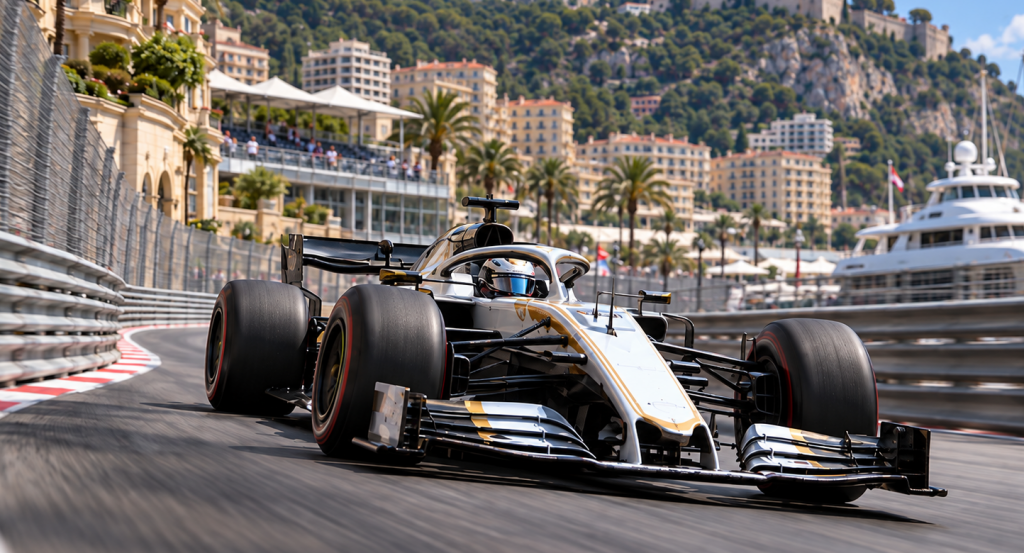
They are not the same kind of event, and treating them as interchangeable would blur what makes them worth examining together. The Grand Prix is a round of a sporting championship. Its shape is set by practice, qualifying and a race, and its central objects are single-seat cars that exist to be measured against one another over a fixed distance. The Yacht Show is a trade and client event for the superyacht industry. Shipyards, brokers, designers and management companies attend it to do business, and the vessels along the quays are there as products, as evidence of a builder’s work, or as assets under discussion.
The two also occupy time differently. A race weekend builds through its sessions toward a single afternoon, and anyone can say exactly when it ended and who won. The Yacht Show is four days of appointments, inspections and introductions whose outcomes are contracts and negotiations, many of which will not surface publicly for months, if they ever do. One event produces a result. The other produces a pipeline.
What connects them is subtler than a shared price bracket. Each takes activities that Monaco already contains all year and raises them to a pitch at which they cannot be overlooked. High-value machinery is part of daily life in the principality. International visitors arrive in every season. Private transport, by road or by sea, is woven into how people move and meet, and hospitality operates at a scale that such a small territory would not otherwise suggest. The events do not introduce these things. They gather them, for a few days, into a form that a resident, a visitor or a camera can take in at once.
The gathering is physical before it is anything else. In June, streets that normally carry commuters, residents and coaches become part of the racing circuit. In September, the central space of the Yacht Show is not an exhibition hall at the edge of town but the harbour itself, with vessels lined along berths that boats use throughout the year. Most major sporting and trade events happen inside grounds built for them, with perimeters, car parks and a margin of distance between the event and its surroundings. Monaco offers very little of that margin.
It also helps to be exact about what “machine” means in each case. A Formula 1 car is a competition tool built to a technical regulation. A road-going Lamborghini is a consumer product designed to be driven legally among other traffic. A 60-metre yacht is a vessel whose functions may include private use, professional operation, sale and charter. All three are expensive, but they answer different needs, and much of what follows depends on keeping them apart.
The sequence follows the calendar. June comes first, and with it an arrangement most sports never attempt: a world championship staged not on land set aside for the purpose but on the streets of an inhabited place.
Borrowed Tarmac
The circuit is assembled rather than built. In the weeks before a race weekend, barriers, catch fencing, grandstands and temporary structures go up along roads that must be returned to ordinary use afterwards. It is the reverse of how a permanent racing complex works, where the surface, the pits and the spectator terraces are designed together and stay in place. In Monaco the road already exists for other reasons, and the race is fitted around it. The corner at Sainte-Dévote, the climb toward Casino Square, the run through the tunnel and the sweep along the harbour front all have day jobs. Between 5 and 7 June 2026 they were given a second one.
The result is a set of dimensions that rarely belong to motor racing. Purpose-built circuits are generally laid out with wide margins for error. Monaco’s barriers stand close to the racing line because there is nowhere else for them to stand. The streets follow a hillside town that took its shape long before the first Grand Prix in 1929, with gradients, blind crests and tight corners that reflect the pace of ordinary traffic. The layout has been adjusted over the decades, but its essential route, from the harbour up to the casino and back down again, has been kept. Safety infrastructure has been added around a course that was not designed with it in mind.
Even the surface belongs to another purpose. Drivers here deal with tarmac laid for everyday traffic, with the camber, drain covers and painted markings that implies, rather than a track engineered for grip and drainage. Formula 1 cars are built for extreme speed and cornering loads, and the narrowness is a large part of why qualifying carries such weight in Monaco: overtaking is hard, so grid position counts for a great deal. That is a point about geography rather than results. The outcome on 7 June matters less to this argument than the place where the race was run.
A Formula 1 car has no business in normal traffic. It is not road-legal, and the streets it uses in June are, for most of the year, shared by buses, scooters, taxis and pedestrians. During a race weekend the arrangement inverts. Everyday vehicles are excluded or rerouted, and the racing machines become the only traffic. The inversion is total but temporary, and the temporariness is the point. The car is not adapted to the city, and the city is not permanently adapted to the car. A short, heavily managed suspension of the usual order lets one pass through the other. Outside the weekend the same roads return to speed limits, junctions and pedestrian crossings, and the circuit survives only as a route that residents happen to know.
Proximity determines who sees what. At a permanent circuit, a spectator is usually separated from the machinery by fencing, gravel and distance, seated in a stand facing one section of track. In Monaco the boundary between the race and its surroundings is thin. Buildings rise directly above the road. Hospitality terraces overlook corners. The harbour lies beside the start-and-finish area, so that cars, pit facilities and water sit in a single view. Because the surrounding structures double as viewing points, the town behaves like a large, unplanned grandstand, and the cars are seen against apartment blocks, shopfronts and moored boats rather than an empty horizon.
That is why the setting counts for as much as the machinery. Racing cars are technically the same wherever they run. What changes here is how their speed is perceived. A car passing a few metres from a building façade communicates velocity in a way that a car crossing open ground does not, and the closeness of hotels, terraces and boats makes that perception part of what the event offers. The value of the Grand Prix to Monaco cannot be reduced to the presence of expensive cars. It lies in a physical arrangement that shows them at close range in a place that remains recognisable as a town.
When the barriers come down and traffic returns, the racing cars leave with their teams. Other high-value machines do not. Some belong to residents, some are parked outside hotels, some have arrived from elsewhere on the coast, and none of them is competing with anything. June is only one concentration. In September a different kind of expensive object gathers at another point on the same small map, along the edge of the harbour that the Formula 1 cars had used as a backdrop.
A Harbour Turned Trading Floor
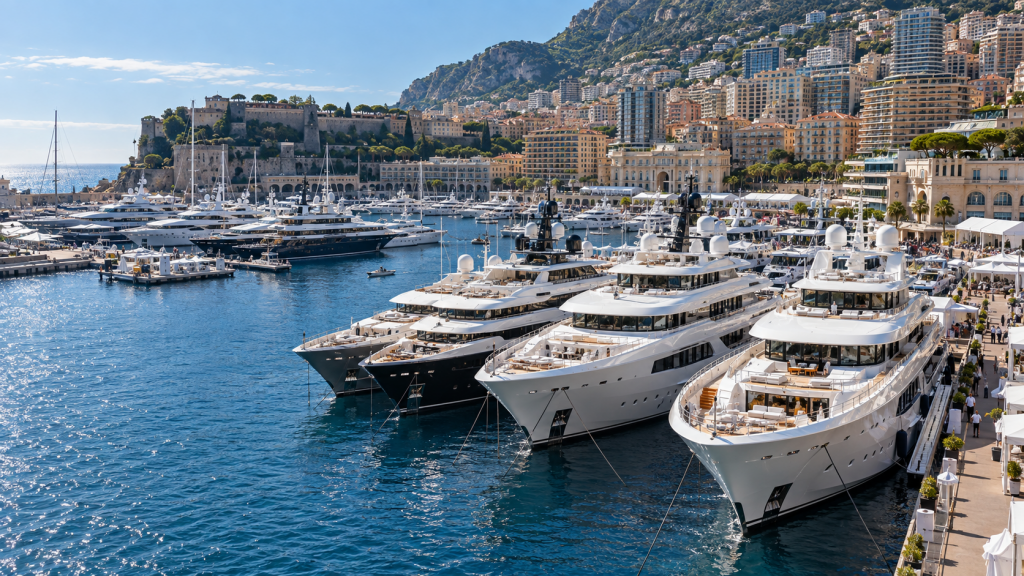
When the Yacht Show opened in Port Hercule on 23 September, the harbour changed scale. Formula 1 cars are compact objects moving fast through a corridor. Superyachts are very large objects that scarcely move. The 35th Monaco Yacht Show, which ran until 26 September, listed about 120 superyachts, a term usually applied to professionally crewed yachts above roughly 24 metres. The effect on the harbour was the opposite of the June race: mass occupying space, rather than speed passing through it.
The exhibitor count deserves as much attention as the fleet. More than 560 exhibitors were listed, several times the number of yachts. A show that consisted essentially of boats on display would have no use for that many companies. The ratio points to activity that happens off the water: shipyards, brokers, naval architects and designers, yacht management companies, refit specialists, and the providers of the many services a large vessel requires throughout its working life.
One figure needs careful handling. In July, the official fleet announcement stated that 43 of the yachts then listed were 2026 deliveries. That means the vessels had been handed over by their builders during the year. It does not mean they were unveiled at Monaco, and it does not mean they were launched for the first time in the harbour. A delivery is the moment a yacht passes from builder to owner. A premiere is a decision about when a vessel is first shown to the public. The two can coincide but need not. What the figure does indicate is that a substantial part of the listed fleet had been finished recently, which in an industry where construction is measured in years says something about the pipeline feeding the show.
It would be a mistake, then, to treat the event as a harbour full of expensive boats arranged for onlookers. Its function is professional and commercial. Construction, purchase, brokerage, charter, design, management, refit and specialist services all meet there, and a yacht on a berth is a product under examination as much as an object of admiration. For a builder, the show places a finished hull in front of clients who would otherwise have to travel to a shipyard. For a broker, it is a place to meet buyers and sellers. For a designer, it is a way of being seen by both. That is a different logic from a festival, even when the two share a waterfront.
The logic rests on inspection. A large, customised, movable asset is difficult to judge from photographs and specifications. Layout, materials, noise, finish and the way spaces relate to one another become clear only in person. Assembling many vessels in one harbour lets a client compare in a day what would otherwise take weeks of travel between shipyards and marinas, and it lets the companies behind those vessels compete for attention in the same place. The show’s own materials describe it in their own terms, but the underlying function is plain enough: it is a marketplace that has to happen physically.
That physical requirement shapes the audience too. A Grand Prix crowd is mixed, from people who have followed the sport for decades to those attending for the occasion. A yacht show’s core audience is narrower and more purposeful, made up of people who build, sell, manage, crew or are considering buying vessels, together with the specialists who support them. Many will be in Port Hercule for professional reasons that have little to do with being seen there. What outsiders read as display is, for those inside the industry, largely a working week.
The objects in that marketplace are mobile, which is unusual for assets of this value. The buildings around Port Hercule do not travel, while the yachts inside it arrive by sea, are inspected, and leave. That mobility means a temporary market can in principle be assembled wherever there is deep water and enough berths. That it gathers in Monaco depends on other things: the proximity of clients, the hotels, the harbour infrastructure and an existing concentration of yachting expertise. For a few days each September, a small harbour holds a large number of very expensive vessels together with the people who build, sell and manage them.
Most of those vessels depart within days of the show’s close. Cars are different, and the road-going counterpart of what happens in the harbour is a permanent feature of the principality rather than a four-day event.
What Stays on the Road When the Barriers Come Down
Formula 1 leaves Monaco with its barriers. The cars that remain fall into different categories, and the distinctions blur when everything is filed under “expensive.” A Formula 1 car is a single-seat competition machine, built to a technical regulation and not permitted on ordinary roads. A supercar is a road-legal, low-volume performance car, designed around acceleration, handling and visual presence. A grand tourer, or GT, prioritises covering long distances quickly and comfortably, trading some agility for composure. A large luxury saloon or SUV is about space and refinement, and is often driven by someone else. Beneath all of these sits ordinary private mobility: small cars, scooters, taxis and buses moving through streets laid out for a slower age. Each category has a job. The confusion arises only because they share a road.
The road network sets the terms. Monaco’s streets are short and steep, interrupted by junctions, tunnels and pedestrian crossings, and governed by urban speed limits. A car capable of very high speeds can go a long time without a stretch on which it could approach them. That does not make performance cars irrelevant here, but it changes what they are for. In this setting their engineering is experienced through sound, response and design rather than pace, and their role is closer to personal transport with character than to sport.
Geography matters too, and precision helps. Monte-Carlo is one district of Monaco, the one around the casino and its neighbouring hotels, not a synonym for the whole principality. Monaco also includes Monaco-Ville on the Rock, La Condamine around Port Hercule, Fontvieille and Larvotto. Cars are most conspicuous in Monte-Carlo because the casino square and the large hotels put vehicles in front of the most onlookers, but they circulate throughout the territory and across the border into the neighbouring French communes, with Italy further along the coast. The wider region, the French Riviera, is where much of that movement begins and ends.
Movement across that border is not only a matter of visitors. Many of the people who work in Monaco live in the surrounding communes, so the principality’s roads carry a daily flow of ordinary commuting alongside its more conspicuous traffic. The ordinary and the exceptional vehicle use the same tunnels and the same junctions, at the same hours. A Ferrari and a delivery van are, for the purposes of the road network, both simply waiting their turn.
Event periods intensify all of this. When a large number of visitors arrive in a short window, whether for the Grand Prix in June or the Yacht Show in September, demand for movement rises, and so does the share of vehicles that are present only temporarily. Some of the exceptional cars seen in event-heavy weeks are driven in from elsewhere on the coast. Others arrive through short-term hire, and luxury car rental in Monaco is best understood as one of the ways in which the visible fleet expands and contracts with the calendar. It is a logistical fact about a compact place with a large seasonal audience, and it tells us more about how the streets fill than about any single vehicle.
None of this connects road cars to the race itself. The machines on the circuit belong to Formula 1’s teams and are run and regulated entirely within the championship. Nothing that can be bought or hired for the road has a place in that system. The cars that occupy Monaco outside the race weekend inhabit a separate, everyday economy that happens to use the same tarmac.
They do carry a particular cultural weight here, and that weight has a history. The principality’s motoring associations include the Grand Prix, first run in 1929, and the rally that carries the name of Monte-Carlo. A performance car arriving at a hotel entrance is therefore read against a background that few other places can supply, even though the car’s actual purpose has nothing to do with racing.
A Lamborghini makes the distinction concrete. Whether it is owned outright or arrives through Lamborghini rental in Monaco, it is a road-legal product, built to meet emissions and noise limits, pass crash-safety requirements, tolerate traffic and be started and driven by someone who does not have a team of engineers behind them. A race car is built around lap time within a rulebook. Even road models with a strong competition heritage are engineered for public roads, and their relationship to motorsport is one of styling, marketing lineage and inspiration rather than equivalence. The Formula 1 grid and the hotel forecourt hold different kinds of object.
The question of who gets access to such objects has a second, larger version in the harbour. A road car can be owned or hired. A yacht of significant size involves several more layers, and it is the harbour, after the show has ended, that shows how they work.
After the Berths Empty
The show lasts four days, and the harbour carries on afterwards. Port Hercule is a working harbour used throughout the year, with a smaller one at Fontvieille. September is exceptional in the number of large vessels present, but not in kind. Superyachts are part of the coast’s ordinary traffic, and Monaco sits on a stretch of the French Riviera where moving between harbours by sea is routine: Cap-d’Ail, Villefranche-sur-Mer, Antibes and Cannes to the west, and Italian ports to the east.
The show is one moment in a longer chain of activity, and the stages of that chain are easy to conflate. Viewing is inspection, whether at an event or on a berth by appointment. Buying usually means acquiring an existing yacht through brokers, who represent buyers or sellers and handle negotiation, survey and paperwork. Building, or commissioning, means contracting a shipyard to construct a new vessel, often to a designer’s plan and an owner’s specification, over a period measured in years. Brokerage is the intermediary work itself, and it covers sales and charter alike. Management is what happens once a yacht exists: crew, maintenance, compliance and accounts, handled by specialist firms on behalf of owners who are frequently not involved in daily running.
Seen this way, the 43 yachts delivered in 2026 look different. Vessels finished in one year will generally have been contracted well before, so a show that includes recent deliveries is showing the end of long cycles that began at drawing boards and shipyard contracts. The event sits where that pipeline becomes visible, in a single harbour and for a few days.
A yacht is also a means of transport, and that is what ties it to the rest of the principality’s mobility. It moves guests, and sometimes an owner’s household, between harbours along a coastline where the sea is often the easier route. A vessel berthed in Port Hercule is not necessarily part of any event. It may be waiting between voyages, being prepared for a crew change, or simply in port. The harbour’s traffic follows a logic of its own, and the show is only its most concentrated expression.
Charter operates on a separate track. A vessel shown in Port Hercule might also be chartered, might be offered for sale, or might be present for reasons that have nothing to do with either, and the show itself does not settle which. The market for superyacht charter in Monaco has its own intermediaries, its own seasonal rhythm and its own commercial arrangements, and it functions whether or not a show is taking place. Charter means temporary use of a crewed vessel by someone who does not own it, which makes it a different thing from inspecting a yacht at an industry event, and different again from owning one.
That separation matters because the two audiences overlap only partly. A client at the show may be evaluating a yacht to buy, to commission or to understand, while a charter client is buying time aboard a vessel that someone else owns and operates. The same hull can serve both, but the relationship between the person and the vessel is entirely different. Treating them as one market would mistake the shop window for the shop.
The harbour’s geography gives charter one further dimension. Because Port Hercule lies beside part of the race circuit, yachts berthed there during the Grand Prix weekend sit within sight of the cars, and that proximity is the setting for what is marketed as yacht charter during the Monaco Grand Prix. It is an example of one event’s setting reaching into another sector. Yacht charter on the French Riviera as a whole follows a wider pattern, in which Monaco is one link in a chain of harbours, distinguished less by any claim to priority than by its position, its facilities and its concentration of services.
Those services matter. A large yacht is a vehicle that depends on shore support: fuel, provisioning, technical maintenance, crew accommodation and berthing. Cars, of course, draw on roads, garages and fuel. When a vessel is refitted, managed or supplied from Monaco, it draws on the same small territory that supports the cars and the hotels, and the demands on berths, on staff and on space build on one another.
That accumulation returns us to the underlying puzzle. The activity in the harbour and the activity on the roads draw on the same limited pool of land, staff and buildings. The remaining question is how so small a place ends up as the point where so much automotive, marine and hospitality activity collects.
What a Small Map Makes Visible
The Grand Prix works on public roads partly because the network is small enough to be managed as a single system. Streets can be closed, reconfigured and reopened because there are so few of them and because the authorities can coordinate them. The harbour follows a similar logic. Land rises steeply behind Port Hercule, so that the water is overlooked from streets, terraces and hotel windows above, and a harbour full of yachts is visible from many angles without anyone having to plan a viewing platform.
Hospitality follows the same pattern. Hotels, restaurants and terraces sit within walking distance of both the circuit and the harbour, so the same buildings serve a race weekend in June and a trade show in September. Staff and visitors arrive from the wider coast and across the border with France and Italy, and once inside the principality the distances between an event, a meeting and a bed are short. Compression applies to people as well as objects.
The calendar adds repetition. Because the same infrastructure is used for different purposes at different times, the arrangement is rehearsed. The roads, the harbour, the hotels and the service industries know how to expand, absorb an audience and return to normal. That practice is itself a form of infrastructure, and it is harder to reproduce than a building.
Within that system the machines keep their separate roles. The Formula 1 car is a competition machine. A Lamborghini on a public road is private mobility and a consumer product. A superyacht at the show may be a new delivery, a brokerage opportunity, an industry product or a private asset, and a charter yacht is another form of access, temporary use by someone who does not own it. Concentration does not merge these categories. It puts them in one visual field, where an observer may be tempted to read them as one, and the argument here has been that they are not.
Status enters only where it follows from observable behaviour. A car parked at the front of a hotel is seen by everyone who passes, and that is a fact about the setting rather than about the intentions of whoever left it there. Visibility is a property of the place. The density means that any valuable object is likely to be seen by many people, whatever the reason it is there. Some of those reasons are functional, some are professional and some are social, and the geography does not distinguish between them. Signalling wealth may be part of the picture for some people, but it cannot be read off the mere presence of a car or a boat.
That is why concentration explains more than price does. Price describes how much something costs. Concentration describes structure: how activities that normally sit apart come to share one map. Motor sport usually takes place at circuits outside towns. Yacht trading is done at shipyards and marinas along a coast. Hospitality clusters in resorts and hotel districts, and private motoring happens on ordinary roads. Elsewhere these pursuits have separate addresses, and their participants rarely see one another at work.
In Monaco, one stretch of harbour front shows the effect most plainly. In June it forms part of the circuit, with pits, grandstands and cars in a single view. In September the yachts of the Monaco Yacht Show are berthed along the same harbour, inspected by professionals and clients who have crossed the same border roads as the race crowd did. In between, it is used by ordinary boats and ordinary pedestrians. Nothing about that arrangement was designed for display. It is what happens when the roads, the water and the hotels are too close together to keep apart, and when the people who follow motor racing and the people who buy yachts can stand in the same spot a few months apart.