
How the 2026 Maxi Yacht Rolex Cup Reinforced Porto Cervo’s Role in Mediterranean Yachting

The content of this material is informational and educational in nature and cannot be regarded as financial advice. It is extremely important to conduct an independent analysis before any financial transactions. If you are not sure about financial matters, it is strongly recommended to seek the advice of an independent expert.
Sixty Feet and Up: A Fleet Assembled to Race
Size is the first thing anyone notices about a maxi yacht and the least useful thing to know about one. The Maxi Yacht Rolex Cup does set a threshold on length: 60 feet, or roughly 18 metres, which monohulls and multihulls alike must reach to be eligible. That figure describes who may enter. It says nothing about what happens once they are on the water.
The 36th edition ran from 6 to 12 September 2026, organised by Yacht Club Costa Smeralda in collaboration with the International Maxi Association, with Rolex as title sponsor. More than 40 yachts assembled in Porto Cervo, six of them multihulls. Racing began on 7 September, and the final prize-giving took place on 12 September. In between, the fleet was not there to be looked at from the quay. It was there to be sailed hard against comparable boats, by crews facing a week of demanding racing with world championships at stake.
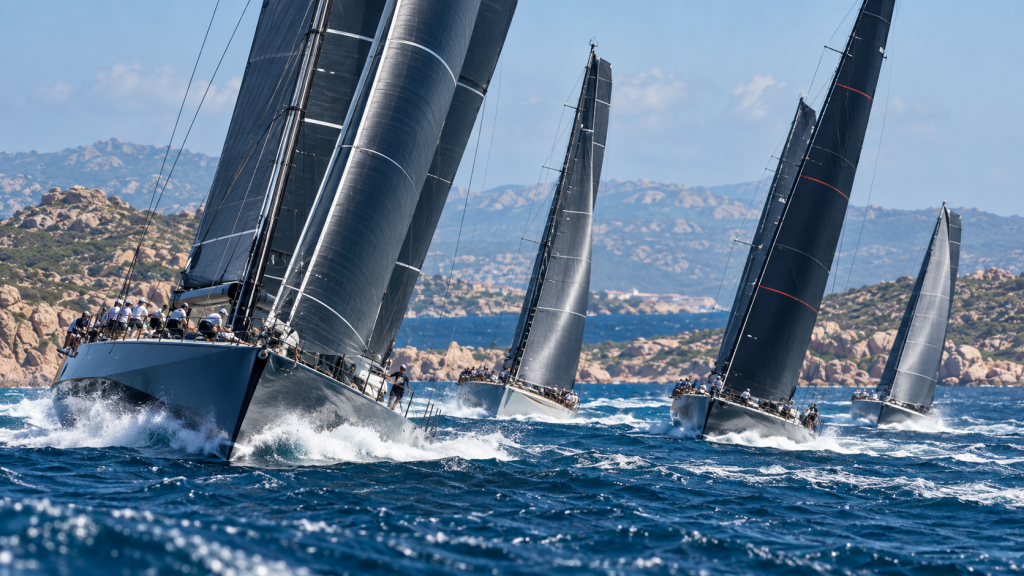
A fleet on this scale is easy to describe in terms of appearance: rigs that tower over the marina, hulls that dwarf whatever is moored beside them. All of that is accurate, and none of it explains why the regatta exists. A maxi event is built around classes, and classes exist so that yachts of similar performance race one another. Organisers are solving a sporting problem: how to put boats of different designs and speeds into fair contests. Not every class sails the same distance, and courses can be set around the performance profile of each division.
The length floor also hides a wide spread. Sixty feet is a minimum, and above it sit boats whose designers had very different aims. Some are conceived around outright speed, with light structures and large sail plans that demand a big, well-drilled crew. Others are built for a more moderate pace. The six multihulls add a further variable, because a boat of that type accelerates and responds to changes in wind quite differently from a monohull of comparable length. Sorting that spread into fair contests is the quiet work behind any maxi regatta, and it explains why results are announced division by division rather than as one league table.
The programme reflects that. Coastal races took the fleet through and around the La Maddalena Archipelago, with course lengths set according to class rather than applied uniformly. Off Porto Cervo itself, the Maxi 1 and Maxi Grand Prix divisions also sailed windward-leeward races, in which yachts sail upwind to a mark, run back down and repeat the lap. The two formats ask for different things. A coastal race rewards navigation and judgement over a long stretch of water. Windward-leeward racing compresses the contest into starts, mark roundings and boat handling with other large yachts close by, where a single poor manoeuvre is costly and visible.
Two world championships were contested within the week, alongside the class titles. The results come later in this account. What matters here is the shape of the week: a demanding, multi-format regatta in which each division was tested on terms suited to it.
The result was a particularly serious segment of international sailing gathered in one small harbour on Sardinia’s north-eastern coast. The harbour has long had a role in the sport, and one week does not create it; what a week like this can do is make that role unusually easy to see. The more concrete question is why this stretch of water suits maxi yachts so well, and the answer begins just outside the harbour mouth.
Reading the Water Between the Islands
A coastal race is only as interesting as the ground it crosses, and the La Maddalena Archipelago gives race committees a lot of ground to work with. Islands interrupt the wind and redirect it. Channels between them can shelter a boat in one place and expose it in the next. A yacht that has sailed a long leg well can lose the gain by choosing the wrong side of an island or committing too early to a passage.
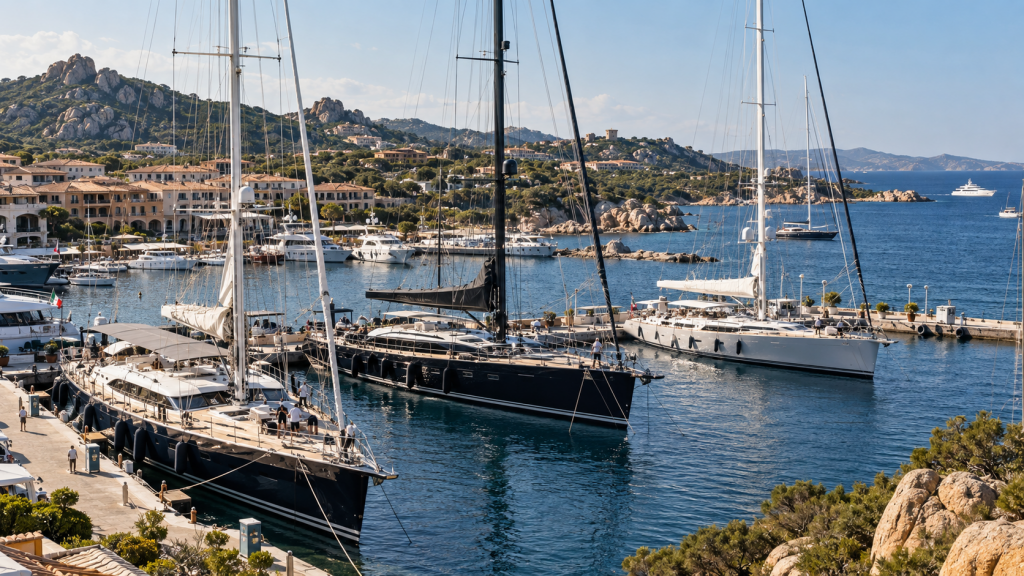
That is why the geography counts as part of the competition rather than a backdrop to it. Navigators and tacticians have to decide where the breeze is likely to hold, where it will fade behind land, and how much distance a shortcut is worth. Local knowledge counts, and so does the discipline to sail the boat rather than the plan when the wind does not match the forecast. Course lengths also differed by class in 2026, so faster and slower divisions were solving different problems over different distances, each set to suit its performance.
Speed compounds the difficulty. The faster a yacht, the sooner it arrives at each decision point and the less time its crew has to weigh a change of plan. A multihull that covers a leg in far less time than a heavy monohull meets shifts and land effects on a different clock, which is one reason the classes are kept apart. Knowing when to commit to a channel, and when to stay in open water with fewer surprises, is the kind of judgement that separates crews sailing similar boats.
Off Porto Cervo the demand changes. The Maxi 1 and Maxi Grand Prix divisions raced windward-leeward courses there, with fixed marks and repeated laps. Navigation matters less on a course that is laid out in advance and sailed several times; what counts is execution. Starts, tacks, gybes and mark roundings come round again and again, and the yachts that handle them cleanly gain a little each lap. Because every boat in a division is on the same short course, gaps are visible and errors are quickly punished. For the largest boats in the fleet, sailing tight manoeuvres accurately is a test of crew coordination as much as raw speed.
The week’s weather meant no single skill dominated. According to official Yacht Club Costa Smeralda reporting, earlier racing took place in lighter winds, with stronger Mistral conditions arriving later in the week and gusts above 28 knots at times. The Mistral is a northwesterly wind, known in Italian as the maestrale, and it is a familiar feature of these waters. Light air rewards smooth sail handling and the ability to keep a heavy yacht moving; a strong breeze puts more load on gear and crew and makes control the priority.
Gusts add their own difficulty. Air that surges and drops is harder to sail than steady air of the same average strength, since trim and steering have to keep adjusting to it. A regatta that runs through both light and strong winds asks whether a boat and its team can be quick in each, not merely in the conditions they prefer.
Race organisers do not build a maxi regatta around a location by chance, and these waters have been used for that purpose for a long time. To see why the class keeps coming back to this coast, it helps to go back to the first time it did.
The Long Line From 1980
The regatta began in Sardinia in 1980 under a plainer name, the Maxi World Championship. The title described the event accurately: a world championship for maxi yachts, staged on the Costa Smeralda, that gave the class a recurring meeting point. Rolex was not part of that first edition. Its title-sponsorship relationship with the event dates from 1985, so the name sailors use now belongs to a later stage of the story, not to the original competition.
The numbers need the same care. The 2026 regatta was the 36th edition, and that is all the figure claims. It counts editions held. It does not promise one in each of the forty-six years since 1980, and nothing in this argument depends on such a promise.
What runs through the whole period is the place. Yacht Club Costa Smeralda remains central to the organisation, with the International Maxi Association collaborating and Rolex in the title role. The arrangement makes sense for a world championship, which needs a body that speaks for the class as well as a club that can run the water. A host club that stages one class of racing over decades builds up things a newcomer cannot acquire quickly. It has race officers used to handling very large boats and familiarity with how the archipelago behaves in different winds. It has a shore base arranged around yachts of this size. Those points are editorial inference, not claims made by the organisers, but they go some way to explaining why a class keeps returning to a venue that already knows the work.
The 2026 edition added a visible piece of institutional memory. A new perpetual trophy was introduced in memory of H.H. the Aga Khan IV, founder of the club. A perpetual trophy passes from winner to winner, so it ties future editions to a single name. The relevance here is narrow. The body that shaped Porto Cervo’s sailing culture still runs its principal regatta, and it marked his memory with a prize designed to outlast any one result.
The sport itself was settled on the water. Leopard 3 won the Rolex IMA Maxi 1 World Championship, and Northstar III won the Rolex IMA Maxi Grand Prix World Championship. Other class winners included Artemis Bleu, Yoru, H2O and Highland Fling XVIII.
The names matter less than the structure they imply. Titles were awarded division by division, each fleet was decided against its own competitors, and the outcome was a set of separate winners rather than one ceremonial champion. Championships decided over a week of racing, in light air and in a Mistral, are also harder to win by luck than a single-day result, because consistency across varied conditions counts as much as one fast race. An event that only gathered impressive boats would have no use for that machinery, and no reason to keep it running across decades of changing yachts.
This is one specialised end of yachting: boats designed, crewed and prepared to be sailed at their limit, with results that count. Sardinia’s waters hold a great many other vessels, and most of them have no interest in a start line at all.
Two Kinds of Yacht on One Coastline
A yacht that races and a yacht that cruises can share a length and very little else. The boats in the Maxi Yacht Rolex Cup are built or adapted for competition, sailed by trained crews, grouped by class and prepared around a regatta calendar. Everything about how they are used follows from the start line. Around them, the same coast supports a different population: private sailing and motor yachts kept for cruising, sailing yachts used outside racing, larger leisure superyachts, and vessels operated commercially for paying guests.
The differences show up in the boats themselves. A yacht designed to race is typically shaped around weight, sail area and crew positions, with accommodation kept to what the regatta requires. A leisure yacht is shaped around the opposite priorities: space, comfort and range for the people aboard. Motor yachts sit outside sailing competition altogether. Two hulls of similar length can therefore be entirely different pieces of engineering, which is why length alone tells an observer so little.
The categories can overlap technically. A performance cruiser may be raced hard one week and cruised the next, and a club regatta will admit yachts that spend most of the season doing something else. What separates the groups is purpose. Racing yachts are organised around rating, crew and result. Leisure yachts are organised around the wishes of the people aboard. A chartered yacht is a further case again, because its owner’s aim is to have it used by others, on itineraries that guests and captain settle between them.
The commercial Sardinia yacht charter market that operates along this coast is a civilian business with its own operators, seasons and expectations, and it works independently of the regatta and of the club that runs it. Taking part in the Cup does not place a yacht on any charter list. A week aboard a chartered yacht is not a version of racing in a world championship, and charter guests are not competitors. The race courses belong to the event while it is running.
Northern Sardinia lets these uses coexist because its geography serves several purposes at once. The archipelago that shapes coastal race courses in September also offers sheltered anchorages and short passages between islands, which suit cruising boats in other weeks. A marina that fills with racing yachts for one regatta serves ordinary summer traffic around it. The racing world and the leisure world share water, and the timetable keeps them largely apart.
Seen from the water, Porto Cervo is one stopping point in a much longer movement of boats through the western Mediterranean each summer, and that wider movement is where the story goes next.
Sardinia as a Junction
Where Sardinia sits explains much of its use. The island lies in the western Mediterranean with Corsica a short passage to the north, the Tyrrhenian Sea to the east, and the Balearic Islands, southern France and the Italian mainland all within reach of a summer’s cruising. The north-east corner, around Porto Cervo and the La Maddalena Archipelago, is the part nearest to that traffic. The Strait of Bonifacio separates it from Corsica, and a yacht moving between the French Riviera and the southern Tyrrhenian can reasonably route through it, making a stop here a natural part of the passage.
Yachts do not all follow one pattern. Some vessels are based in the Mediterranean and move with the season. Others arrive for a single summer. Many never come near Sardinia, spending their weeks along other coasts entirely. The narrower claim is that this corner of the island is one of the places where several kinds of activity gather, each for different reasons.
Timing differs as well. For much of the leisure fleet, the core of the Mediterranean season is the summer, when passages along the coast and between islands are most comfortable and many boats spend their weeks moving between anchorages. Racing follows a separate logic. Regattas are placed in the calendar by class associations and host clubs, and the Maxi Yacht Rolex Cup’s September dates put it after the height of the summer season.
Racing yachts come for a date and a race area, and their presence is short and concentrated. Private cruising yachts use the same water differently, taking short hops between islands and sheltered stops with no schedule beyond the weather. The larger leisure segment, motor yachts and sailing yachts of substantial length used for time afloat rather than results, spends part of the season around this coast too. Some of these vessels are used privately. Others are operated commercially, and the market for superyacht charter in Sardinia draws on that pool of larger leisure boats. It has its own operators and seasons and no link to the regatta, and it says nothing about who competed in September.
The calendar shows how these uses fit together. Once the Maxi Yacht Rolex Cup finished on 12 September, Porto Cervo did not go quiet. The 23rd Rolex Swan Cup ran from 13 to 19 September, and its timing coincided with the 60th anniversary of Nautor Swan. Official Yacht Club Costa Smeralda reporting described a record fleet of approximately 170 Swan yachts. The event is a separate regatta with a different character, built around a single marque and its owners, and it deserves its own account. Here it matters for one reason: two major international regattas following one another in the same harbour meant two weeks of serious competition back to back.
The picture that emerges is of a place where different kinds of yachting overlap in the same waters without becoming the same activity. Racing crews, private owners and larger leisure yachts each use the coast for their own purposes, and geography allows all of them to do so at once. That brings the article back to its central question: what does this concentration of serious sailing tell us about Porto Cervo’s continuing role?
What One Week Can and Cannot Explain
A single regatta cannot build a reputation, and this one did not. The 2026 Maxi Yacht Rolex Cup drew attention to Porto Cervo because the conditions for that attention were already in place. Saying it reinforced the harbour’s role is a claim about focus: for a week, the sport’s calendar turned there. It is not a ranking, and no comparative source has been offered here to support one.
The weight behind that attention was accumulated over decades. A club whose regatta traces back to 1980, and which has carried Rolex’s title since 1985, can receive more than 40 maxi yachts at a venue whose race management, shore arrangements and course knowledge are already understood. The 2026 edition asked all of that to work once more, with two world championships to decide and a fleet spanning monohulls and multihulls.
The water did its share. Coastal courses through the archipelago set navigation and judgement beside speed, and windward-leeward racing off the harbour tested handling. A week that moved from light air to a Mistral separated boats and crews on all-round ability rather than a single strength, which is much of why the results carry weight.
The calendar amplified the effect. The Rolex Swan Cup began the day after the maxi prize-giving and drew a record fleet of approximately 170 yachts, so the harbour carried two weeks of serious competition in succession. Each regatta stood on its own merits. Around both, private cruising, larger leisure yachts and commercial charter went about their own business on the same coastline, and the racing tells us nothing about how busy that wider environment was that month.
Take the sporting pieces together and the visibility looks earned rather than manufactured. It rests on an institution that has run this regatta for decades, a stretch of water that rewards preparation, and a fleet that arrived because racing here counts. There is also a practical reason such a place holds its position. Owners and crews tend to go where the course, the organisers and the logistics are already known quantities, and a compact harbour keeps a large fleet close together, on the dock and on the water. A small port with a demanding sea beyond it and a club that knows how to run both can go on drawing serious fleets for as long as the racing there stays worth the journey.