
Why the Balearics Function as a Meeting Point for Modern Yachting

The content of this material is informational and educational in nature and cannot be regarded as financial advice. It is extremely important to conduct an independent analysis before any financial transactions. If you are not sure about financial matters, it is strongly recommended to seek the advice of an independent expert.
A Working Archipelago, Not a Summer Backdrop
Seen from outside, the Balearic Islands can look like a seasonal endpoint: yachts arrive when the weather improves, circulate among the islands and leave again as the Mediterranean summer winds down. That picture captures a visible part of the activity, but it misses much of the machinery behind it. Yachts are also repaired, maintained, managed, sold, chartered and prepared here. Some cruise privately; others race. Marinas accommodate vessels whose commercial and operational purposes can be entirely different even when they occupy the same regional waters.
Mallorca and Ibiza make that range particularly clear because they belong to the same regional system without performing identical roles. Palma offers a useful window onto the industrial and service side of yachting: technical work, brokerage, marina operations, refit, maintenance and the businesses that support vessels before and between periods of active use. Ibiza brings another emphasis into view, with concentrated seasonal yacht activity, charter, private cruising and organised superyacht racing.
Two events held at opposite ends of the 2026 summer season help frame the distinction. In Palma, the 42nd Palma International Boat Show ran from 29 April to 2 May with 310 exhibitors and 600 boats. The Balearic Government described the event as marking the opening of the Mediterranean nautical season.
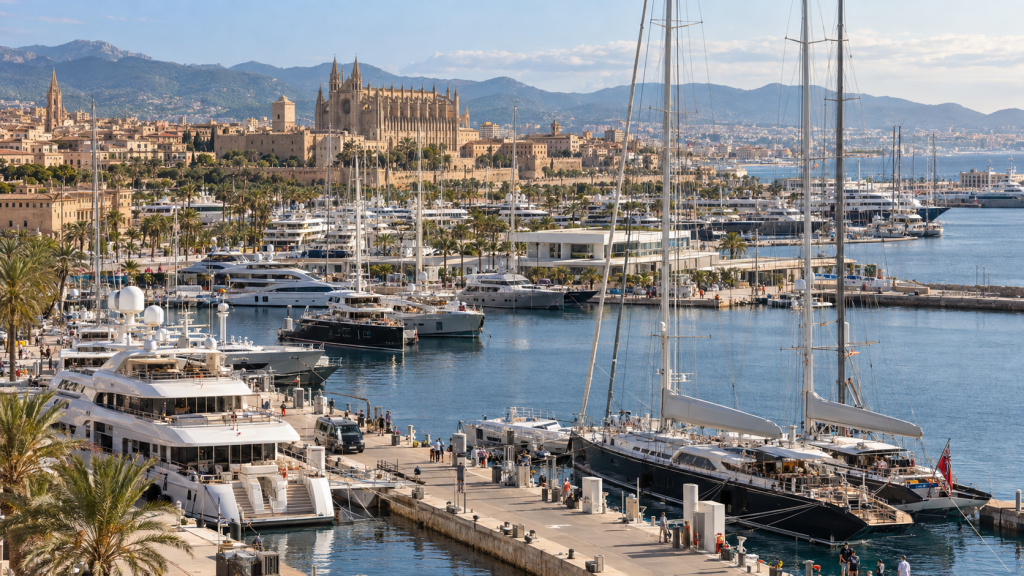
Several months later, the sixth Ibiza JoySail Superyacht Regatta took place from 17 to 20 September around Ibiza and Formentera. Organisers had announced a fleet of 20 superyachts in advance; by the opening of the event, official reporting referred to 19 participating yachts. The invitational competition put large sailing yachts into an entirely different operating context.
The significance of those events lies less in comparing one with the other than in what happens around them. A spring boat show can bring shipyards, brokers, technical suppliers and yacht-service businesses into the same setting just as vessels prepare for another Mediterranean season. By September, a regatta can put large sailing yachts under racing conditions, requiring crews, technical preparation, race management and marina support.
Between those moments sits an extensive period of ordinary yacht operation. Privately operated boats move through the islands. Commercial vessels undertake charter programmes. Yachts enter marinas for technical attention or routine servicing. Brokerage, management and repair continue whether or not a major event is taking place.
That is why the Balearics are better understood as an interconnected yachting environment than as a single type of destination. The activities overlap geographically without becoming interchangeable. Racing, brokerage, maintenance, private cruising and commercial charter represent different relationships with a yacht, yet they can all exist within a relatively compact marine economy.
The permanent infrastructure behind those distinctions is most visible around Palma. The boat show makes part of it public for four days, but Mallorca’s more consequential role begins with the businesses and facilities that remain after the exhibition pontoons have been cleared.
The Infrastructure Behind Palma’s Yacht Scene
The yacht activity visible along Palma’s waterfront rests on a quieter layer of work. Vessels may attract attention when they arrive at a marina or appear at a boat show, yet their ability to operate depends on maintenance schedules, technical contractors, spare parts, haul-out facilities, management and a long chain of specialist services.
Official Balearic Government material makes an important distinction about the regional nautical sector. It describes the local industry as relatively less concentrated on building vessels from scratch and particularly strong in the processes that follow construction: repair, maintenance, distribution, marinas, services and associated marine industries.
That description places Mallorca within the longer working life of a yacht. Delivery from a shipyard is only the beginning. Engines and generators need servicing; navigation, electrical and hydraulic systems require inspection; hulls and interiors eventually need repair or renewal. Larger yachts add layers of crew administration, compliance, logistics and management. Even vessels requiring no substantial refit still need berthing and routine technical support.
These functions are separate businesses, and there is no reason to assume that every company around Palma serves every part of the market. Their significance comes from concentration. A vessel requiring specialist work can operate within an environment where marinas, contractors, managers, brokers and technical suppliers are already present.
Palma International Boat Show briefly condenses that environment into one event. Its 2026 edition brought 310 exhibitors and 600 boats together across areas covering different parts of the sector. Brokerage and yacht sales appeared alongside equipment suppliers, refit and repair businesses, new-build representation and other marine services.
The timing gives the gathering additional context. Late April and early May sit close to the transition into the main Mediterranean summer operating period. That does not mean every yacht follows the same annual schedule: private itineraries, maintenance cycles, charter programmes and racing calendars vary considerably. Still, spring is a logical point at which technical preparation, commercial discussions and decisions about the months ahead become especially visible.
A boat may emerge from scheduled maintenance before beginning summer operations. Another might be undergoing brokerage activity rather than preparing to cruise at all. A third may enter a yard for work while other yachts are already active elsewhere in the Mediterranean. Palma’s relevance lies in being able to accommodate several of those processes rather than in imposing a single pattern on every vessel.
This is the less visible side of the modern yacht economy. The working life of a yacht includes long periods when the boat is neither being sold at a show nor photographed underway. Time spent maintaining systems, coordinating contractors, managing crews or preparing for the next programme is essential to everything that follows.
If Mallorca exposes that supporting structure, Ibiza later in the season reveals a different side of the same regional network: large yachts under sail, crews working competitively and marine infrastructure being used for active operation rather than preparation alone.
When the Yachts Become Competitors
Ibiza JoySail offers a useful counterpoint because the yachts are not presented primarily as objects for sale, display or technical work. It is a sailing competition. The sixth edition took place from 17 to 20 September 2026 around Ibiza and Formentera. Twenty superyachts had been announced before the event, while the fleet that actually participated numbered 19.
The participating yachts were spread across Performance, three Performance Cruising divisions, and World Cruising. Those classifications reflect differences in design, configuration and competitive profile rather than treating large sailing yachts as a uniform group.
That sporting context matters. A superyacht capable of long-range cruising can also be a technically demanding racing platform. Competition requires coordinated crews, race preparation, measurement and handicapping systems, course management and continual responses to weather and tactical conditions. The final racing involved different classes and competitive outcomes, but the significance here is not who finished where. It is what organised racing demands from vessels that might otherwise be viewed simply as large cruising yachts.
None of this turns every large sailing yacht in the Balearics into a racing boat. JoySail represents a specialised use of yachts that may spend much of their lives cruising. Its value to the wider picture is precisely that specificity: vessels occupying the same broad marine environment can be doing radically different things.
The organisation of the regatta also creates a less obvious connection with Mallorca. The 2026 event involved bodies including STP Shipyard Palma, Marina Ibiza, Club Náutico de Ibiza and Real Club Náutico de Palma, alongside the relevant sailing organisations and authorities.
Those institutions do not represent the entire Balearic yacht sector, but their participation shows that the relationship between Mallorca and Ibiza is institutional as well as geographic. A shipyard organisation in Palma, clubs on both islands and a marina in Ibiza can operate within the same competitive structure.
The Perpetual Trophy makes the connection physical. Its record challenge runs for 48 nautical miles between Punta Cala Figuera in Mallorca and Tagomago near Ibiza. The course is a competition against the clock, not a prescribed cruising or charter itinerary, but its geography is unusually useful for understanding the regional relationship: the two islands become the start and finish points of the same sailing test.
Once racing ends, however, that specialised sporting world becomes only one part of the yacht activity around the islands. The same broader environment also contains privately operated vessels and commercial yachts used by people who have no involvement in competition. That raises a different question: where does temporary access through charter fit into an economy already built around ownership, technical work, management and brokerage?
Where Charter Fits Into Mallorca’s Marine Economy
Those categories are easy to blur because they often operate through much of the same physical infrastructure. A privately owned yacht, a commercially operated charter vessel and a boat undergoing brokerage may all require marina access and technical support even though the economic relationships behind them differ substantially.
Brokerage concerns the sale and purchase of yachts. Management can cover continuing administrative, technical and operational responsibilities on an owner’s behalf. Repair and refit concern the physical vessel. Charter gives a client temporary use of a commercially operated yacht without transferring ownership.
That distinction matters in Mallorca because the island’s service infrastructure can support yachts at several stages of their working lives. One vessel may be undergoing planned technical work; another may be preparing for private summer cruising; another may be marketed for sale. A commercial yacht might require many of the same marina and engineering services while operating under a completely different framework.
Charter therefore fits more logically into Mallorca’s yacht economy when treated as one activity among many. The presence of yacht charter in Mallorca sits within an environment where vessels are also serviced, managed, repaired, marketed and prepared for continued operation across the Mediterranean.
The same yacht can pass through different phases over time. Ownership may change. Major technical work may be scheduled between seasons. A vessel managed for private use can have a different operational structure from one certified and managed commercially. In each case, the marina, engineering and service environment remains relevant even though the legal or commercial position of the yacht may change.
This is one reason reducing the regional sector to “yacht rental” would obscure rather than explain it. Mallorca yacht charter is visible because people use yachts commercially, but the surrounding marine economy exists on a broader foundation: technical competence, berthing capacity, specialist labour and the management of vessels whose purposes vary widely.
Mallorca therefore shows how access through charter can coexist with ownership, brokerage and maintenance without replacing them. Across the archipelago, Ibiza places those distinctions into a more intensely seasonal operating environment, where commercial charter sits beside private cruising, large crewed yachts and the specialised racing activity already visible through JoySail.
Ibiza in Active Use
JoySail makes competitive sailing conspicuous because a regatta compresses crews, technical preparation and race organisation into a defined period. Outside that setting, the Ibiza yacht environment contains vessels following very different programmes. Privately operated yachts, commercial charter vessels and larger crewed superyachts all form part of the island’s seasonal marine activity.
A yacht entered in a regatta is present as a competitor. Its immediate priorities involve crew performance, sailing configuration, race rules and technical preparation. A private yacht may instead be moving according to an owner’s itinerary. Commercial charter introduces another arrangement, providing temporary use of a vessel operated within a charter framework.
That is where yacht charter in Ibiza belongs in the wider picture: as one civilian form of access operating alongside private ownership and competitive sailing. Charter forms part of Ibiza’s working yacht environment without defining the status or purpose of the other vessels active around the island.
Geography helps these different uses coexist. Ibiza and Formentera form a closely related area of yacht operation, something visible in the JoySail racing programme itself. The proximity of the islands also matters outside competition because yachts do not have to be understood as stationary assets attached to a single port. Movement is part of their normal operation.
That movement can take several forms. A yacht might spend only part of a Mediterranean season around Ibiza before continuing elsewhere. Another may remain in the Balearics for an extended period. Some vessels move between islands repeatedly, while others arrive for a particular event or programme. No single route or seasonal timetable describes all of them.
This fluidity makes marina and service infrastructure important even in an environment defined by seasonal movement. A visiting yacht still requires berthing, crew logistics, technical assistance and routine operational support. Larger vessels add scale to those demands through more complex systems, larger crews and greater logistical requirements.
The presence of large yachts should not be confused with their commercial status. Some superyachts are privately operated, while others work commercially or arrive for specific sailing programmes. Within that wider seasonal field, superyacht charter in Ibiza represents one commercial segment of large-yacht operation rather than a description of the superyacht population as a whole.
This is where Ibiza adds something different to the argument established in Mallorca. Palma exposes much of the infrastructure that supports yachts before and between active programmes. Ibiza makes the operational side particularly visible: yachts moving, cruising, being used commercially and, in the specialised case of JoySail, competing.
Formentera strengthens that picture without needing to be turned into an itinerary. Its proximity extends the working geography around Ibiza and appears directly in the racing environment. Mallorca, meanwhile, remains connected through institutions, service businesses and the movement of vessels across the wider island group.
The result is not two independent yacht markets placed next to one another. It is a regional system in which each island brings a different concentration of activities while sharing many of the underlying requirements of modern yacht operation.
When Geography Becomes Part of the Infrastructure
The Balearics matter to contemporary yachting because activities that are often discussed separately can exist within one closely connected island group. Repair, maintenance, brokerage, management, charter, private cruising and racing involve different businesses and participants, but they repeatedly draw on overlapping physical and professional infrastructure.
Palma provides the clearest view of the service layer. Its marinas, technical businesses, repair and refit activity, brokerage and management services support yachts across different stages of ownership and operation. The boat show makes many of those functions unusually visible in spring, yet the permanent facilities matter long after the event closes.
Ibiza brings the operating season into sharper focus. Here the regional picture includes private cruising, commercial charter, larger crewed yachts and organised sailing competition. Marina Ibiza appears in that environment both as working infrastructure and as part of the institutional structure behind JoySail, while nearby Formentera extends the geography across which yacht activity occurs.
The 48-nautical-mile record challenge between Punta Cala Figuera and Tagomago provides an unusually literal expression of that connection. It does not establish a standard route for ordinary yacht traffic, but it shows how naturally Mallorca and Ibiza can become two points within the same competitive framework.
None of this means that every yacht in the western Mediterranean depends on the Balearics, that Mallorca and Ibiza perform identical functions or that yachting defines the islands as a whole. The more defensible point is narrower and more useful. Within a compact geography, several stages and forms of yacht activity repeatedly overlap.
A vessel can require technical work before a period of operation, management while in use and marina support throughout. It may later be sold, privately cruised, commercially chartered or prepared for competition. These activities remain distinct, but each can draw on different, overlapping parts of the professional and physical network established across the islands.
That is what turns physical proximity into an operational advantage. The distance between a service centre, a marina, a cruising area and a racing venue is short enough for different parts of the yacht world to remain in regular contact. The Balearics function as a meeting point because infrastructure, seasonal movement and different forms of yacht use repeatedly draw on overlapping parts of the same regional network.