
Marbella’s 2026 Classic-Car Weekend Put the Costa del Sol’s Car Culture in the Spotlight

The content of this material is informational and educational in nature and cannot be regarded as financial advice. It is extremely important to conduct an independent analysis before any financial transactions. If you are not sure about financial matters, it is strongly recommended to seek the advice of an independent expert.
Historic Cars Without the Museum Rope
Forty-five historic automobiles were registered for the XIV Exposición de Vehículos Antiguos “Ciudad de Marbella”, held on 25 and 26 September 2026, with a programme built around road routes and public displays across the municipality. It is the fourteenth edition of an exhibition that has settled into the town’s September calendar, and its entrants came from Marbella itself and from other parts of Spain.
The itinerary refused to stay in one place. It took in San Pedro Alcántara, Marbella’s centre and seafront, Nueva Andalucía and Puerto Banús, with the surrounding roads tying them together. All four sit within the same municipality, yet they read as distinct settings: a coastal town organised around its own avenues, a residential district set back from the shoreline, a marina lined with hospitality venues and moored boats. A group of cars travelling through each would be seen against four different backdrops.
Those backdrops matter because the organisers combined driving routes with public displays instead of choosing one format. An exhibition hall asks visitors to look at a car as an object. A street asks them to see it as a machine that still has to share the road with delivery vans, scooters and modern saloons, and that must be started, steered and stopped by someone sitting inside it. The routes assumed the cars could be driven, and the displays were meant to put them in front of whoever happened to be passing.
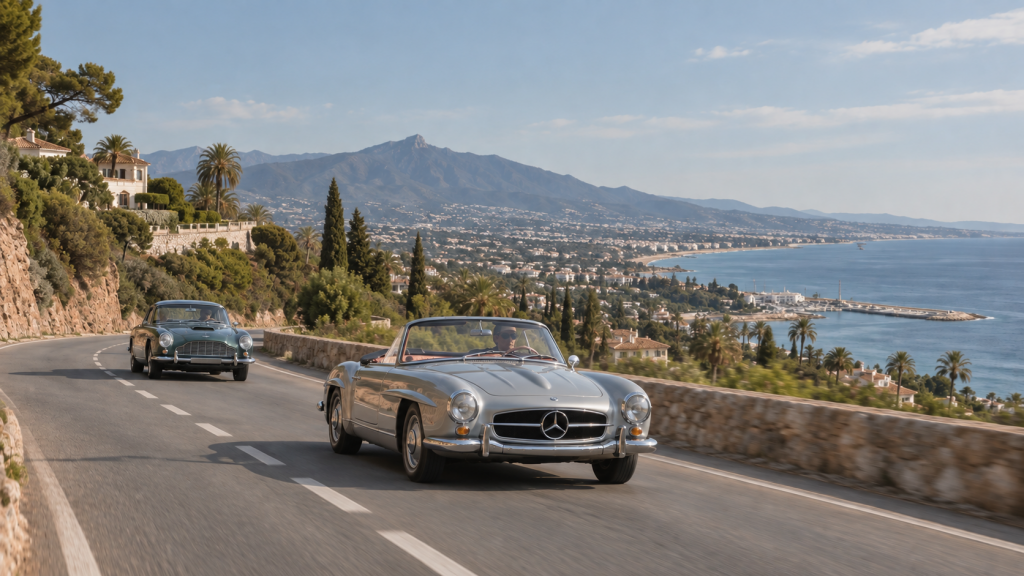
That distinction is the reason to write about the weekend at all. Forty-five cars are not a census, and one September programme cannot stand in for everything Marbella and the wider Costa del Sol do with automobiles. What it can do is make one strand unusually visible: the long-term keeping of cars that left production long ago and whose owners have chosen to maintain them anyway, in a place whose automotive reputation tends to be built on current models. The exhibition works as a window into local car culture, and its limits are part of the evidence.
The range of models named in the programme makes that strand easy to follow. Some date from the 1920s, others from the 1970s, and the decades between are covered by makers as different as Ford, DeSoto, Lincoln, Rolls-Royce and Mercedes-Benz. Set side by side, they do not simply age in a straight line. Bodies grow lower, wider and smoother, cabins change in what they ask of the people inside, and the idea of what a good car should be shifts from one decade to the next.
Ordering forty-five vehicles by year of manufacture is the easy part. Working out what each period believed about speed, comfort and status, and how much of that belief survives in the metal, is the more interesting one.
Keeping a Car the Way It Was Built
The organising club put particular weight on preserving each vehicle’s original configuration and characteristics. It is an unusual thing to prize, because most cars are altered over the decades. Owners add conveniences, replace worn parts with whatever is available and adjust things to taste, and each change is reasonable when it is made. Preservation often means resisting unnecessary improvement, so that the car continues to record the decisions its makers originally took, as far as practical. Replacing a worn component or repairing something sympathetically can sit comfortably within that aim.
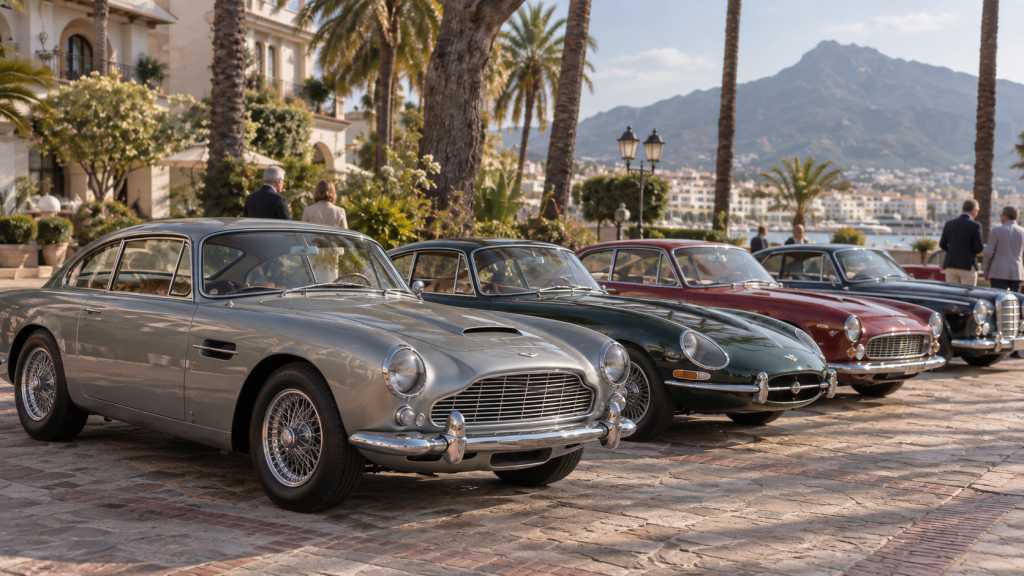
The Mercedes-Benz group shows how much those decisions can vary under a single badge. The Pontón takes its name from the slab-sided, pontoon-style flanks that replaced the separate wings of earlier designs. The Adenauer is named after the West German chancellor associated with the model, a reminder that some cars carry a political and social context as well as a shape. The Pagoda owes its nickname to the profile of its roof, and the 190 SL belongs to the family of open sports roadsters. The 450 SLC, a 1970s coupé, comes from another period again, with different proportions and different assumptions about what a large, comfortable car should feel like. Five models across roughly three decades read almost as a running argument within one company.
The oldest cars in the group push the range back further. The Fords from 1926, 1927 and 1929 and the 1930 DeSoto belong to a period when motoring was becoming ordinary rather than exceptional. Their cabins are tall and upright compared with those of the Mercedes-Benz cars, and they come from a time when the basic layout of a car was still being settled. To the extent that they keep their original form, they show what a manufacturer considered adequate before many later expectations existed.
Comfort meant different things in different places. A 1950s Rolls-Royce comes from a tradition in which refinement was central to the product, while a 1960s Lincoln Continental speaks in the scale and presence associated with American cars of its era. Neither needs a statistic to be understood. Sitting in them, or simply standing beside them, makes the difference in priorities obvious.
What survives in a well-preserved car goes beyond the bodywork. It includes the materials of the period, the layout of the controls and the relationship between driver and machine, which in many cars of these decades involved less assistance and fewer electronic aids than later became standard. It also includes the drawbacks. Crash protection, fuel efficiency, reliability and everyday convenience have all moved on, and these cars keep the older standards along with the character. That is not an argument that they were better or worse, only that they are different in ways that can still be examined.
Marbella’s programme did not treat these cars as exhibits alone. It planned for them to be driven.
A Car That Has to Get Home
Friday’s programme called for a route from the Marbella area toward El Chorro, inland from the coast, with a return later in the day. A route with a return leg asks a different question from a static display. A parked car demonstrates condition. A car that goes out and comes back demonstrates that the condition holds up when it is asked to do something.
Driving puts old machinery through demands that no viewing rope can reproduce. Cooling systems work harder in traffic and on climbs, brakes are asked to slow a heavy car repeatedly, steering and suspension respond to real road surfaces, and the driver has to pay attention to all of it. That is a general point about historic vehicles. The available programme material was published before the event, so it establishes intent and does not document how any individual car performed or what condition it was in.
Saturday’s itinerary spread the cars across the municipality. The plan included a public display around Avenida Marqués del Duero in San Pedro Alcántara, a route through Nueva Andalucía, an entry into Puerto Banús and a continuation toward Marbella, with a later display around the seafront. Reading that as a list of stops misses the point. What matters is the range of settings it set out: a town avenue, a residential district, a marina and a seafront, each with a different pace and a different relationship to traffic.
Puerto Banús is the most useful of these settings, because its reputation for expensive modern cars is well established. Nothing in the programme documents which modern cars would be parked or passing there, so the comparison has to stay conceptual. What can be said is that a marina district built around current leisure culture looks different when vehicles designed decades earlier move through it. Their proportions and engineering belong to another period, and the surroundings make that plain without any help from a caption.
The public displays were meant to do something the routes could not. They gave people a chance to walk around the cars, look at details and read the vehicles as objects. Combined with the driving, they let the same car be understood in two ways: first as a machine in operation, then as a preserved artefact at rest. Each mode informs the other, and the event was designed to use both.
The programme therefore has a second subject beyond the cars themselves. These are historic machines placed in a location that has kept changing. The roads named in the itinerary are the same ones that carry today’s residents, workers and visitors, in vehicles that follow very different rules about performance, electronics and safety. The natural next question is how the automotive environment around them has changed.
The Road Kept Moving
Those roads belong mainly to a different mobility environment. They carry ordinary traffic of every kind, from commuters and delivery vans to visitors, and nearly all of it is built around expectations that did not exist when the oldest cars on the programme were made. Modern performance cars operate at levels of acceleration, braking, electronic assistance and everyday usability far beyond what was expected when many of these historic vehicles were designed. Many carry driver-assistance and advanced safety systems, some use hybrid or electrified powertrains, and all of them are far easier to live with day to day. They start reliably, keep their occupants comfortable and demand little attention to the machinery underneath.
Those are different priorities from the ones the historic cars represent, and the two sets can coexist without either needing to defeat the other. A collector of historic vehicles may value provenance, originality and engineering history, while a driver of a modern performance car may value technology, comfort and everyday usability. Neither list says much about any individual owner’s motives. They answer different questions: what an earlier period built and how it can be kept intact, against what current engineering can do on an ordinary road.
Access to modern high-end cars is also broader than ownership. Purchase, leasing and short-term use all exist, and the last of these, including luxury car rental in Marbella, is one part of the present-day automotive environment, distinct from collecting and preserving historic vehicles. It involves different audiences with different aims, and it has no connection with the exhibition or its cars, which belong to their own participants.
The difference is one of timescale as much as taste. A visitor arranging car hire in Marbella for a week and a member of a classic-car club who has kept one vehicle for decades relate to cars over very different spans. One relationship is measured in use and convenience, the other in stewardship, and the exhibition speaks mainly to the second.
Technology marks the sharpest divide between the eras. An older car makes its mechanical processes plainly present to the driver, while a modern one manages many of them electronically and mostly out of sight. That shift changes what it means to drive well, and it changes what makes a car interesting to the people who care about them. It also leaves a narrower question about the cars whose appeal rests most directly on performance, and how that appeal fits with ordinary road use.
Two Ways of Finding a Car Interesting
With an older vehicle, the interest usually sits in its history. Age matters, and so do originality, mechanical character, rarity and the context it was built in. A car from the 1950s or 1970s can show how a maker solved problems that current engineers no longer face in the same form, and how well the object has been preserved is part of the story.
A modern sports car draws on a different list. Chassis engineering, powertrain technology, braking, handling and outright performance form the core of its appeal, and so does something the older cars rarely offer, which is usability. It can be driven in ordinary traffic without constant attention to its mechanical state. None of this makes it more or less authentic than a classic, and neither category is the better one.
The distinction matters because the phrase “car culture” is often used as though it described a single thing. It covers collecting, restoring, maintaining, driving, following motorsport and simply appreciating well-made machines, and different people take part in different ways. The Marbella exhibition sat firmly in the preservation strand. The contemporary performance-car world sits elsewhere, with its own reasons for taking part and its own measures of what makes a car worth caring about.
The region’s roads help explain why that world involves more than parking a car where people can see it. The area around Marbella offers several distinct settings: urban streets, coastal corridors and routes that climb inland from the shoreline. Each asks something different of a vehicle and its driver. Town traffic rewards smoothness and visibility, coastal roads suit steady travel, and inland climbs show how a car copes with gradient and changing surfaces. All of this happens within normal road use, under posted limits and with other people sharing the space. Public roads are not racetracks, and a modern sports car’s performance is mostly a margin of composure and safety in ordinary driving, not something to be tested there.
Temporary access is one contemporary way of taking part in that world, and sports car hire in Marbella sits in that category: a way for a driver to spend time with a modern performance car without owning one. Such cars are not collector vehicles, they have no place in the historic exhibition, and the relationship they offer is with current engineering, not with the past.
Two people can care about cars in these two ways without any contradiction. One values a machine because it has survived, the other because of what present-day engineering makes possible. A classic invites questions about how things were done, while a modern performance car invites questions about how much can now be done within the limits of ordinary use.
That difference sharpens the question the weekend raises. If a small historic-car event and a broad contemporary performance market coexist in the same municipality, what can a single September programme actually tell us about Marbella’s automotive identity?
What a Single Weekend Can Bear
The most direct reading is also the most modest. An exhibition that reached its fourteenth edition has an organised local audience for historic-car preservation. Its entrants come from different parts of Spain, which suggests a network wider than Marbella itself. The programme gave weight to public display and to driving, and its planned routes were designed to place automotive history into the everyday streets of a modern town. Those points are supported by the published programme.
Other conclusions would go too far. One event cannot make Marbella Spain’s classic-car capital, and it says nothing reliable about how many residents care about cars at all. Nor does it show that luxury vehicles define the Costa del Sol, or that the forty-five registered cars represent every strand of local car culture. They represent the strand that organised itself, chose a date and signed up. The pre-event material also cannot confirm final attendance or whether every route ran exactly as planned, so claims about what the weekend achieved should stay proportionate.
What the programme does establish is a design intention. Entering a car in an event built around road routes implies that its owner considers it fit for use, even though the material does not document how any individual car fared. That intention is significant in itself, because keeping an older vehicle usable requires continuing attention to parts, materials and mechanical knowledge that no longer sit in the mainstream of the industry.
It also creates a direct link between three things that are usually discussed separately: automotive history, present-day roads and contemporary car culture. The cars come from earlier decades, but the plan was for them to operate on streets used by current vehicles and to cope with modern traffic. That contact is where the event becomes informative. It sets out what earlier engineering looks like when it is asked to function in today’s conditions.
The larger lesson concerns what preservation means. Keeping a car intact behind glass is one form of stewardship. Keeping it usable, and planning to put it back on the road among vehicles with entirely different capabilities, is a more demanding one. By combining planned road routes with public displays, the exhibition treated these cars as machines intended to remain usable, not merely objects to be viewed.
A historic car intended to share a road with modern traffic is a working record of how motoring once was, and it stays a record only while someone keeps it usable.