
What MIMO 2026’s 30,000 Visitors Say About Italy’s Supercar Culture

The content of this material is informational and educational in nature and cannot be regarded as financial advice. It is extremely important to conduct an independent analysis before any financial transactions. If you are not sure about financial matters, it is strongly recommended to seek the advice of an independent expert.
A Motor Show Held Inside a Racetrack
Most motor shows solve the same problem in the same way. Vehicles that belong on roads or racing circuits are parked under lights in a convention hall, and visitors are asked to imagine the rest. The fifth MIMO Milano Monza Motor Show, held from 26 to 28 June 2026, started from the opposite premise. It took place at the Autodromo Nazionale Monza, and the cars stayed inside the kind of setting that gives many of them their reputation. A hall can display a car; a circuit can suggest what it is for.
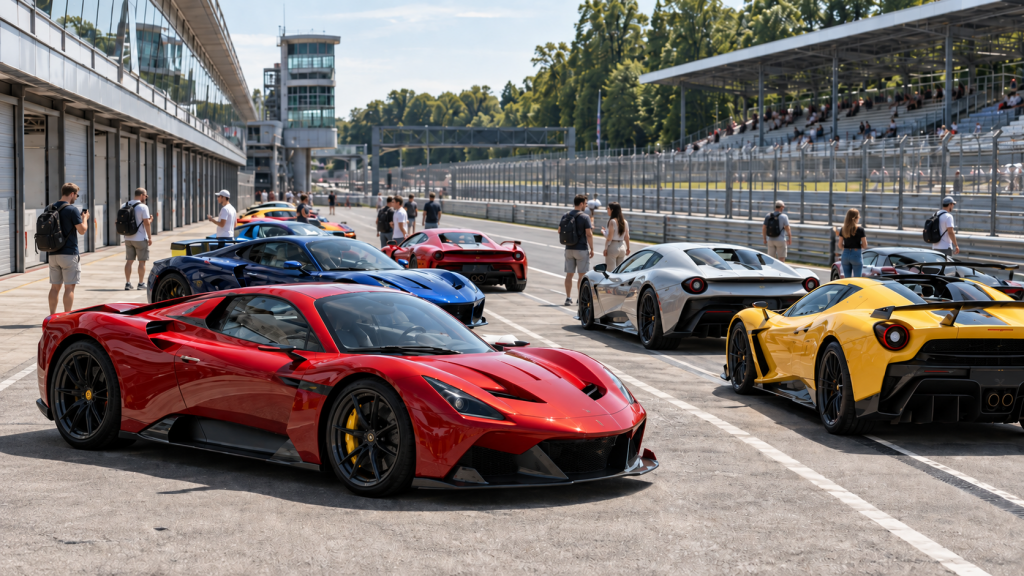
Admission was free, and organisers reported more than 30,000 visitors across the three days. That figure describes a crowd, not a single type of enthusiast. Some people will have come for the hypercars, others for the electric models, a day out or a chance to drive something they were considering buying. The programme was built to hold all of them, and no attendance number can say how those motives divided.
The programme itself is more revealing. The Supercar Paddock gathered high-performance cars from private collections, manufacturers and specialist builders. Around it sat new production models, prototypes and one-off vehicles, and an Electric Area devoted to zero-emission cars and charging infrastructure. Public test drives ran on dedicated routes, and official material reported sold-out activity. Companies offering cars included OMODA, JAECOO, Tesla, Changan and Mercedes-Benz, a list that runs from long-established names to recent arrivals and sits well away from the supercar world. Some sessions used areas within the circuit complex, among them the historic banking, though visitors were not simply released onto the Formula 1 track.
Track activity ran alongside. Parades sent supercars and hypercars around the Grand Prix circuit; Time Attack, Track4fun, drift demonstrations and other on-track experiences filled out the schedule. All of it was organised and supervised, and that distinction matters. A circuit is a place where extreme performance comes with rules, marshals and a defined purpose. A public road offers none of those, and nothing at MIMO suggested otherwise.
The result was a single site that combined selling, sport and public participation. A new electric model could be sampled within the same grounds where privately owned performance cars were on display to be looked at rather than bought. In an exhibition hall those categories would sit in separate aisles. At Monza they overlapped, because the circuit gave every one of them the same reference point: motorsport. The venue, home of the Italian Grand Prix, supplied that context without needing to announce it.
That makes MIMO a useful lens, within limits. It says nothing definitive about how Italian drivers as a whole regard cars, and not every vehicle on site was Italian. What it does show is narrower: an event that can put the ordinary and the extraordinary side by side, charge nothing at the gate, and still draw a crowd of that size. It also raises a question that the Supercar Paddock makes hard to avoid. Most people walking through it were looking at cars they would not buy or drive, and might never see again. Why that still holds an audience is where the argument has to go next.
The Pleasure of Watching What You Will Never Own
The Supercar Paddock operated on a plain principle: gather cars that most visitors will never drive and let people study them at close range. Manufacturers and private collectors supplied supercars and hypercars, and the atmosphere was closer to a meeting of interested parties than a sales floor. Nobody needed a budget to get in.
Movement came from the parades. The inaugural MIMO Parade on 26 June sent supercars, hypercars, new products and specialist vehicles around the Formula 1 circuit, and Supercar Parade sessions followed later in the programme. Two of the participants show how varied the spectacle was.
The 55 SGT made its world premiere in that first parade. SGT Automobili created it as a tribute to the Alfa Romeo 155 V6 TI associated with the 1993 DTM championship. A German touring-car season more than three decades old is an unlikely subject for a new car, which is exactly what makes it informative. The 155 belongs to a specific public memory of Italian saloon-car racing abroad, and the project chose to address that memory openly. Nothing established here says how the car will sell or whether it will be built in numbers, and neither is needed for the point: racing history is being used as raw material for new objects.
The Giamaro Krafla sits at the opposite end. Official MIMO and Monza material describes a quad-turbo V12 producing 2,157 hp. The number is startling, but it explains little about why anyone stood near the car. A figure that large is difficult to grasp; the car itself, seen in person, is not.
Several explanations for the appeal coexist, and no survey from the event ranks them. Engineering is one. A supercar exposes what ordinary cars conceal, from aerodynamic surfaces to the way an engine bay is packaged. Sound is another: a turbocharged or twelve-cylinder engine working on a circuit produces something a video only approximates. Design draws its own audience, and rarity adds to it, since a car built in small numbers may be seen in person only a handful of times. Collecting brings a further dimension. A privately owned car set in a paddock invites questions about provenance, upkeep and history that a dealership example never prompts.
Motorsport ties these strands together. At Monza, a car standing in the paddock and a car passing on the circuit are recognisably the same object in two states, one at rest and one doing what it was made for.
None of this depends on ownership. People take part in car culture by following a championship, turning up to an event, learning how a gearbox works, collecting at a modest level, or simply driving an ordinary car with some attention. MIMO’s own programme, with its electric models and mainstream test drives, assumed a public that moves between those positions rather than sitting in one.
Even so, the interest visible in the paddock did not begin in June 2026. It sits on top of a longer industrial and racing history, concentrated in particular parts of northern Italy, which had already made such machines locally significant long before anyone organised a show around them.
Where the Cars Are Made, Raced and Argued Over
Monza explains where a good deal of Italian performance-car history was tested in public, but not where the cars came from. The autodromo opened in 1922 and has hosted the Italian Grand Prix ever since; it is a venue. Manufacturing sits elsewhere. The specialist end of the industry is concentrated in Emilia-Romagna, in the area around Modena, Bologna and Parma that is often called Motor Valley. Ferrari is at Maranello, Lamborghini at Sant’Agata Bolognese, Pagani at San Cesario sul Panaro and Dallara at Varano de’ Melegari, near Parma, while Maserati has long been tied to Modena. Milan appears on that map mainly as a centre of design, business, media and consumers. It is where much of the industry’s audience lives, not where its most exotic cars are built.
The companies in that cluster are not variations on one template. Ferrari’s road cars grew out of a racing operation: Scuderia Ferrari competed from 1929, and cars carrying the founder’s name arrived in 1947, with road sales helping to fund the racing. Lamborghini reversed the order. Ferruccio Lamborghini, who made his money in tractors, founded the company in 1963 to build grand tourers, and its reputation formed on the road before it counted for much in competition. Both routes lead to the same category, which suggests the category has several ways in.
Other firms fill different roles. Pagani builds very small numbers of hand-finished carbon-fibre cars under a founder, Horacio Pagani, who made his career in Italy as an engineer. Dallara is better known for what most people never see: racing chassis supplied to series around the world, plus a low-volume road car of its own, the Stradale. Alfa Romeo and Maserati carry competition histories inside brands that now address wider markets. The 55 SGT shows how durable those histories are. Its reference to the Alfa Romeo 155 V6 TI and the 1993 DTM season only works because enough people still remember the original car.
Proximity helps explain why the cluster persists. Engineers, body and composite specialists, suppliers and test drivers working within a short drive of one another can share knowledge, and workers can move between companies. This is a partial account of a complicated industry, but it accounts for how a small region carries an outsized share of the specialist work.
The technology is shifting, and MIMO showed it directly. The Electric Area, the EV test drives and the charging displays sat within the same grounds as the Giamaro Krafla’s twelve-cylinder engine. Performance culture now includes hybrid systems, batteries, software and charging networks, alongside combustion engines. That does not amount to a loss of identity, and it does not make combustion the only authentic form of performance. The skills involved in packaging, cooling and controlling power are not confined to one kind of engine, and the public at Monza had access to both.
Yet most people meet these companies’ products on ordinary roads, not on circuits or in factories, and the roads around Milan and Monza are where that encounter takes place.
The Road Beyond the Circuit
A Formula 1 circuit and a city street are different kinds of space. Monza offers barriers, run-off areas, marshals and a clear purpose, which is why the parades, Time Attack sessions and Track4fun activity at MIMO could be run safely. Milan offers traffic, tram lines, pedestrians and speed limits. A modern supercar in that setting spends most of its time moving slowly, and nothing about the city invites anything else. The event brought both worlds into contact for three days, but it did not merge them.
Milan’s role is different from Monza’s. It is Italy’s largest business and design centre, a place where media, fashion, finance and retail concentrate, and where the road environment includes everything from delivery vans to premium saloons. Access to the central districts is restricted in various ways, which shapes how any vehicle is used there. A city of that kind produces its own relationship with high-end cars, one based on visibility and daily use rather than on lap times.
It helps to separate the categories. A supercar, built for extreme performance with little regard for practicality, is a rare sight on public roads. A luxury grand tourer, designed to cover long distances quickly and comfortably, is far more common in wealthy districts. Ordinary urban transport, from small hatchbacks to electric commuter cars, accounts for most of what actually moves through the city. MIMO’s test-drive programme, with its mainstream and newer manufacturers, sat closer to that last group than to the paddock.
People reach performance cars in several ways. Ownership is the most obvious, and the least common. Collecting is a related but distinct activity, often driven by history rather than performance. Manufacturer events and driving programmes give buyers and enthusiasts supervised experience of a car, usually on a track. Temporary use fills another space: a visitor or resident who wants to rent a car in Milan can choose anything from a compact model to something faster, and that sits alongside a public transport network most residents rely on. It is one route among several to the same road, not a stand-in for a circuit or an event like MIMO.
None of these routes turns a public road into a racetrack, and that distinction deserves stating plainly. Extreme performance belongs in supervised settings. What ordinary road use offers instead is something quieter: proximity to well-made machines, the chance to notice how a car feels at moderate speed, and a familiarity that builds up from seeing them in daily life.
Milan, though, is one city, wealthy and industrial, in the north. Whether the same relationship with performance cars holds in other parts of the country is a separate question, and the answer changes as the map widens.
Balancing a car’s commercial role against its cultural overlap.
The Same Car, Different Streets
The meaning of a supercar shifts with the place it is standing in. At Monza it is track machinery, a collector’s possession or an exhibit in a public event, and the circuit sets the terms for all three. In Milan it becomes a road-going performance car, a design object, private transport or something borrowed for a few days. Rome changes the setting again, in ways that owe more to the city than to the industry.
Northern Italy’s part in this story is specific. Emilia-Romagna supplies the manufacturing cluster, Monza the racing tradition, and Milan the commercial and design economy. None of that makes the rest of the country a passive audience, and the contrast is not a simple one between a car-making north and a car-watching south. Even within the north, Maranello and Milan are different places with different relationships to the same cars.
Temporary access to the performance segment now sits alongside ownership and collecting as a way of meeting these cars, and exotic car rental in Milan is one form it takes. Its scope is narrow. It gives someone time in a car on ordinary roads and in ordinary traffic; it does not offer the closed, supervised conditions of a circuit, and it has no connection with what happened at MIMO. Its interest here is that it shows the road-going supercar being met by people who do not own one, on terms set by the city rather than the paddock.
Collecting works differently again. A collector keeps a car for its history and condition, and the car may run only at gatherings, club events or parades of the kind seen at Monza. Its value depends on provenance and originality more than on speed, which is why a collector car and a car borrowed for a weekend, though both are high-performance, belong to separate worlds.
Rome sits outside the industrial map altogether. No major supercar maker is based there, and nothing in this argument requires one. What the city offers is a different physical setting for the same objects. The historic core is dense and largely cobbled, with a limited-traffic zone restricting vehicle access to much of it. Beyond the centre the picture changes. The EUR district, conceived in the late 1930s for an exhibition that was never held, has wide modern avenues and has hosted Formula E races. The Grande Raccordo Anulare ring road circles the city, and Vallelunga, a motorsport circuit, lies north of it. Rome therefore holds a compact version of the distinctions this article has drawn, from historic streets to modern districts to a racing venue within reach.
Access to high-end road cars extends into that context too, and car hire in Rome gives a visitor or resident a version of the same temporary relationship found in Milan. It carries the same limits. A performance car in the historic centre is mostly parked, watched or driven slowly, and its presence there registers as spectacle against a backdrop several centuries older than the car. The city sets a different scale, and the car takes on a different meaning as a result. Car rentals in Rome do not make the city a motoring centre, and the point of the comparison is contrast rather than equivalence.
Across all these settings the car itself is the same commercial product, sold at a price and built to a specification. What changes is what surrounds it: a racing circuit, a design capital, a historic city, a collector’s garage. That variability raises the question the title asks. If a purchase price fixes what a car costs, something else must determine what it comes to mean.
A Product With Several Lives
A supercar begins as a product. It has a price list, a delivery schedule, a warranty and a sales target somewhere in a spreadsheet, and nothing in Italy’s relationship with these cars cancels that. Ferrari and Lamborghini are businesses, Dallara sells to racing series, and the newer names at MIMO’s test-drive stands were there to attract customers. The more precise claim is that certain cars accumulate other roles on top of the commercial one, and that in Italy the conditions for that accumulation are unusually dense.
Those roles have different sources. A factory in Emilia-Romagna carries manufacturing history: skills, suppliers, a workforce that moves between firms. A racing programme supplies technical reputation and a public story. A collector adds provenance, keeping a particular car in a particular state for reasons unrelated to its original price. A design tradition gives the object a silhouette people recognise from a distance, and a public event turns all of it into something to watch. No single one of these makes a car cultural. The effect comes from their overlap, and a purchase price cannot express that.
MIMO is reasonable evidence for the overlap, though not proof of anything larger. Across three days at Monza there were collector cars beside new models, hypercars beside electric ones, established manufacturers beside companies new to the European market, test drives beside timed runs, and a crowd that had not paid to enter. The mix undercuts the tidy Ferrari-and-Lamborghini version of the story, and equally the nostalgic one. The 55 SGT looked back to 1993 while the Electric Area looked at charging infrastructure. Both belonged to the same event, and neither needed to be judged the more authentic.
The limits matter as much as the evidence. The event cannot show that most Italians care about supercars, and plenty plainly do not. It cannot show that Italy values cars more than other countries do, since Germany, Britain, Japan and the United States have their own circuits, museums and clubs. It cannot say whether electrification will strengthen or thin out this culture either, because it showed only the two coexisting. Those questions need different evidence, and treating one event as an answer would be overreach.
What MIMO can support is more modest, and perhaps more useful. A free gate, a working circuit and a programme that declined to sort its cars into separate halls made visible something that usually stays scattered. The factory, the racetrack, the private garage and the road each hold part of these cars’ meaning, and at Monza they were briefly in one place, with anyone able to walk between them. That a single car can be a product, a piece of engineering, a racing memory and a public spectacle at once, to many kinds of people, does more to explain its durability than any price it commands.