
How the 2026 Palma International Boat Show Kicked Off the Mediterranean Yachting Season

The content of this material is informational and educational in nature and cannot be regarded as financial advice. It is extremely important to conduct an independent analysis before any financial transactions. If you are not sure about financial matters, it is strongly recommended to seek the advice of an independent expert.
Late April in Palma, Where the Mediterranean Season Turns
The 42nd Palma International Boat Show ran from 29 April to 2 May 2026 and closed with 32,947 visitors, according to the organisers’ final report. That was 9.5% more than the previous edition and the highest attendance the event had recorded in ten years. On the supply side, 310 exhibitors brought 600 boats to Palma, 275 of them displayed on the water. The main site was Moll Vell, with a separate large-yacht area at Marina Port de Mallorca.
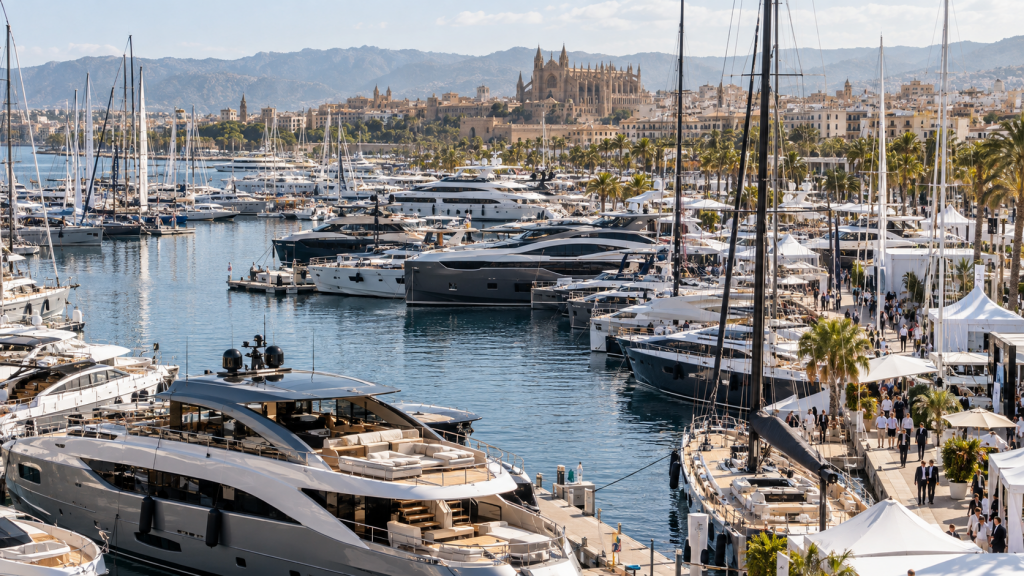
Figures like these are easy to quote and less revealing than the date. Official descriptions present the show as marking the opening of the Mediterranean nautical season, and that is the formulation this article follows. Any wider claim, such as reading the show as a signal for European summer yachting as a whole, is interpretation rather than an organiser slogan. It is an argument about timing, and the timing deserves a closer look.
For several months before a fair like this, a large part of the Mediterranean fleet is occupied with work that never appears in a brochure. Boats are lifted out of the water, surveyed, repainted and serviced. Refit projects are scheduled around yard availability, sometimes years in advance. Crews are hired or reshuffled, and owners and managers settle what will be repaired, upgraded or replaced before the warm weather arrives.
By early May much of that programme is typically drawing to a close, although timetables differ from yard to yard and from vessel to vessel. Yachts begin moving out of yards and winter berths toward cruising, brokerage viewings, charter programmes and the routine operations of summer. The cycle is far from universal. Some yachts work through the winter in other waters, some are private and never chartered, and some remain in refit well past spring. Still, enough of the industry passes through this transition at roughly the same moment to make it a meaningful point on the calendar.
A show held at that hinge sits between two kinds of business. Behind it lies the winter’s maintenance and technical preparation. Ahead lies a season in which decisions about buying, selling, chartering and crewing carry real consequences. An event that gathers hundreds of exhibitors just before that pivot can plausibly claim to be a checkpoint as well as an exhibition, a place where an industry takes stock of what it has prepared and what it intends to do next. For the people who work in it, the fair also serves as a fixed date around which yard schedules, crew arrangements and client meetings can be organised.
Scale alone does not settle what kind of checkpoint it was. A count of 600 boats could describe a retail fair for consumer craft, a launch platform for shipbuilders, or a trade meeting of brokers and technicians. Palma turned out to be a mixture, and the proportions of that mixture say more about the Mediterranean yachting economy than any headline total. To see them, it helps to look at how the show itself was organised.
Three Areas, Three Kinds of Business
The organisers built the 2026 event around three principal areas, and the divisions follow lines of business rather than simple differences in boat size. Reading the layout is a quick way to see who the show was designed for.
Shipyards & Equipment is the section closest to the traditional idea of a boat show. Builders present their vessels there, alongside the companies that supply the marine equipment going into and onto them. Its audience is a mix of buyers and the trade, and its business is the making and outfitting of boats, from the practical to the technical. Suppliers of engines, electronics and onboard systems occupy the same section as the builders, which reflects how much of a modern boat is assembled from components made elsewhere.
The Superyacht Village works differently. It concentrates on yachts over roughly 24 metres, most of them associated through brokerage companies with sale, charter or both. A yacht of that size is an operating enterprise as much as an object, since it needs a crew, a management structure, regular maintenance and periodic refit. The village accordingly gathers the people who provide those things: brokers, charter specialists, yacht managers, crew agencies, refit and repair companies and other support services. A visitor walking the pontoons is looking at boats and, just as importantly, at the network of businesses that keeps such boats running.
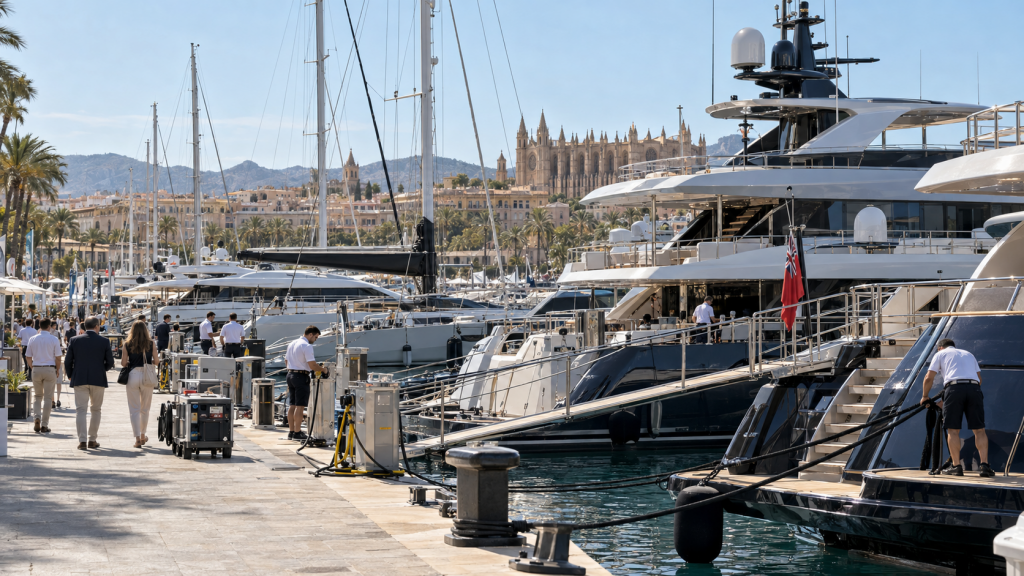
That presence should not be read too literally. A yacht moored in the village is associated with brokerage, but the connection does not mean every vessel was on the market, and it certainly does not mean every one was available for charter. The brokerage link tells a visitor who represents a yacht, not whether it is for sale or free for a given week, and the terms attached to each vessel differ from one to the next.
The third area, the dedicated large-yacht and new-build hub at Marina Port de Mallorca, belongs to another part of the industry. It focuses on larger yacht construction and projects, and the conversations there tend to look further ahead than those around vessels that are already afloat and in service. It is a reminder that a boat show serves people commissioning future yachts as well as those dealing with existing ones.
Sailing runs across all of this. The organisers’ 2026 closing material stated that Palma hosted Europe’s largest exhibition of large sailing yachts. The claim comes from the organisers and describes a single category, not the show overall. It says nothing about whether Palma was the largest yacht show, superyacht show or boat show in Europe, and it should not be stretched to do so. Large sailing yachts nonetheless bring their own technical demands, including rigging, sail handling and specialist crews, that tie them closely to the service side of the industry.
The show, then, is a four-day gathering of makers, sellers, managers and technicians. Yet a good number of those businesses do not pack up when the pontoons come down. The repair yards, brokers, marinas and technical suppliers that give the event its content operate around Palma all year, and that permanent base is the more revealing part of the story.
The Work That Happens After the Launch
A boat show has a fixed run and an audience that comes and goes. The businesses behind it stay. Long after the pontoons at Moll Vell have been dismantled, Palma’s yards, workshops and marinas are still doing the routine work of keeping large yachts in working order. That permanent activity goes a long way toward explaining why the event is held in Palma at all.
Official Balearic commentary draws a useful distinction. The islands’ nautical sector is described as strong in repair, refit, maintenance, distribution, marinas, brokerage, technical support and yacht services, and it is set apart from places whose reputation rests on building large vessels from scratch. The distinction is analytical, not absolute, and it does not mean nothing is built locally. It does indicate where the weight of the local economy sits. Other regions may launch the hulls, while much of a yacht’s long working life is spent being looked after elsewhere.
Consider what a large yacht needs once it has been delivered. Engines and generators run to service intervals. Coatings, decks, stabilisers, electronics and climate systems wear at different rates and are replaced on different schedules. Survey dates arrive, regulations change, and an owner may decide after a few years to alter interiors or update systems. None of this happens once. It recurs for as long as the vessel is in service, so a place that can do the work competently, and source parts and specialists quickly, earns repeat business in a way that a yard delivering a single hull every couple of years cannot.
Marinas belong to the same picture. For the people responsible for a yacht, a berth means winter mooring, proximity to shipwrights and the ability to move between quay and yard at short notice. Distribution matters too: engines, sails, electronics and consumables have to reach the boats, and local suppliers shorten that chain. Brokerage sits alongside, because a yacht being maintained in Palma can also be viewed, surveyed and sold from Palma.
Spring gives that infrastructure a deadline. Vessels that spent the winter in yards or on maintenance berths need to be ready for intensive use by early summer, so the weeks around the show fall near the end of the preparation window for many of them. Remaining refit tasks are finished or deferred, sea trials are run, crews return and management teams confirm operating plans. Commercial decisions do not wait for the show either. Brokers agree terms and owners reconsider whether to keep or sell in offices and on quaysides, far from any exhibition stand.
Not every yacht in Palma follows this pattern, and the island does not service the whole Mediterranean fleet. Yet the concentration of skills, berths and suppliers gives the show something no four-day event can manufacture, which is a working industry already in place. Within that industry, chartering a yacht is one activity among several, and seeing where it fits means first separating it from the others.
Charter Is One Relationship Among Several
Yacht markets are often discussed as if building, buying, selling and chartering were variations on a single transaction. They are separate businesses, with different clients, timescales and risks, and Palma’s wider industry touches each of them, though at different weights.
New construction is the longest commitment, in which a client commissions a design and a yard and waits years for a result. Ownership starts at delivery and brings continuing obligations: insurance, crew, upkeep. Brokerage is intermediary work, matching buyers with existing yachts or placing yachts with clients, and it is paid according to the deal. Resale is simply the transfer of a yacht from one owner to the next. Management is operational, covering the employment of crew, the scheduling of maintenance, and compliance and accounts on the owner’s behalf. Refit and maintenance are the technical labour that keeps everything else possible.
Charter sits apart from all of these. It gives a client temporary access, often for a week or two, to a yacht that someone else owns, maintains and crews. The client takes on no capital cost and no upkeep. The owner accepts wear and the operator carries the responsibility, so the commercial relationship resembles hospitality far more than it does a sale. It also changes what an owner expects from the people around the yacht, since a vessel that earns income through charter has to be available and in working order on dates fixed months in advance.
Alongside the yards, marinas and brokers that support the fleet, yacht charter in Mallorca forms one strand of the island’s marine-services environment, and it depends heavily on the others. A charter yacht that runs reliably is the product of prior maintenance, competent management and a capable crew, all of which are supplied by the same local network.
The Palma International Boat Show reflects this overlap without collapsing it. Brokerage and charter companies take part, mostly around the Superyacht Village, and their presence shows how closely the commercial side of yachting sits beside the technical side. It does not follow that every yacht displayed there could be chartered. A visitor cannot read availability from a berth.
What the show does reveal is how these separate activities share the same infrastructure and the same calendar. Once the spring preparation period ends, they stop being background work and start being visible. Yachts leave their winter berths, crews take up seasonal posts, and the movement of vessels around Mallorca and the wider Balearics begins to determine how the summer is actually run.
Leaving the Yards, Entering the Islands
By the time the exhibition stands come down, the yards around Palma have usually released the boats they spent the winter working on, and the water that hosted a trade fair becomes a departure point. A yacht can come out of refit, take on crew and stores, and leave from the same bay where it was serviced. That does not describe every vessel in Palma, but it explains why the island does two jobs at once. It prepares yachts, and it is where many of them begin their season.
The Balearic Islands give the second job its shape. Mallorca is the largest island in the group, with Menorca to the north-east and Ibiza and Formentera to the south-west, and the passages between them are short enough to plan around weather and schedule rather than endurance. Palma, with its berths, suppliers and technical support, can serve as a point of departure or return for boats working across the islands. Plenty of yachts base themselves elsewhere and arrive only for a season or a few weeks, so the archipelago is better understood as a cruising area with a service base attached than as a single destination.
Different vessels use that geography differently. Sailing yachts keep a rhythm set partly by wind, and their itineraries tend to follow conditions as much as intentions. Motor yachts cover more distance in a day and can compress a route, but they make heavier demands on fuel, berths and provisioning. The two attract different clients with different expectations, and treating them as one market hides more than it reveals.
Size adds further divisions. A larger crewed yacht operates as a small enterprise, with a captain, engineers, and deck and interior staff, and its movements depend on whether a marina can take its length, whether an agent can arrange supplies and whether a technician can be reached quickly. Within that group, superyacht charter in Mallorca is a narrow segment of the broader charter environment, defined less by coastline than by whether the surrounding infrastructure can support a vessel of that scale. The show’s Superyacht Village illustrates the same dependence from another angle, since the brokers, crew agencies and refit specialists gathered there are the businesses such yachts rely on once the season is under way.
Smaller and mid-sized boats sit differently. Yacht charter in the Balearic Islands covers a similarly wide range of vessels rather than one standard product, with crew arrangements, trip lengths and operating costs varying widely between them. That variety is one reason generalisations about “the charter market” tend to mislead. A short passage between islands on a sailing yacht and a week’s programme on a large motor yacht may share a harbour and a season, but they involve different crews, different suppliers and different planning.
Summer also leans on the same businesses that carried out the spring preparation. A fault at sea or an unplanned crew change is handled by the yards, suppliers and agents who may have worked on the boat months earlier, which is why Palma’s late-April position matters. Preparation and the first departures happen in the same harbour, within days of each other.
Reading the Signal
Attendance offers a first, limited reading. The rise in visitors, to a ten-year high, shows the show drew more people than the previous edition, which is worth recording, but a visitor count says little about how the summer will trade. The figures available do not include sales or bookings, and none should be inferred from them.
The exhibits are a better guide to what the industry is working on. Electric motors, hybrid vessels, electric personal watercraft and hydrogen-powered boats were on show, alongside marine equipment aimed at technical improvement, and the organisers pointed to carbon measurement and waste management in the running of the event itself. These indicate direction, presented by companies competing for attention. A hydrogen boat on a pontoon is not a hydrogen-powered fleet, and most of the yachts that work this summer are already in the water. Adoption will depend on how much of this equipment proves practical for the yards and crews who have to install, maintain and rely on it. The same caution applies to sailing. The organisers’ description of Palma as host to Europe’s largest exhibition of large sailing yachts marks one segment of the fleet with its own technical and seasonal logic, and it says nothing about the show’s standing overall.
The clearer signal lies elsewhere. Gathering several hundred boats in one place for four days is largely a matter of logistics. Having the yards, berths, brokers, technicians and crew agencies already in place, working before the event and continuing after it, is much harder to arrange, and that is what the show sits inside. A good number of its exhibitors are not visitors to Palma’s marine economy. They are part of it.
That helps explain the date. Boat shows elsewhere fall at other points in the calendar, but a late-April show in Palma meets an industry at the moment its own work is changing character. Through the winter, the emphasis falls on lifting, repairing, refitting and surveying. By early May, those same businesses are talking to buyers, managers and crews about how the yachts they prepared will be used, sold, staffed or chartered.
One boat show cannot stand for the whole European or Mediterranean industry, and it would be a mistake to read the summer’s fortunes from a single harbour. As an early indicator, though, Palma has a particular advantage. It is where an industry finishing the preparation of its fleet and an industry beginning to put that fleet to work occupy the same pontoons for a few days, and where the second visibly takes over from the first.