
- Home
- Careers
- സിവില് സര്വ്വീസ് പരീക്ഷ: ഇന്ത്യൻ ഭരണഘടനാ ഭേദഗതിയെ ചോദ്യം ചെയ്യാൻ സുപ്രീം കോടതിക്ക് കഴിയുമോ ?
സിവില് സര്വ്വീസ് പരീക്ഷ: ഇന്ത്യൻ ഭരണഘടനാ ഭേദഗതിയെ ചോദ്യം ചെയ്യാൻ സുപ്രീം കോടതിക്ക് കഴിയുമോ ?
ഇന്ത്യന് ബ്യൂറോക്രസിയുടെ ഏറ്റവും ഉയര്ന്ന പദവിയിലേക്കുള്ള പരീക്ഷയാണ് സിവില് സര്വ്വീസ് പരീക്ഷ. ഇന്ത്യന് അഡ്മിനിസ്ട്രേറ്റീവ് സര്വ്വീസ് (ഐഎഎസ്), ഇന്ത്യന് പൊലീസ് സര്വ്വീസ് (ഐപിഎസ്), ഇന്ത്യന് ഫോറിന് സര്വ്വീസ് (ഐഎഫ്എസ്) എന്നീ ഗ്ലാമര് പദവികള് മുതല് നിരവധി വകുപ്പുകളിലേ ക്ലാസ് വണ് ഉദ്യോഗങ്ങളിലേക്കും ചില ഗ്രൂപ്പ് ബി തസ്തികകളിലേക്കുമുള്ള തെരഞ്ഞെടുപ്പും സിവില് സര്വ്വീസ് പരീക്ഷയെ അടിസ്ഥാനമാക്കിയാണ് നടക്കുന്നത്. അതുകൊണ്ട് തന്നെ കടുത്ത മത്സരം നടക്കുന്ന പരീക്ഷകളിലൊന്നാണ് സിവില് സര്വ്വീസ് പരീക്ഷ. പരീക്ഷയ്ക്കിറങ്ങും മുമ്പ് നിരന്തരമുള്ള തയ്യാറെടുപ്പ് ആവശ്യമാണ്. ഫോര്ച്ച്യൂണ് അക്കാദമിയും ഏഷ്യാനെറ്റ് ഓണ്ലൈനും ചേര്ന്നൊരുക്കുന്ന സിവില് സര്വ്വീസ് പരീക്ഷാ ചോദ്യോത്തരങ്ങളുടെ അഞ്ചാമത്തെ ചോദ്യാവലിയാണിത്. സിവില് സര്വ്വീസില് മാത്രമല്ല, കേരള സിവില് സര്വ്വീസ് പരീക്ഷയെന്നറിയപ്പെടുന്ന കേരള അഡ്മിനിസ്ട്രേറ്റ് സര്വ്വീസ് (KAS) പരീക്ഷയ്ക്കുള്ള പഠനത്തിനും ഈ ചോദ്യോത്തരങ്ങള് നിങ്ങളെ സഹായിക്കും. അതെ, ചെറിയ ചില കാല്വെപ്പുകള് വിലയ മുന്നേറ്റങ്ങള്ക്ക് കാരണമാകാം. വരൂ, നമ്മുക്കൊന്നിച്ച് മുന്നേറാം.
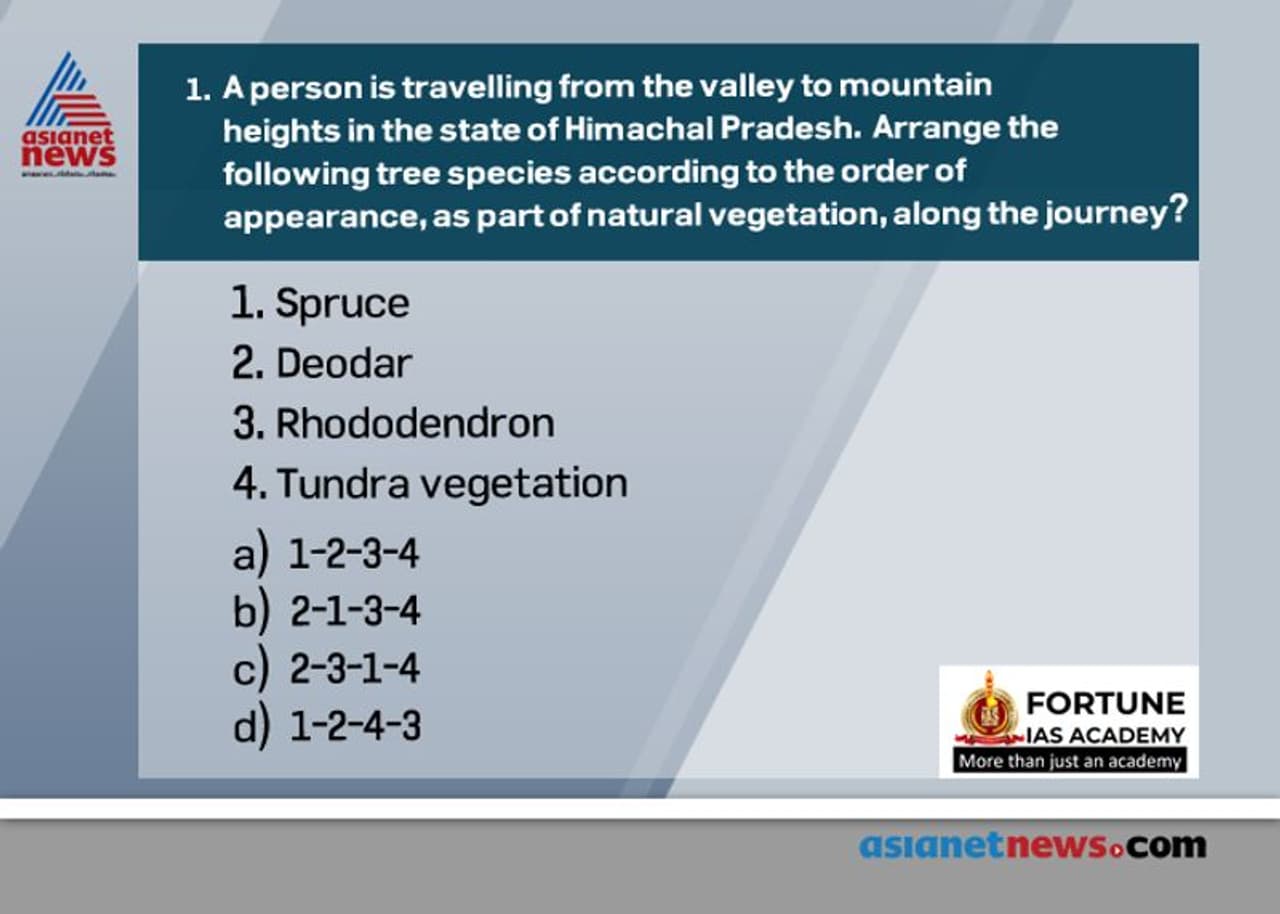
<p><span style="font-size:16px;"><strong>Answer: (b)</strong></span></p> <p><br /> <strong>. T</strong>he Himalayan ranges show a succession of vegetation from the tropical to the tundra, which change in with the altitude. Deciduous forests are found in the foothills of the Himalayas.<br /> <strong>. I</strong>t is succeeded by the wet temperate type of forests between an altitude of 1,000-2,000 m.<br /> <strong>. D</strong>eodar, a highly valued endemic species (temperate vegetation) grows mainly in the western part of the Himalayan range. Deodar is a durable wood mainly used in construction activity. Similarly, the chinar and the walnut, which sustain the famous Kashmir handicrafts, belong to this zone.<br /> <strong>. O</strong>ther examples of temperate vegetation are in the eastern Himalayas such as oak, chestnut, pine forests etc.<br /> <strong>. B</strong>lue pine and spruce appear at altitudes of 2,225-3,048 m. At many places in this zone, temperate grasslands are also found.<br /> <strong>. B</strong>ut in the higher reaches, there is a transition to Alpine forests and pastures. Silver firs, junipers, pines, birch and rhododendrons, etc. occur between 3,000-4,000 m.<br /> <strong>. A</strong>t higher altitudes, mosses and lichens form part of the tundra vegetation.</p> <p><br /> <strong>Source</strong> - India: Physical Environment Class : XI.</p>
Answer: (b)
. The Himalayan ranges show a succession of vegetation from the tropical to the tundra, which change in with the altitude. Deciduous forests are found in the foothills of the Himalayas.
. It is succeeded by the wet temperate type of forests between an altitude of 1,000-2,000 m.
. Deodar, a highly valued endemic species (temperate vegetation) grows mainly in the western part of the Himalayan range. Deodar is a durable wood mainly used in construction activity. Similarly, the chinar and the walnut, which sustain the famous Kashmir handicrafts, belong to this zone.
. Other examples of temperate vegetation are in the eastern Himalayas such as oak, chestnut, pine forests etc.
. Blue pine and spruce appear at altitudes of 2,225-3,048 m. At many places in this zone, temperate grasslands are also found.
. But in the higher reaches, there is a transition to Alpine forests and pastures. Silver firs, junipers, pines, birch and rhododendrons, etc. occur between 3,000-4,000 m.
. At higher altitudes, mosses and lichens form part of the tundra vegetation.
Source - India: Physical Environment Class : XI.


<p><br /> <span style="font-size:16px;"><strong>Answer (c)</strong></span></p> <p><br /> <strong>. S</strong>tatement 1 is incorrect: The Reserve Bank of India (RBI) has introduced a separate channel, namely “Fully Accessible Route” (FAR), to enable non-residents to invest in specified government bonds. Certain specified categories of government bonds would be opened fully for non-resident investors without any restrictions. The Reserve Bank shall notify the government securities that shall be eligible for investment under the ‘FAR’. <br /> <strong>. S</strong>tatement 2 and 3 are correct: All new issuances of government securities of 5-year, 10-year and 30-year tenors from the financial year 2020-21 will be eligible for investment under the FAR. This will substantially ease access of non-residents to Indian government securities markets and facilitate inclusion in global bond indices. This would facilitate the inflow of stable foreign investment in government bonds.<br /> </p>
Answer (c)
. Statement 1 is incorrect: The Reserve Bank of India (RBI) has introduced a separate channel, namely “Fully Accessible Route” (FAR), to enable non-residents to invest in specified government bonds. Certain specified categories of government bonds would be opened fully for non-resident investors without any restrictions. The Reserve Bank shall notify the government securities that shall be eligible for investment under the ‘FAR’.
. Statement 2 and 3 are correct: All new issuances of government securities of 5-year, 10-year and 30-year tenors from the financial year 2020-21 will be eligible for investment under the FAR. This will substantially ease access of non-residents to Indian government securities markets and facilitate inclusion in global bond indices. This would facilitate the inflow of stable foreign investment in government bonds.
<p><span style="font-size:16px;"><strong>Answer: (d)</strong></span></p> <p><br /> <strong> Statement 1 is CORRECT.</strong> Bioventing technique involve controlled stimulation of airflow by delivering oxygen to unsaturated (vadose) zone in order to increase bioremediation, by increasing activities of indigenous microbes.<br /> <strong> Statement 2 is CORRECT.</strong> Bioslurping technique combines vacuum- enhanced pumping, soil vapour extraction and bioventing to achieve soil and groundwater remediation by indirect provision of oxygen and stimulation of contaminant biodegradation<br /> <strong> Statement 3 is CORRECT.</strong> Biosparging technique is very similar to bioventing in that air is injected into soil subsurface to stimulate microbial activities in order to promote pollutant removal from polluted sites. However, unlike bioventing, air is injected at the saturated zone, which can cause upward movement of volatile organic compounds to the unsaturated zone to promote biodegradation.<br /> <strong> Statement 4 is CORRECT.</strong> Phytoremediation technique relies on the use of plant interactions (physical, biochemical, biological, chemical and microbiological) in polluted sites to mitigate the toxic effects of pollutants.</p> <p><br /> <strong>Source: </strong>https://www.ncbi.nlm.nih.gov/pmc/articles/PMC5026719/</p>
Answer: (d)
Statement 1 is CORRECT. Bioventing technique involve controlled stimulation of airflow by delivering oxygen to unsaturated (vadose) zone in order to increase bioremediation, by increasing activities of indigenous microbes.
Statement 2 is CORRECT. Bioslurping technique combines vacuum- enhanced pumping, soil vapour extraction and bioventing to achieve soil and groundwater remediation by indirect provision of oxygen and stimulation of contaminant biodegradation
Statement 3 is CORRECT. Biosparging technique is very similar to bioventing in that air is injected into soil subsurface to stimulate microbial activities in order to promote pollutant removal from polluted sites. However, unlike bioventing, air is injected at the saturated zone, which can cause upward movement of volatile organic compounds to the unsaturated zone to promote biodegradation.
Statement 4 is CORRECT. Phytoremediation technique relies on the use of plant interactions (physical, biochemical, biological, chemical and microbiological) in polluted sites to mitigate the toxic effects of pollutants.
Source: https://www.ncbi.nlm.nih.gov/pmc/articles/PMC5026719/
<p><br /> <span style="font-size:16px;"><strong>Answer: (c)</strong></span></p> <p><br /> <strong>. Statement 1 is INCORRECT:</strong> Calcutta Madrasa was set up by Lord Warren Hastings in 1781. It was established for the study of Persian and Arabic languages.<br /> <strong>. Statement 2 is INCORRECT:</strong> Banaras Sanskrit college was set up by Jonathan Duncan in 1791 for the cultivation of the laws, literature and religion of the Hindus. This institution aimed to provide a regular supply of qualified Indians to help in Company’s administration.<br /> <strong>. J</strong>ames Thomason developed the Thomason plan. It tried to develop a comprehensive scheme of village education through vernacular language in the Northwest provinces.<br /> <strong>. S</strong>tatement 3 is CORRECT: Hindu College was set up in Calcutta by David Hare. It was later known as Presidency College. It aimed to promote secular education.</p> <p><br /> <strong>Source:</strong> Modern Indian History, Sonali Bansal & Snehil Tripathi, chapter 3.63<br /> </p>
Answer: (c)
. Statement 1 is INCORRECT: Calcutta Madrasa was set up by Lord Warren Hastings in 1781. It was established for the study of Persian and Arabic languages.
. Statement 2 is INCORRECT: Banaras Sanskrit college was set up by Jonathan Duncan in 1791 for the cultivation of the laws, literature and religion of the Hindus. This institution aimed to provide a regular supply of qualified Indians to help in Company’s administration.
. James Thomason developed the Thomason plan. It tried to develop a comprehensive scheme of village education through vernacular language in the Northwest provinces.
. Statement 3 is CORRECT: Hindu College was set up in Calcutta by David Hare. It was later known as Presidency College. It aimed to promote secular education.
Source: Modern Indian History, Sonali Bansal & Snehil Tripathi, chapter 3.63
<p><strong>Answer: (c)</strong></p> <p><br /> <strong>D</strong>istribution of power between the Centre and the States in the Indian Constitution is based on the Government of India Act. 1935.</p>
Answer: (c)
Distribution of power between the Centre and the States in the Indian Constitution is based on the Government of India Act. 1935.
<p><br /> <span style="font-size:16px;"><strong>Answer: (a)</strong></span></p> <p><br /> <strong>. S</strong>ub Index of Ease of Doing Business Index comprises starting a business, Getting a location( labour market regulation,constuction permits, getting electricity, registering property), Accessing finance (Getting credit, Protecting Minority investor), Dealing with day to day operation (Paying taxes, enforcing contracts).</p> <p><br /> <strong>Source</strong>:https://www.worldbank.org/content/dam/doingBusiness/media/Annual- Reports/English/DB2019-report_web-version.pdf<br /> </p>
Answer: (a)
. Sub Index of Ease of Doing Business Index comprises starting a business, Getting a location( labour market regulation,constuction permits, getting electricity, registering property), Accessing finance (Getting credit, Protecting Minority investor), Dealing with day to day operation (Paying taxes, enforcing contracts).
Source:https://www.worldbank.org/content/dam/doingBusiness/media/Annual- Reports/English/DB2019-report_web-version.pdf
<p><span style="font-size:16px;"><strong>Answer: (c)</strong></span></p> <p><strong>. T</strong>he economic cost of food grains consists of three components, namely the MSP including central bonus, if applicable, as the price paid to farmers, procurement incidentals, and the cost of distribution.</p> <p><br /> <strong>Source:</strong> https://frontline.thehindu.com/static/html/fl1706/17060980.htm<br /> </p>
Answer: (c)
. The economic cost of food grains consists of three components, namely the MSP including central bonus, if applicable, as the price paid to farmers, procurement incidentals, and the cost of distribution.
Source: https://frontline.thehindu.com/static/html/fl1706/17060980.htm
<p><br /> <span style="font-size:16px;"><strong>Answer: (d)</strong></span></p> <p><br /> <strong>. T</strong>he 42nd Amendment Act of 1976 curtailed the judicial review power of high court. It debarred the high courts from considering the constitutional validity of any central law.<br /> <strong>. H</strong>owever, the 43rd Amendment Act of 1977 restored the original position. High Court has the power to invalidate any central law which goes against the ethos of the constitution. Similar is the case with Supreme Court. If any constitutional amendment goes against the basic structure of the constitution, Supreme court has the power to call it into question. In 2015, the Supreme Court declared both the 99th Constitutional Amendment, 2014 and the National Judicial Appointments Commission (NJAC) Act, 2014 as unconstitutional and null and void.</p>
Answer: (d)
. The 42nd Amendment Act of 1976 curtailed the judicial review power of high court. It debarred the high courts from considering the constitutional validity of any central law.
. However, the 43rd Amendment Act of 1977 restored the original position. High Court has the power to invalidate any central law which goes against the ethos of the constitution. Similar is the case with Supreme Court. If any constitutional amendment goes against the basic structure of the constitution, Supreme court has the power to call it into question. In 2015, the Supreme Court declared both the 99th Constitutional Amendment, 2014 and the National Judicial Appointments Commission (NJAC) Act, 2014 as unconstitutional and null and void.
<p><span style="font-size:16px;"><strong>Answer: (a)</strong></span></p> <p><br /> <strong>. T</strong>he Storage of Payment System Data directive issued by RBI requires all System Providers to ensure that the entire data relating to payment systems operated by them are stored in a system in India only. Also, System Providers shall provide a System Audit Report (SAR) and the audit should be conducted by CERT-IN empaneled auditors.</p> <p><br /> <strong>Source: </strong>RBI Website: https://www.rbi.org.in/scripts/NotificationUser.aspx?Id=11244</p>
Answer: (a)
. The Storage of Payment System Data directive issued by RBI requires all System Providers to ensure that the entire data relating to payment systems operated by them are stored in a system in India only. Also, System Providers shall provide a System Audit Report (SAR) and the audit should be conducted by CERT-IN empaneled auditors.
Source: RBI Website: https://www.rbi.org.in/scripts/NotificationUser.aspx?Id=11244
<p><br /> <span style="font-size:16px;"><strong>Answer: (b)</strong></span></p> <p><br /> <strong>. T</strong>he money-multiplier is the maximum amount of broad money (M3 Money) that could be created by the commercial banks for a given fixed amount of base money or reserve ratios. Or, simply it can be stated that the maximum amount of money that the banking system generates with each rupees of reserves.</p> <p><strong>. S</strong>o, more the people will be linked with the banking system or have the habit of banking more will be the money in use in the form of loans, credits etc. that results an increase in economic activity. This will directly help in increase money multiplier in an economy. The money multiplier goes up because of the reduction in the cash reserve ratio (CRR).</p> <p><br /> <strong>Source:</strong>https://www.imf.org/external/region/tlm/rr/pdf/laomonetarystatistics.pdf https://shodhganga.inflibnet.ac.in/bitstream/10603/115659/8/08_chapter%203.pdf<br /> </p>
Answer: (b)
. The money-multiplier is the maximum amount of broad money (M3 Money) that could be created by the commercial banks for a given fixed amount of base money or reserve ratios. Or, simply it can be stated that the maximum amount of money that the banking system generates with each rupees of reserves.
. So, more the people will be linked with the banking system or have the habit of banking more will be the money in use in the form of loans, credits etc. that results an increase in economic activity. This will directly help in increase money multiplier in an economy. The money multiplier goes up because of the reduction in the cash reserve ratio (CRR).
Source:https://www.imf.org/external/region/tlm/rr/pdf/laomonetarystatistics.pdf https://shodhganga.inflibnet.ac.in/bitstream/10603/115659/8/08_chapter%203.pdf