
- Home
- Careers
- സിവില് സര്വ്വീസ് പരീക്ഷ; ഇന്ത്യൻ സമ്പദ്വ്യവസ്ഥയിലെ ‘ട്വിന് ബാലൻസ് ഷീറ്റ് സിൻഡ്രോം’എന്തിനെ സൂചിപ്പിക്കുന്നു
സിവില് സര്വ്വീസ് പരീക്ഷ; ഇന്ത്യൻ സമ്പദ്വ്യവസ്ഥയിലെ ‘ട്വിന് ബാലൻസ് ഷീറ്റ് സിൻഡ്രോം’എന്തിനെ സൂചിപ്പിക്കുന്നു
ഇന്ത്യന് ബ്യൂറോക്രസിയുടെ ഏറ്റവും ഉയര്ന്ന പദവികളിലേക്കുള്ള പരീക്ഷയായ സിവില് സര്വ്വീസ് പരീക്ഷയ്ക്കായി ഏഷ്യാനെറ്റ് ഓണ്ലൈനും അമൃത ഐഎഎസ് അക്കാദമിയും ചേര്ന്നൊരുക്കുന്ന ചോദ്യമാതൃകയുടെ പത്തൊന്പതാം ഭാഗം.
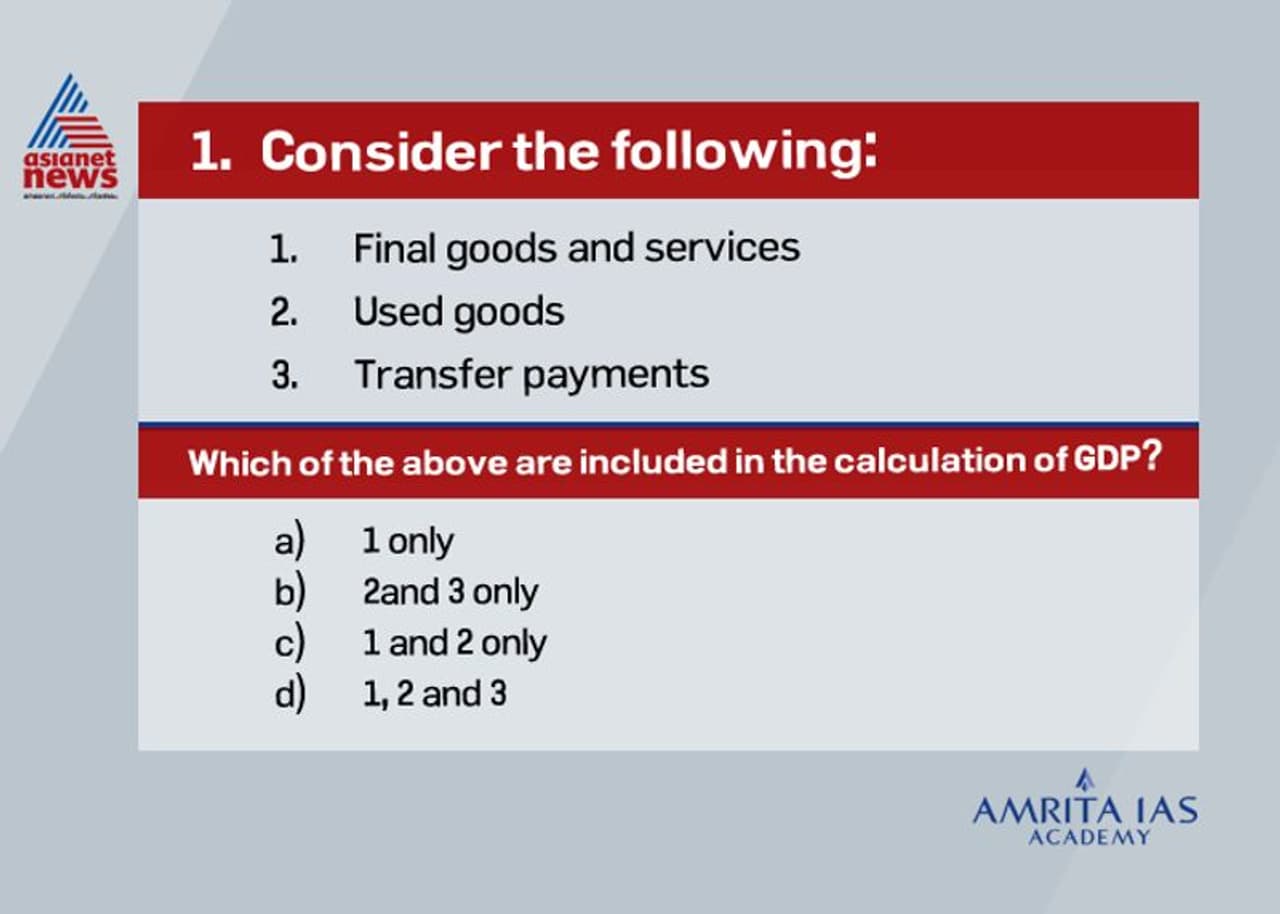
Answer (a) What is counted in GDP? • Final goods and services • Intermediate goods that have not yet been used in final goods and services. • Raw materials that have been produced, but not yet used in the production of intermediate or final goods. What is not included in GDP? • Intermediate goods that have been turned into final goods and services (e.g. tires on a new truck) • Used goods • Transfer payments • Non-market activities • Illegal goods Notice the items that are not counted into GDP, as outlined in the list above. The sales of used goods are not included because they were produced in a previous year and are part of that year’s GDP. Transfer payments are payments by the government to individuals, such as Social Security. Transfers are not included in GDP, because they do not represent production. Production of non-marketed goods and services—such as home production like when you clean your home—is not counted because these services are not sold in the marketplace.
Answer (a)
What is counted in GDP?
• Final goods and services
• Intermediate goods that have not yet been used in final goods and services.
• Raw materials that have been produced, but not yet used in the production of intermediate or final goods.
What is not included in GDP?
• Intermediate goods that have been turned into final goods and services (e.g. tires on a new truck)
• Used goods
• Transfer payments
• Non-market activities
• Illegal goods
Notice the items that are not counted into GDP, as outlined in the list above.
The sales of used goods are not included because they were produced in a previous year and are part of that year’s GDP.
Transfer payments are payments by the government to individuals, such as Social Security. Transfers are not included in GDP, because they do not represent production.
Production of non-marketed goods and services—such as home production like when you clean your home—is not counted because these services are not sold in the marketplace.


Answer(c) The balance sheets of both public sector banks (PSBs) and some corporate houses are in terrible shape. It is known as the twin balance sheet problem as the challenges faced by the banks are linked to that of the corporate sector. The corporates are unable to repay their loans to banks.
Answer(c)
The balance sheets of both public sector banks (PSBs) and some corporate houses are in terrible shape.
It is known as the twin balance sheet problem as the challenges faced by the banks are linked to that of the corporate sector.
The corporates are unable to repay their loans to banks.
Answer(b) In 1998 the government appointed second committee under the chairmanship of Mr Narsimham. It is better known as the Banking Sector Committee. It was told to review the banking reform progress and design a programme for further strengthening the financial system of India. The committee focused on various areas such as capital adequacy, bank mergers, bank legislation, etc.
Answer(b)
In 1998 the government appointed second committee under the chairmanship of Mr Narsimham. It is better known as the Banking Sector Committee.
It was told to review the banking reform progress and design a programme for further strengthening the financial system of India.
The committee focused on various areas such as capital adequacy, bank mergers, bank legislation, etc.
Answer(d) First time use of EVMs occurred in the general election in Kerala in May, 1982; however, the absence of a specific law prescribing its use led to the Supreme Court striking down that election. Subsequently, in 1989, the Parliament amended the Representation of the People Act, 1951 to create a provision for the use of EVMs in the elections (chapter 3).
Answer(d)
First time use of EVMs occurred in the general election in Kerala in May, 1982; however, the absence of a specific law prescribing its use led to the Supreme Court striking down that election.
Subsequently, in 1989, the Parliament amended the Representation of the People Act, 1951 to create a provision for the use of EVMs in the elections (chapter 3).
Answer(c) Cabinet Council of Ministers The cabinet consists of many senior ministers who hold important portfolios such as defense, home affairs, education etc. They consist of Cabinet Ministers, Deputy Ministers and Ministers of State It was conferred the status of a constitutional body after the passing of the Constitutional Amendment Act of 1978 (Also Known as 44th Amendment) It is a constitutional body The Cabinet consists of some of the most experienced ministers. Thus, the Prime Minister seeks their advice on important matters. The decisions of the cabinet are binding to all ministers It is up to the Prime Minister to consult with the council of ministers or not when it comes to making important decisions It enforces the collective responsibility of the council to its members It enforces collective responsibility to the lower houses of the parliament The Cabinet meets as frequently as possible to formulate policies and to decide on certain matters of national importance The meetings between the council of ministers are rare. The size of the cabinet is about 15-20 ministers The council of ministers usually consists of about 60 to 70 ministers of the government.
Answer(c)
Cabinet Council of Ministers
The cabinet consists of many senior ministers who hold important portfolios such as defense, home affairs, education etc. They consist of Cabinet Ministers, Deputy Ministers and Ministers of State
It was conferred the status of a constitutional body after the passing of the Constitutional Amendment Act of 1978 (Also Known as 44th Amendment)
It is a constitutional body
The Cabinet consists of some of the most experienced ministers. Thus, the Prime Minister seeks their advice on important matters. The decisions of the cabinet are binding to all ministers It is up to the Prime Minister to consult with the council of ministers or not when it comes to making important decisions
It enforces the collective responsibility of the council to its members It enforces collective responsibility to the lower houses of the parliament
The Cabinet meets as frequently as possible to formulate policies and to decide on certain matters of national importance The meetings between the council of ministers are rare.
The size of the cabinet is about 15-20 ministers The council of ministers usually consists of about 60 to 70 ministers of the government.
Answer(b) The Constitution under Article 143 authorizes the President to seek the opinion of the Supreme Court in the two categories of matters: • On any question of law or fact of public importance which has arisen or which is likely to arise. • On any dispute arising out of any pre-constitution treaty, agreement, covenant, engagement, sanad, or other similar instruments.
Answer(b)
The Constitution under Article 143 authorizes the President to seek the opinion of the Supreme Court in the two categories of matters:
• On any question of law or fact of public importance which has arisen or which is likely to arise.
• On any dispute arising out of any pre-constitution treaty, agreement, covenant, engagement, sanad, or other similar instruments.
Answer(c) In 1917, the Government of India appointed a Commission to study and report on the problems of the Calcutta University following the enactment of The Universities Act of 1904.
Answer(c)
In 1917, the Government of India appointed a Commission to study and report on the problems of the Calcutta University following the enactment of The Universities Act of 1904.
Answer(a) Bhulabhai Desai was the leader of the Congress Parliamentary Party in the Central Assembly and also a personal old friend of the Deputy Leader of the Muslim league, Nawabzar Liaqat Ali Khan, who was also the General-Secretary of the Muslim League since 1937. Desai and Liaquat Ali Khan held a series of discussions and drew the following private and confidential proposals for cooperation between the Congress and the League. Both of them came up with the draft proposal for the formation of an interim government at the Centre, consisting of: • An equal number of persons nominated by the Congress and the League in the central legislature. • 20% of the seats reserved for minorities. • The Commander-in-Chief. • The Government would function within the framework of the existing Government of India Act, 1935.
Answer(a)
Bhulabhai Desai was the leader of the Congress Parliamentary Party in the Central Assembly and also a personal old friend of the Deputy Leader of the Muslim league, Nawabzar Liaqat Ali Khan, who was also the General-Secretary of the Muslim League since 1937.
Desai and Liaquat Ali Khan held a series of discussions and drew the following private and confidential proposals for cooperation between the Congress and the League.
Both of them came up with the draft proposal for the formation of an interim government at the Centre, consisting of:
• An equal number of persons nominated by the Congress and the League in the central legislature.
• 20% of the seats reserved for minorities.
• The Commander-in-Chief.
• The Government would function within the framework of the existing Government of India Act, 1935.
Answer(b) During the 8th century AD, a struggle for control over the Kannauj took place among three major empires of India namely the Palas, the Pratiharas and the Rastrakutas. The Palas ruled the eastern parts of India while the Pratiharas controlled western India (Avanti-Jalaor region). The Rastrakutas ruled over the Deccan region of India. The struggle for control over Kannuj among these three dynasties is known as the tripartite struggle in Indian history. The result of the struggle created a vacuum which was utilized by Afghan and Turkish rulers.
Answer(b)
During the 8th century AD, a struggle for control over the Kannauj took place among three major empires of India namely the Palas, the Pratiharas and the Rastrakutas.
The Palas ruled the eastern parts of India while the Pratiharas controlled western India (Avanti-Jalaor region). The Rastrakutas ruled over the Deccan region of India.
The struggle for control over Kannuj among these three dynasties is known as the tripartite struggle in Indian history.
The result of the struggle created a vacuum which was utilized by Afghan and Turkish rulers.
Answer(a) It is located in Istanbul, Turkey and is a UNESCO World Heritage Site. It was built in 537CE and considered the epitome of Byzantine architecture.
Answer(a)
It is located in Istanbul, Turkey and is a UNESCO World Heritage Site.
It was built in 537CE and considered the epitome of Byzantine architecture.
Answer(d)
Answer(d)
Answer(b) The broken hill-ranges of the Eastern Ghats, spread across Odisha, Telangana, Andhra Pradesh, Karnataka and Tamil Nadu, are home to unique ecosystems. Though it has over 450 endemic plant species, the region remains one of the most exploited and degraded ecosystems of India.
Answer(b)
The broken hill-ranges of the Eastern Ghats, spread across Odisha, Telangana, Andhra Pradesh, Karnataka and Tamil Nadu, are home to unique ecosystems.
Though it has over 450 endemic plant species, the region remains one of the most exploited and degraded ecosystems of India.
Answer(a) Basel Convention — Control of Transboundary Movements of Hazardous Wastes and Their Disposal: Opened for signature on 22 March 1989, entered into force on 5 May 1992 Parties — 187. Haiti and the United States have signed the Convention but not ratified. It is an international treaty that was designed to reduce the movements of hazardous waste between nations, and specifically to prevent transfer of hazardous waste from developed to less developed countries (LDCs). It does not address the movement of radioactive waste. The Convention is also intended to minimize the amount and toxicity of wastes generated, to ensure their environmentally sound management and to assist LDCs in environmentally sound management of the hazardous and other wastes they generate.
Answer(a)
Basel Convention — Control of Transboundary Movements of Hazardous Wastes and Their Disposal:
Opened for signature on 22 March 1989, entered into force on 5 May 1992
Parties — 187.
Haiti and the United States have signed the Convention but not ratified.
It is an international treaty that was designed to reduce the movements of hazardous waste between nations, and specifically to prevent transfer of hazardous waste from developed to less developed countries (LDCs).
It does not address the movement of radioactive waste.
The Convention is also intended to minimize the amount and toxicity of wastes generated, to ensure their environmentally sound management and to assist LDCs in environmentally sound management of the hazardous and other wastes they generate.
Answer(a) The Living Planet Report is published every two years by the WWF since 1998. For two decades it has tracked the populationabundance of thousands of mammals, birds, fish, reptiles and amphibiansfrom around the world.
Answer(a)
The Living Planet Report is published every two years by the WWF since 1998.
For two decades it has tracked the populationabundance of thousands of mammals, birds, fish, reptiles and amphibiansfrom around the world.
Answer(d) It is a part of the six Kalvari-class submarines being built in India. It is part of Project-75 programme by the Indian Navy that entails building six Scorpene Class attack submarines. Scorpene is a conventional powered submarine weighing 1,500 tonnes and can go up to depths of 300m. It is given support by the Department of Defense Production (Ministry of Defense) and Indian Navy throughout its various phases of construction. Two submarines, Kalvari and Khanderi, have been commissioned into the Indian Navy. The third submarine, Karanj, is in the last phase of rigorous sea trials. The fourth Scorpene, Vela, has commenced its sea trials. The sixth and last submarine, Vagsheer, is being readied for boot together.
Answer(d)
It is a part of the six Kalvari-class submarines being built in India. It is part of Project-75 programme by the Indian Navy that entails building six Scorpene Class attack submarines.
Scorpene is a conventional powered submarine weighing 1,500 tonnes and can go up to depths of 300m.
It is given support by the Department of Defense Production (Ministry of Defense) and Indian Navy throughout its various phases of construction.
Two submarines, Kalvari and Khanderi, have been commissioned into the Indian Navy.
The third submarine, Karanj, is in the last phase of rigorous sea trials.
The fourth Scorpene, Vela, has commenced its sea trials. The sixth and last submarine, Vagsheer, is being readied for boot together.
Answer(b) The Ministry of Tribal Affairs has launched the Tribal Health and Nutrition Portal ‘Swasthya’ and an e-newsletter on health and nutrition ALEKH. e-portal on tribal health and nutrition named ‘Swasthya’, a first of its kind e-portal, providing all health and nutrition-related information of the tribal population of India in a single platform.
Answer(b)
The Ministry of Tribal Affairs has launched the Tribal Health and Nutrition Portal ‘Swasthya’ and an e-newsletter on health and nutrition ALEKH.
e-portal on tribal health and nutrition named ‘Swasthya’, a first of its kind e-portal, providing all health and nutrition-related information of the tribal population of India in a single platform.
Answer(c) June 5 is international environment day and July 11 is international population day.
Answer(c)
June 5 is international environment day and July 11 is international population day.
Answer(a) ‘Nineteen Eighty-Four’ is a novel, often referred to as 1984, is a dystopian social science fiction novel by English novelist George Orwell.
Answer(a)
‘Nineteen Eighty-Four’ is a novel, often referred to as 1984, is a dystopian social science fiction novel by English novelist George Orwell.